Meteorite
Brachinite
Brakinit
Rare meteorites made almost entirely of olivine: dunite-like brachinites, the first of which was at first mistaken for a meteorite from Mars.
- Popularly: Meteorite

In short
Brachinites are a group of meteorites classified either as primitive achondrites or as asteroidal achondrites. They contain 74 to 98 per cent olivine by volume and count as a peridotite of the wehrlite type. They are named after the type specimen, found near Brachina in South Australia in 1974. As of 2022, 56 meteorites had been classified as brachinites.
Photos

How does it form?
Brachinites pose a puzzle: their chemistry is more or less chondritic, yet their textures are clearly cumulate and achondritic, which suggests igneous processing. They may have formed as olivine crystals accumulated in a magma. Melt inclusions in the Brachina meteorite, made of glass with orthopyroxene and anorthoclase, show that melting processes were active on the parent body.
As with the ureilites, it is not certain whether brachinites are melt residues or cumulates settled from a magma. Their only clear difference from chondrites is the very high ratio of olivine to orthopyroxene.
What is it used for?
- Melting on the parent body: The contrast between their chondrite-like chemistry and igneous textures, and the melt inclusions they contain, are used to study how melting worked on the parent body.
- Telling meteorites apart: The story of Brachina, first taken for a Martian meteorite and later recognised as a separate group, shows how important trace-element and oxygen isotope analyses are in classifying meteorites.
- Links to asteroids: Their olivine compositions are compared with the spectra of asteroids such as 289 Nenetta.
The Brachina meteorite
The Brachina meteorite was found by B. M. Eves in South Australia on 26 May 1974; it consists of two fragments of about 200 grams in all. It is made of about 80 per cent olivine, 10 per cent plagioclase, 5.5 per cent clinopyroxene and 3 per cent iron sulphide, with small amounts of chromite, chlorapatite, pentlandite and meteoric iron. Its chemistry and mineralogy are similar to those of the Martian meteorite Chassigny, but its trace elements are fundamentally different.
What determines its value?
Brachinites are very rare meteorites; as of 2022 only 56 had been classified. A specimen's value depends on its mass, its freshness and whether it belongs to a well-known specimen such as Brachina.
This information is educational, not buying, selling or investment advice. Value varies enormously with quality and treatment.
How to recognise it
- 1
Light to dark brown; fresh specimens show a dull black fusion crust.
- 2
Fine-grained and fairly homogeneous, it resembles terrestrial dunites and peridotites.
- 3
Because its chemistry and mineralogy resemble those of the Martian chassignites, only trace-element and oxygen isotope analyses can confirm the type.
Myths and misconceptions
MythEvery olivine-rich meteorite that looks like a Martian meteorite comes from Mars.
FactThe Brachina meteorite was first thought to be one of the Martian chassignites, but its trace-element pattern and unique oxygen isotope composition showed that it came from an asteroid. Only detailed analyses can tell apart meteorites that look alike.
Did you know?
The Brachina meteorite was classified in 1978 as a second chassignite, that is a Martian meteorite like Chassigny. When trace-element analyses in 1983 showed that it was different, it became the type specimen of a new group.
The only clear difference between brachinites and chondrites is their very high ratio of olivine to orthopyroxene.
The Brachina meteorite has a total mass of only about 200 grams: two small fragments found in 1974.
Where is it found?
Loading map…
- Brachina, South Australia, Australia · Type localityTwo fragments of about 200 grams in all, found by B. M. Eves on 26 May 1974; the type specimen that gave the group its name.
Locations are approximate to protect sites. Red dots mark places in Türkiye. Open in the big map →
Frequently asked questions
What is brachinite?
Brachinites are a group of meteorites classified either as primitive achondrites or as asteroidal achondrites. They contain 74 to 98 per cent olivine by volume and count as a peridotite of the wehrlite type. They are named after the type specimen, found near Brachina in South Australia in 1974. As of 2022, 56 meteorites had been classified as brachinites.
Which body do brachinites come from?
They are thought to be asteroidal. Studies comparing the olivine compositions of different asteroids suggest that the asteroid 289 Nenetta might be the brachinite parent body. Melt inclusions show that melting processes were active on the parent body.
What is brachinite used for?
Melting on the parent body: The contrast between their chondrite-like chemistry and igneous textures, and the melt inclusions they contain, are used to study how melting worked on the parent body. Telling meteorites apart: The story of Brachina, first taken for a Martian meteorite and later recognised as a separate group, shows how important trace-element and oxygen isotope analyses are in classifying meteorites. Links to asteroids: Their olivine compositions are compared with the spectra of asteroids such as 289 Nenetta.
How hard is brachinite?
It has a hardness of 5.5–7 on the Mohs scale. It can scratch glass; a steel knife scratches it only with difficulty. Its specific gravity is 3.15–3.85 g/cm³.
Where is brachinite found?
Its best-known localities: Brachina, South Australia, Australia.
How can you tell if brachinite is real?
Light to dark brown; fresh specimens show a dull black fusion crust. Fine-grained and fairly homogeneous, it resembles terrestrial dunites and peridotites. Because its chemistry and mineralogy resemble those of the Martian chassignites, only trace-element and oxygen isotope analyses can confirm the type.
Is brachinite valuable?
On the “street to diamond” value ladder it sits on step 7 of nine: Precious stone. Brachinites are very rare meteorites; as of 2022 only 56 had been classified. A specimen's value depends on its mass, its freshness and whether it belongs to a well-known specimen such as Brachina.
Sources
- Brachinite · Wikipedia
- Brachina meteorite · Wikipedia
- Brachinites – composition · Meteorites.tv (Thomas Grau)
- Primitive achondrite · Wikipedia
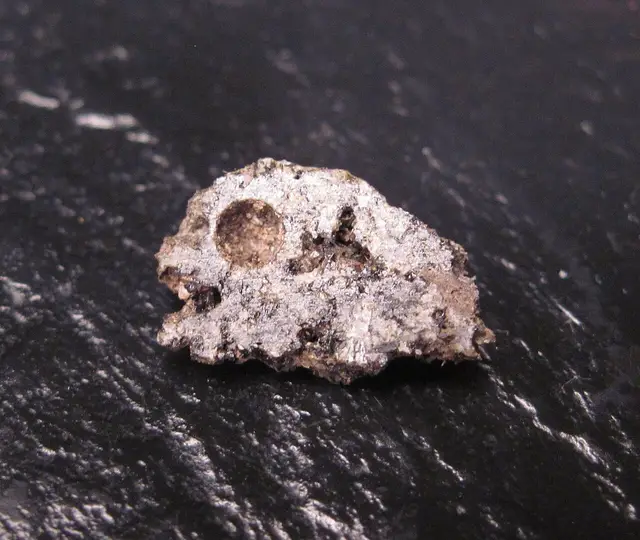
- NWA 3151 meteorite, brachinite.jpg (photo and description by Jon Taylor) · Wikimedia Commons
- Physical properties of the stone meteorites: Implications for the properties of their parent bodies (G. J. Flynn, G. J. Consolmagno, P. Brown, R. J. Macke), Chemie der Erde – Geochemistry 78 · NASA Technical Reports Server, 2018
- Handbook of Mineralogy: Augite · Mineralogical Society of America
- Handbook of Mineralogy: Forsterite · Mineralogical Society of America
External links
Draft: awaiting expert reviewReport an error
On the same step
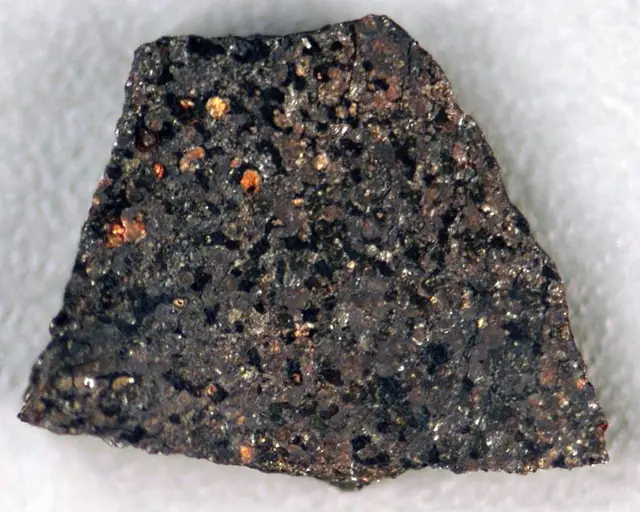
Acapulcoite
Stony meteorites that began to melt but never fully did: metal-veined primitive achondrites, named after a stone that fell near Acapulco in 1976.
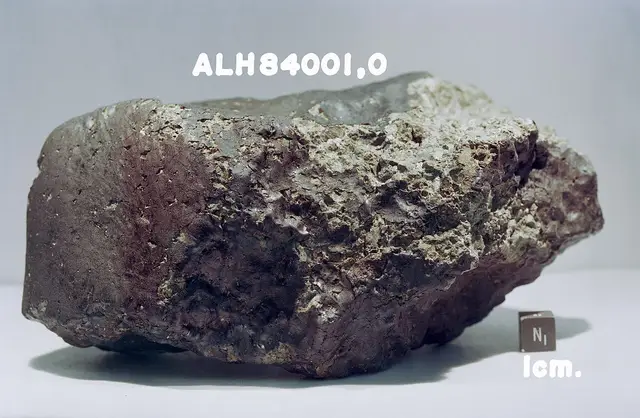
Allan Hills 84001
The stone that sparked the Mars-life debate: a 4-billion-year-old Martian meteorite from Antarctica whose tiny structures were likened to fossil bacteria in 1996.
Angrite
The oldest known igneous rocks: rare basaltic meteorites that crystallised about 4.56 billion years ago, in the very earliest days of the Solar System.