Meteorite
Aubrite
Aubrit
Meteorites that look like white-crystalled “moon rock”: enstatite achondrites formed from rock that melted with almost no oxygen.
Also known as: Enstatite achondrite
- Popularly: Meteorite

In short
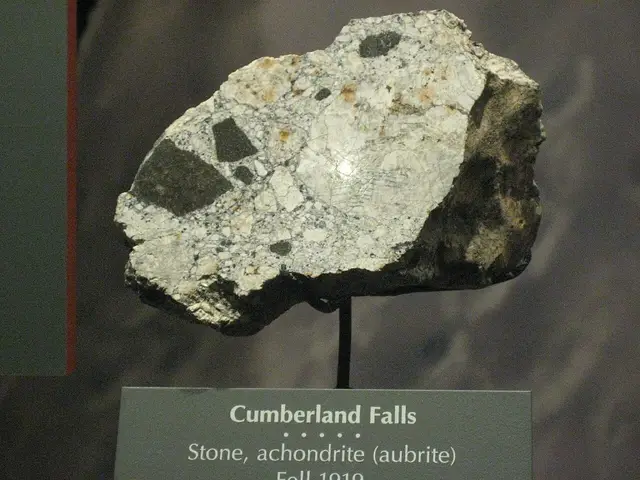
Aubrites are stony meteorites named after Aubres, a small achondrite that fell in 1836 near Nyons, France. Made mainly of enstatite (an iron-poor, magnesium-rich orthopyroxene), they are often called enstatite achondrites. They are igneous, formed from rock that melted on an asteroid. They are light-coloured, with large white crystals, and most are brecciated, which is why they are often said to look “lunar”.
Photos

How does it form?
Aubrites formed from rock that melted on an asteroid under extremely oxygen-poor (reducing) conditions. That is why their pyroxene holds almost no iron and is white enstatite. Their igneous origin sets them apart from the primitive enstatite chondrites, which never melted.
The heavy brecciation of most aubrites shows that their parent body went through violent collisions. Chondritic xenoliths in some aubrites suggest that the parent body collided with an asteroid of chondritic composition.
What is it used for?
- Reducing environments: They help us understand how igneous rocks form without oxygen.
- Asteroid links: They are compared with E-type asteroids of the Nysa and Hungaria families.
- Planetary defence: 2024 BX1 is one of the rare meteoroids discovered before impact whose pieces were then found; such events help test early-warning systems.
Famous aubrites
Aubres (France, 1836) is the fall that named the group. Cumberland Falls fell in Kentucky in 1919. Ribbeck (Germany, 2024) is the remains of the meteoroid 2024 BX1, discovered before it fell.
What determines its value?
Aubrites are rare meteorites, easy to tell from others by their white, coarse-crystalled look. A piece's value depends on its mass, freshness and whether it belongs to an observed fall such as Ribbeck or Cumberland Falls.
This information is educational, not buying, selling or investment advice. Value varies enormously with quality and treatment.
How to recognise it
- 1
A brownish fusion crust outside; white to light grey inside, with large crystals.
- 2
Most are heavily brecciated: broken white crystal fragments look welded together.
- 3
Only laboratory analysis can confirm that a stone is an aubrite.
Myths and misconceptions
MythA white, light-coloured stone can't be a meteorite; meteorites are always black.
FactMeteorites usually have a dark fusion crust, but their insides are not always dark. Aubrites are largely made of white enstatite crystals, and even their fusion crust is brownish.
Did you know?
The small meteoroid 2024 BX1 was discovered by the Hungarian astronomer Krisztián Sárneczky less than three hours before it hit Earth and broke up over Berlin; its pieces turned out to be an aubrite.
Researchers nicknamed the pieces found at Ribbeck “cosmic pears”, after the pear tree in Theodor Fontane's ballad Herr von Ribbeck auf Ribbeck im Havelland.
Some researchers have suggested that aubrites may come from the planet Mercury; the spectrum of the Ribbeck pieces, however, is not meaningfully similar to Mercury.
Where is it found?
Loading map…
- Aubres, near Nyons, Drôme, France · Type localityThe small achondrite that fell in 1836 and gave the group its name. The point marks the town of Nyons.
- Ribbeck, near Nauen, Brandenburg, Germany · Known localityThe meteoroid 2024 BX1, discovered less than three hours before impact, broke up over Berlin on 21 January 2024; about 200 pieces (1.8 kg) were collected near Ribbeck. It is an aubrite.
Locations are approximate to protect sites. Red dots mark places in Türkiye. Open in the big map →
Frequently asked questions
What is aubrite?
Aubrites are stony meteorites named after Aubres, a small achondrite that fell in 1836 near Nyons, France. Made mainly of enstatite (an iron-poor, magnesium-rich orthopyroxene), they are often called enstatite achondrites. They are igneous, formed from rock that melted on an asteroid. They are light-coloured, with large white crystals, and most are brecciated, which is why they are often said to look “lunar”.
Where do aubrites come from?
Their source is uncertain. Their spectra resemble E-type asteroids of the Nysa family, and the small near-Earth asteroid 3103 Eger is often suggested. The Ribbeck pieces that fell in 2024 are thought to come from the Hungaria family. An origin on Mercury has also been suggested.
What is aubrite used for?
Reducing environments: They help us understand how igneous rocks form without oxygen. Asteroid links: They are compared with E-type asteroids of the Nysa and Hungaria families. Planetary defence: 2024 BX1 is one of the rare meteoroids discovered before impact whose pieces were then found; such events help test early-warning systems.
How hard is aubrite?
It has a hardness of 5–6 on the Mohs scale. It can scratch glass; a steel knife scratches it only with difficulty. Its specific gravity is 2.97–3.27 g/cm³.
Where is aubrite found?
Its best-known localities: Aubres, near Nyons, Drôme, France; Ribbeck, near Nauen, Brandenburg, Germany.
How can you tell if aubrite is real?
A brownish fusion crust outside; white to light grey inside, with large crystals. Most are heavily brecciated: broken white crystal fragments look welded together. Only laboratory analysis can confirm that a stone is an aubrite.
Is aubrite valuable?
On the “street to diamond” value ladder it sits on step 6 of nine: Fine ornamental and collector stone. Aubrites are rare meteorites, easy to tell from others by their white, coarse-crystalled look. A piece's value depends on its mass, freshness and whether it belongs to an observed fall such as Ribbeck or Cumberland Falls.
Sources
- Aubrite · Wikipedia
- 2024 BX1 · Wikipedia
- Nyons · Wikipedia
- Meteorite porosities and densities: a review of trends in the data (D. T. Britt & G. J. Consolmagno), Lunar and Planetary Science XXXV, abstract 2108 · Lunar and Planetary Institute, 2004
- Handbook of Mineralogy: Enstatite · Mineralogical Society of America
External links
Draft: awaiting expert reviewReport an error
On the same step
Achondrite
Stony meteorites with no chondrules: rock from melted asteroids, the Moon and Mars, and hard to recognise because they look like Earth rocks.
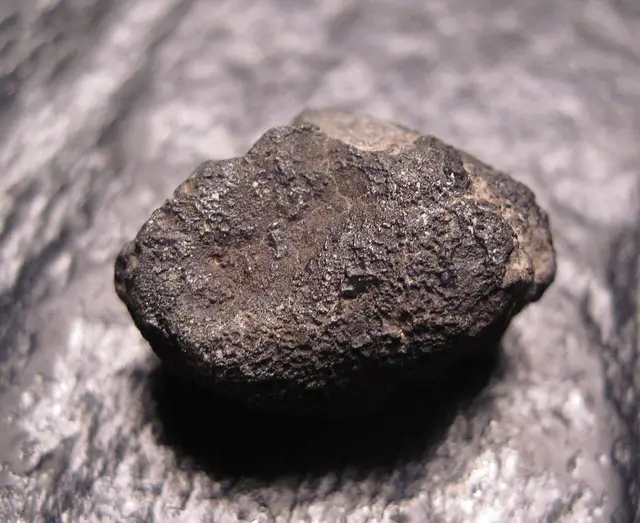
Allende meteorite
The most studied meteorite in history: the largest carbonaceous chondrite, which fell in Mexico in 1969 carrying the first solids of the Solar System.
Amber
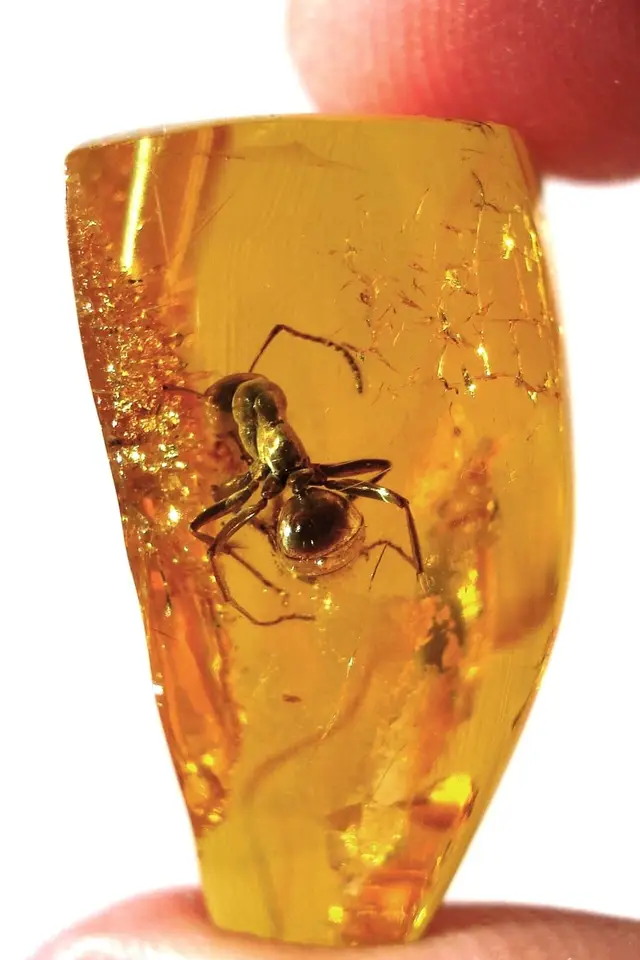
Tree resin fossilised over millions of years: a light, warm organic gem that sometimes holds prehistoric insects.