Meteorite
Tissint meteorite
Tissint meteoriti
A piece of Mars that fell in the Moroccan desert in 2011: the fifth witnessed Martian meteorite fall, with black glass veins holding Martian air.
Also known as: Tissint
- Popularly: Meteorite

In short
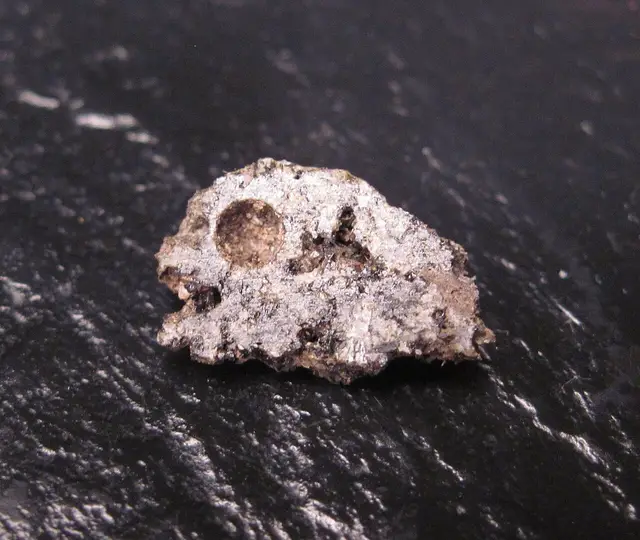
The Tissint meteorite is a Martian meteorite that fell on the night of 18 July 2011 in Tata Province, Morocco. It is the fifth Martian meteorite seen to fall and the first since 1962. Dozens of pieces totalling about 12–15 kilograms were found. It is a shergottite: a basalt with large olivine crystals, formed from magma from deep in Mars's mantle. Because it was collected soon after it fell, it is considered largely free of Earth contamination.
Photos

How does it form?
Tissint is an aluminium-poor, iron-rich basaltic rock formed by magmatic activity on the surface of Mars. Its magma came from a deep mantle region unlike that of any other known shergottite. The rock was weathered by fluids on Mars, which left minerals rich in certain elements in its cracks. Later an impact on the Martian surface melted this material, forming black glassy veins.
The rock was blasted off Mars about 700,000 years ago in one of the largest impact excavations on record and was heavily shocked. On 18 July 2011 it entered Earth’s atmosphere and fell on Morocco.
What is it used for?
- Martian surface and atmosphere: Trapped gases and trace elements in its glass veins directly show the make-up of the Martian surface and atmosphere, consistent with spacecraft observations.
- Water on Mars: Tissint shows signs of weathering by water and elements carried into cracks by water or fluids, something never seen before in a Martian meteorite.
- A fresh sample: Collected soon after the fall, it is largely free of Earth contamination.
History
The fireball was seen by several people at about 02:00 local time on 18 July 2011 in the Oued Drâa valley east of Tata. In October 2011 nomads began finding fresh, fusion-crusted stones in the area. The meteorite was studied by the Moroccan meteoriticist Hasnaa Chennaoui-Aoudjehane of Hassan II University in Casablanca. Because the pieces quickly went to collections abroad, it was hard for Moroccan researchers to get samples.
What determines its value?
Tissint's value comes from being a witnessed Martian meteorite fall and from being collected fresh. Its pieces are displayed in institutions such as the natural history museums in Vienna and London. Martian meteorites in general are so rare that they are among the most sought-after; a piece's value depends on its mass, the completeness of its fusion crust and its documented origin.
This information is educational, not buying, selling or investment advice. Value varies enormously with quality and treatment.
How to recognise it
- 1
The pieces are coated in a shiny black fusion crust, thicker on ridges and over the olivine crystals.
- 2
Broken faces show a pale green-grey interior with millimetre-sized pale yellow olivine crystals and thin veins of black glass.
- 3
Its Martian origin is shown in the lab by features such as the composition of its trapped gases.
Myths and misconceptions
MythThe carbon compounds in Tissint prove there was life on Mars.
FactA biological origin for these compounds was suggested, but the researchers stressed that other geological explanations are possible. There is no proven evidence of Martian life in Tissint today.
Did you know?
One witness said the fireball was yellow at first, then turned green and lit up the whole area before splitting in two; two sonic booms were heard over the valley.
The pieces range from 0.2 grams to 1,282 grams.
Tissint is calculated to have been blasted off Mars about 700,000 years ago by a large impact, possibly the same event that ejected many other shergottites, including the famous EETA79001.
Where is it found?
Loading map…
- Oued Drâa valley, east-southeast of Tata, Morocco · Type localityFrom October 2011 nomads found the pieces about 50 km east-southeast of Tata, between the El Ga'ïdat plateau and the El Aglâb mountains. The meteorite is named after the town of Tissint, 48 km away.
Locations are approximate to protect sites. Red dots mark places in Türkiye. Open in the big map →
Frequently asked questions
What is tissint meteorite?
The Tissint meteorite is a Martian meteorite that fell on the night of 18 July 2011 in Tata Province, Morocco. It is the fifth Martian meteorite seen to fall and the first since 1962. Dozens of pieces totalling about 12–15 kilograms were found. It is a shergottite: a basalt with large olivine crystals, formed from magma from deep in Mars's mantle. Because it was collected soon after it fell, it is considered largely free of Earth contamination.
Were signs of life on Mars found in Tissint?
No, there is no proven sign. One team found carbon- and nitrogen-bearing compounds linked to mineral inclusions formed by hot water, and suggested that a low carbon-13 ratio might be biological. But the same researchers noted that it could also be explained without life, for example by meteorites mixing into Martian soil or by volcanic processes.
What is tissint meteorite used for?
Martian surface and atmosphere: Trapped gases and trace elements in its glass veins directly show the make-up of the Martian surface and atmosphere, consistent with spacecraft observations. Water on Mars: Tissint shows signs of weathering by water and elements carried into cracks by water or fluids, something never seen before in a Martian meteorite. A fresh sample: Collected soon after the fall, it is largely free of Earth contamination.
How hard is tissint meteorite?
It has a hardness of 5.5–7 on the Mohs scale. It can scratch glass; a steel knife scratches it only with difficulty. Its specific gravity is 3.06–3.14 g/cm³.
Where is tissint meteorite found?
Its best-known localities: Oued Drâa valley, east-southeast of Tata, Morocco.
How can you tell if tissint meteorite is real?
The pieces are coated in a shiny black fusion crust, thicker on ridges and over the olivine crystals. Broken faces show a pale green-grey interior with millimetre-sized pale yellow olivine crystals and thin veins of black glass. Its Martian origin is shown in the lab by features such as the composition of its trapped gases.
Is tissint meteorite valuable?
On the “street to diamond” value ladder it sits on step 7 of nine: Precious stone. Tissint's value comes from being a witnessed Martian meteorite fall and from being collected fresh. Its pieces are displayed in institutions such as the natural history museums in Vienna and London. Martian meteorites in general are so rare that they are among the most sought-after; a piece's value depends on its mass, the completeness of its fusion crust and its documented origin.
Sources
- Tissint meteorite · Wikipedia
- Shergottite · Wikipedia
- Meteorite porosities and densities: a review of trends in the data (D. T. Britt & G. J. Consolmagno), Lunar and Planetary Science XXXV, abstract 2108 · Lunar and Planetary Institute, 2004
- Handbook of Mineralogy: Forsterite · Mineralogical Society of America
External links
Draft: awaiting expert reviewReport an error
On the same step
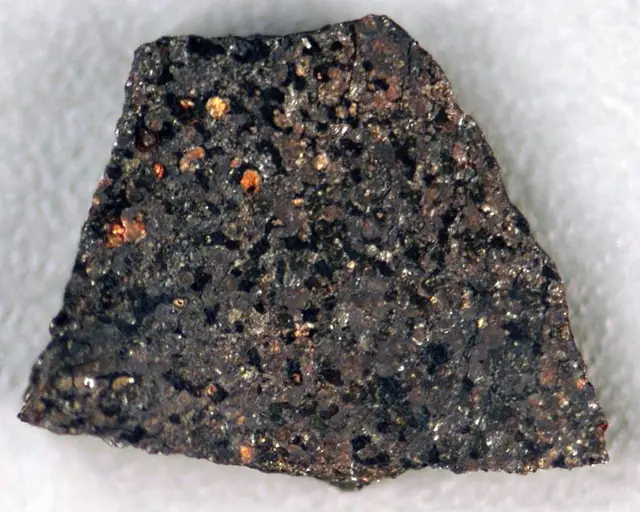
Acapulcoite
Stony meteorites that began to melt but never fully did: metal-veined primitive achondrites, named after a stone that fell near Acapulco in 1976.
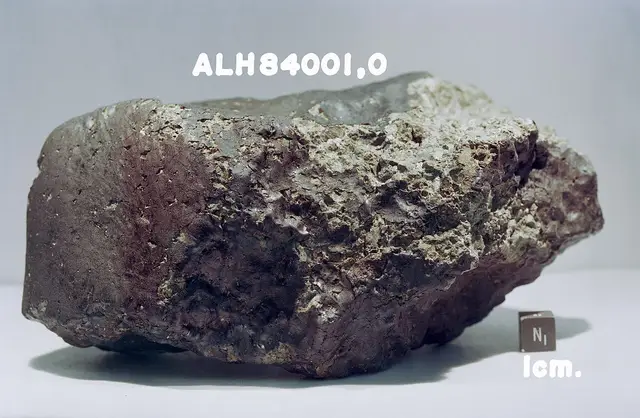
Allan Hills 84001
The stone that sparked the Mars-life debate: a 4-billion-year-old Martian meteorite from Antarctica whose tiny structures were likened to fossil bacteria in 1996.
Angrite
The oldest known igneous rocks: rare basaltic meteorites that crystallised about 4.56 billion years ago, in the very earliest days of the Solar System.