Rock
Syenite
Siyenit
A quartz-free cousin of granite: named after Syene in ancient Egypt, and today a raw material of the glass and ceramics industries.
- Popularly: Natural stone (building and decor)
- Building stone
- Industrial
- Important in Türkiye

In short
Syenite is a coarse-grained rock formed when magma cools slowly deep underground. It looks very like granite, but it contains little or no quartz; its dominant mineral is alkali feldspar. It can be grey, pink or greenish. It is less common in Earth's crust than granite and diorite. In Türkiye it occurs around Kırşehir.
Photos
_2_-_52188157706.jpg)
How does it form?
Syenite is a plutonic rock, formed when magma poorer in silica than granite but rich in potassium and sodium cools slowly and solidifies deep in the crust. The magma can arise in two ways: by very small degrees of melting of rocks such as granite (potassium is among the first elements to enter the melt, so the melt becomes potassium-rich), or through the progressive crystallisation of basaltic magma. If the magma is very poor in silica, feldspathoid minerals such as nepheline form instead of quartz: nepheline syenite.
The same magma reaching the surface and cooling quickly forms fine-grained trachyte. Rocks transitional between syenite and diorite are called monzonite.
What is it used for?
- Glass and ceramics: Nepheline syenite is used as a flux in glass and ceramics, and also in paints and fillers. According to the US Geological Survey (USGS), feldspar and nepheline syenite function as a flux in glass and pottery.
- Building stone: Durable and resistant to frost, it is used as cladding, kerbs, sculpture and landscaping stone.
- Crushed stone: Crushed, it is used as road and concrete aggregate.
- Science and ornament: Sodalite-bearing syenites are sought as ornamental stones and as fluorescent stones such as “yooperlite”. For more about sodalite, see the sodalite page.
Where is it found?
Syenite is not a common rock. Among the best-known alkaline syenite areas are the Khibiny Mountains in Russia, the Ilímaussaq Complex in Greenland and Pilanesberg in South Africa. The famous pink stone of Aswan, from which the rock takes its name, is by today’s classification granite, not syenite.
Syenite in Türkiye
In Türkiye syenite is most often seen in the Kırşehir Massif around Kırşehir. There, within the Upper Cretaceous Central Anatolian granitoids, quartz syenite and nepheline syenite bodies occur around Kaman. The Buzlukdağ nepheline syenite, north-west of Kırşehir, is one of the largest and least altered alkaline intrusions of Central Anatolia; researchers report that its high nepheline and low opaque-mineral content gives it potential for the ceramics and glass industries. Most of Türkiye’s fluorite deposits also lie within these syenitic intrusions; around Kaman, veins of purple and in places green, pink, yellow or white fluorite follow faults in the syenites. For more about fluorite, see the fluorite page.
What determines its value?
Syenite is scarcer than granite but is still a common crushed stone and building stone; sold by the tonne as crushed stone, it is worth little. As block and cladding stone, its value depends on whether large, crack-free blocks can be quarried, on attractive and even colour and pattern, on how well it polishes, on its strength and on transport distance. For nepheline syenite the industrial value depends on chemistry: glassmakers look for high alumina and alkali (sodium and potassium) contents, very low iron oxide and few opaque (iron-bearing) minerals; the size and purity of the quarry set its value.
This information is educational, not buying, selling or investment advice. Value varies enormously with quality and treatment.
How to recognise it
- 1
It is made of visible, interlocking feldspar grains and dark minerals such as hornblende or pyroxene; it looks like granite.
- 2
It differs from granite in showing no glassy grey quartz grains, or very few.
- 3
It is hard to scratch with a steel knife and does not fizz in vinegar or dilute acid.
- 4
In nepheline syenite you may see grey or greenish grains of nepheline with a glassy-greasy look, and sometimes blue grains of sodalite.
Fakes and imitations
What shops usually don’t tell you:
- In the stone trade most hard silicate rocks that take a polish are sold as “granite”, and syenite is among them. To tell granite from syenite you have to look at the quartz content.
- The pink “syenite” statues and obelisks of ancient Egypt are, by today's classification, made not of syenite but of granite and granodiorite.
Myths and misconceptions
MythThe pink “syenite” obelisks and statues of ancient Egypt are made of syenite.
FactThe name syenite goes back to the “lapis Syenites” of Roman times, the pink stone of the quarries at Syene (today's Aswan). By today's classification that stone is granite or granodiorite; syenite is a geologically incorrect name that stuck.
MythSyenite is just another name for granite.
FactThey look alike, but syenite has no quartz or at most about 5%, while granite usually has more than 20%. Feldspar is the main mineral in both, but in syenite alkali feldspar stands out.
Did you know?
The nepheline syenite massif of the Khibiny Mountains in Russia is so rich in minerals that 477 mineral species have been reported there, 108 of them first described in the Khibiny.
The Stolby nature reserve near Krasnoyarsk was founded in 1925 to protect its “syenite buttes”.
The “yooperlite” stones of the Lake Superior shore in Michigan, which glow orange under ultraviolet light, are syenite pebbles containing fluorescent sodalite, carried from Canada by glaciers.
Where is it found?
Loading map…
- Aswan (Syene), Egypt · Historic sourceThe rock's name comes from the stone called “lapis Syenites” in Roman times. By today's classification this pink stone is granite, not syenite, but the name stuck.
- Khibiny Mountains, Kola Peninsula, Russia · Major depositA nepheline syenite massif of about 1,300 km². Famous for its apatite and nepheline deposits; 477 mineral species have been reported, 108 of them first described here.
- Ilímaussaq Complex, South Greenland · Type localityThis intrusion, about 1.16 billion years old, is the type locality of agpaitic nepheline syenite and of thirty minerals.
- Pilanesberg, North West Province, South Africa · Major depositA circular alkaline complex of about 625 km², 1.395 billion years old, with trachyte, phonolite, syenite and nepheline syenite. Most of it lies in Pilanesberg National Park.
- Krasnoyarsk Pillars (Stolby), Siberia, Russia · Known localityThis nature reserve about 10 km south of Krasnoyarsk was founded in 1925 to protect its syenite buttes.
- Kaman area, Kırşehir, Türkiye · Known localityQuartz syenite and nepheline syenite bodies in the Upper Cretaceous Central Anatolian granitoids of the Kırşehir Massif; the Buzlukdağ nepheline syenite is one of the largest and least altered alkaline intrusions of Central Anatolia. Fluorite veins follow faults in the syenites.
Locations are approximate to protect sites. Red dots mark places in Türkiye. Open in the big map →
Frequently asked questions
What is syenite?
Syenite is a coarse-grained rock formed when magma cools slowly deep underground. It looks very like granite, but it contains little or no quartz; its dominant mineral is alkali feldspar. It can be grey, pink or greenish. It is less common in Earth's crust than granite and diorite. In Türkiye it occurs around Kırşehir.
What is syenite used for?
Glass and ceramics: Nepheline syenite is used as a flux in glass and ceramics, and also in paints and fillers. According to the US Geological Survey (USGS), feldspar and nepheline syenite function as a flux in glass and pottery. Building stone: Durable and resistant to frost, it is used as cladding, kerbs, sculpture and landscaping stone. Crushed stone: Crushed, it is used as road and concrete aggregate. Science and ornament: Sodalite-bearing syenites are sought as ornamental stones and as fluorescent stones such as “yooperlite”. For more about sodalite, see the sodalite page.
How hard is syenite?
It has a hardness of 5.5–6.5 on the Mohs scale. It can scratch glass; a steel knife scratches it only with difficulty. Its specific gravity is 2.6–2.8 g/cm³.
Where is syenite found?
Its best-known localities: Ilímaussaq Complex, South Greenland; Khibiny Mountains, Kola Peninsula, Russia; Pilanesberg, North West Province, South Africa; Aswan (Syene), Egypt; Krasnoyarsk Pillars (Stolby), Siberia, Russia.
Where is syenite found in Türkiye?
Known localities in Türkiye: Kaman area, Kırşehir, Türkiye.
How can you tell if syenite is real?
It is made of visible, interlocking feldspar grains and dark minerals such as hornblende or pyroxene; it looks like granite. It differs from granite in showing no glassy grey quartz grains, or very few. It is hard to scratch with a steel knife and does not fizz in vinegar or dilute acid. In the stone trade most hard silicate rocks that take a polish are sold as “granite”, and syenite is among them. To tell granite from syenite you have to look at the quartz content.
Is syenite valuable?
On the “street to diamond” value ladder it sits on step 3 of nine: Building and industrial stone. Syenite is scarcer than granite but is still a common crushed stone and building stone; sold by the tonne as crushed stone, it is worth little. As block and cladding stone, its value depends on whether large, crack-free blocks can be quarried, on attractive and even colour and pattern, on how well it polishes, on its strength and on transport distance. For nepheline syenite the industrial value depends on chemistry: glassmakers look for high alumina and alkali (sodium and potassium) contents, very low iron oxide and few opaque (iron-bearing) minerals; the size and purity of the quarry set its value.
Sources
- Syenite · Wikipedia
- Syenite · Encyclopaedia Britannica
- Nepheline syenite · Wikipedia
- Ornamental Stones (Harrell), UCLA Encyclopedia of Egyptology 1(1) · University of California, 2013
- Aswan · Wikipedia
- Khibiny · Wikipedia
- Kirovsk, Murmansk Oblast · Wikipedia
- Ilimaussaq complex · Wikipedia
- Pilanesberg · Wikipedia
- Stolby Nature Reserve (Krasnoyarsk Pillars) · Wikipedia
- Yooperlite · Wikipedia
- Mineral Commodity Summaries 2026: Feldspar and Nepheline Syenite · U.S. Geological Survey, 2026
- Kaman (Kırşehir-Türkiye) floritlerinin mineralojik ve gemolojik özellikleri (Kaydu Akbudak, Ketenci & Gürbüz), Gümüşhane Üniversitesi Fen Bilimleri Dergisi 12(4): 1012–1023 · Gümüşhane Üniversitesi, 2022
- Nefelin siyenitlerin seramik sanayinde kullanılma potansiyeli: Buzlukdağ örneği (Deniz & Kadıoğlu), Pamukkale Üniversitesi Mühendislik Bilimleri Dergisi 24(6) · Pamukkale Üniversitesi, 2018
External links
Draft: awaiting expert reviewReport an error ↗
On the same step
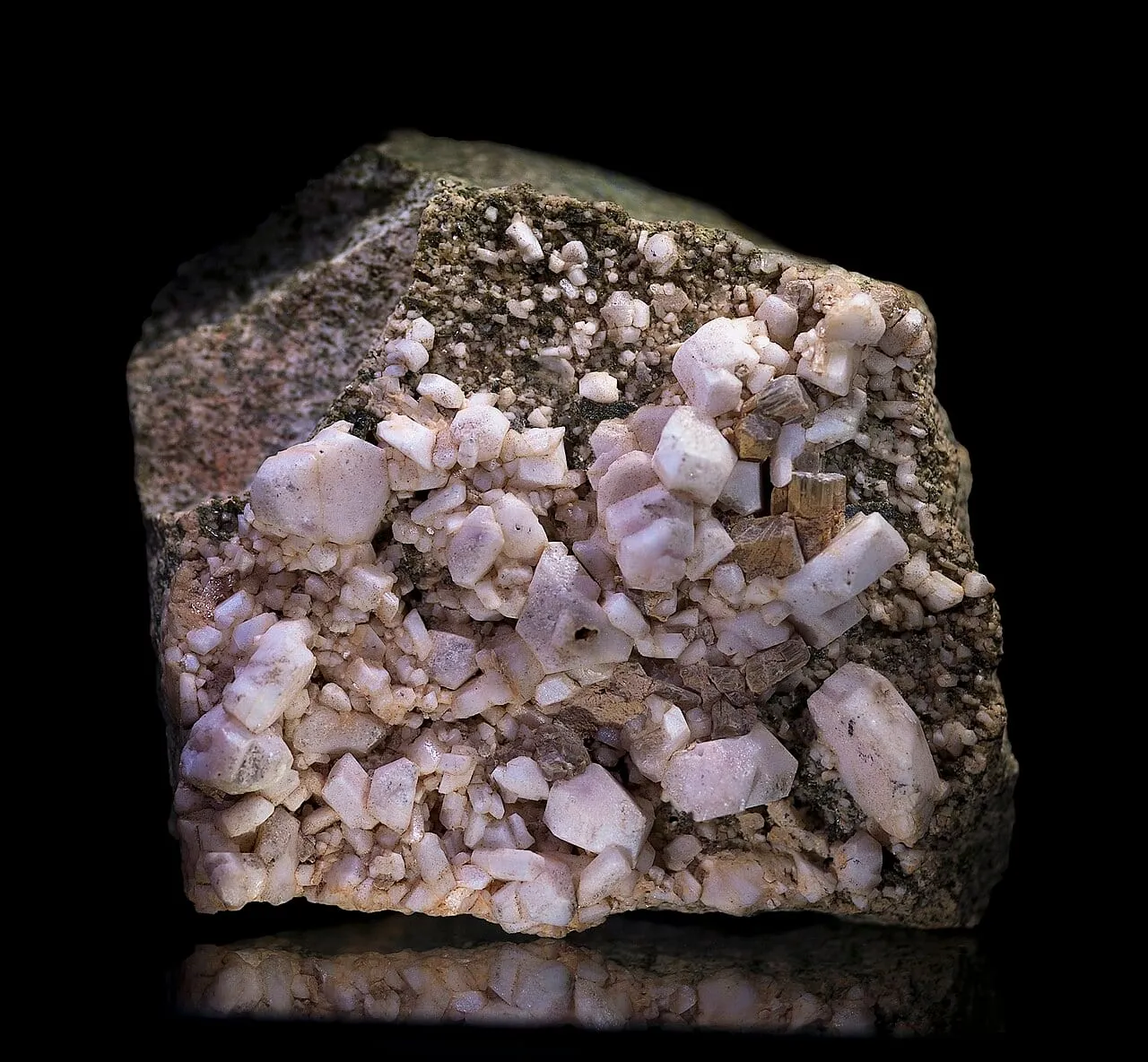
Albite
The white, sodium end of the feldspars: with its deposits at Çine–Milas, a glass and ceramics raw material that makes Türkiye one of the world’s main feldspar producers.
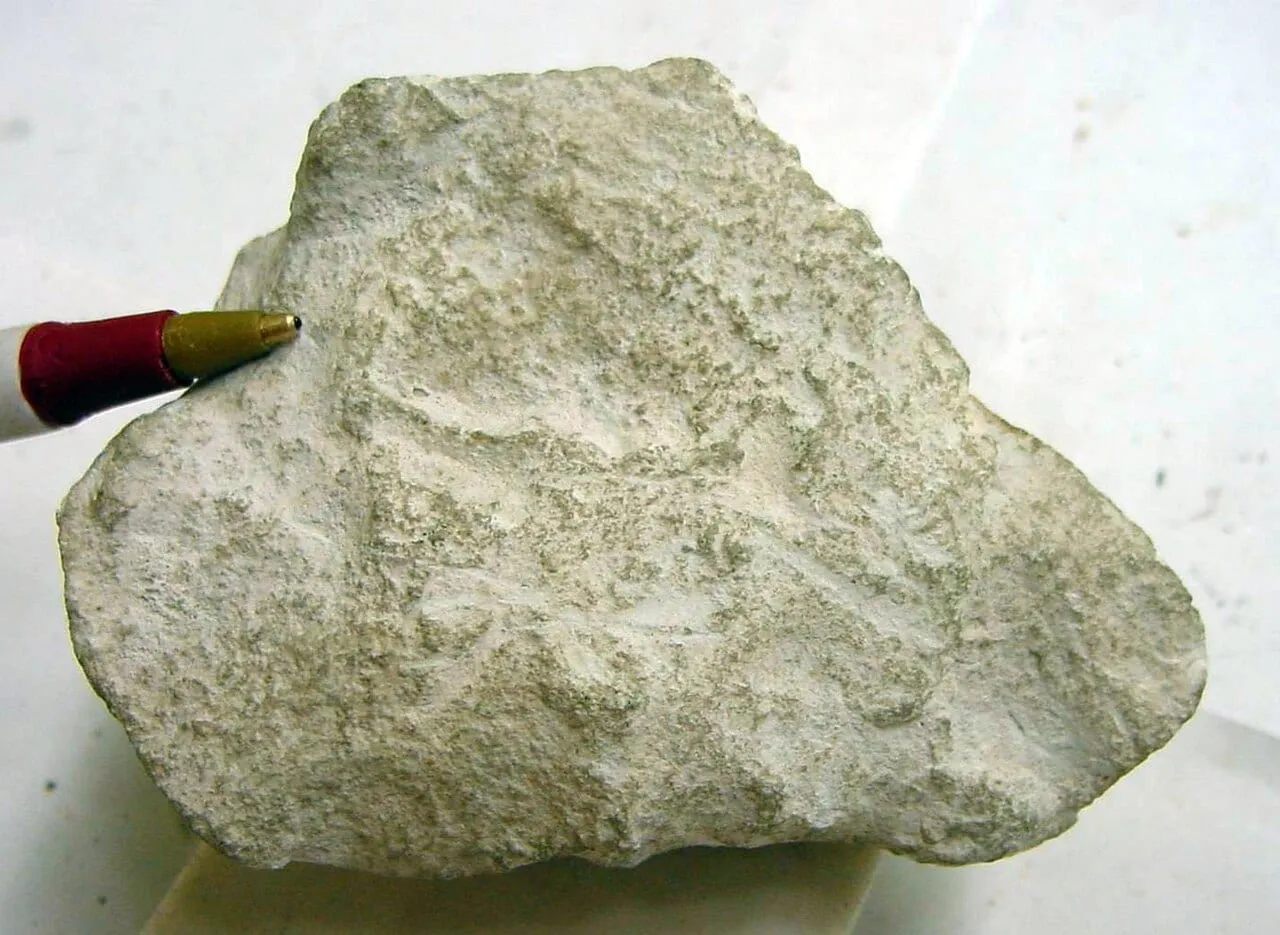
Alunite
The “alum stone” from which alum was made for centuries. Foça, Şaphane in Kütahya and Şebinkarahisar are Türkiye's old alum homelands.
Anhydrite
Gypsum without its water: a calcium sulfate mineral, whose blue-grey Peruvian form is sold as “angelite”.