Mineral
Sillimanite
Al₂SiO₅Sillimanit
A fine-needled or fibrous mineral that is the hallmark of high temperature; named after the American chemist Benjamin Silliman.
Also known as: Fibrolite (fibrous variety)
- Popularly: Semi-precious stone
- Gemstone
- Industrial
- Important in Türkiye

In short
Sillimanite is the high-temperature member of the three minerals with the same Al₂SiO₅ formula, together with kyanite and andalusite. It usually occurs as fine needles or bundles of fibres (fibrolite) in high-grade metamorphic schists and gneisses. Finding sillimanite in a rock shows that the rock reached very high temperatures. Rarely, coloured, transparent crystals are cut as gems.
Photos

How does it form?
Sillimanite forms in high-grade metamorphism, when clay-rich rocks are transformed at high temperature; it occurs in schist, gneiss and hornfels, and more rarely in pegmatites. It can also be found as grains in sediments, washed out of weathered rocks. Its very fine fibrous masses (fibrolite) look like twisted bundles of fibres in the rock. For geologists sillimanite is an indicator of high temperature but variable pressure (an index mineral).
What is it used for?
- Heat-resistant material: Natural sillimanite has been used to make high-alumina refractory bricks (about 55–60% alumina); in this role, however, it has mostly been replaced by andalusite and kyanite.
- Gemstone: Coloured, transparent crystals from places such as Sri Lanka are cut as collector’s stones.
- Science: Finding sillimanite in a rock shows that the rock reached high temperatures.
In Türkiye
Around Sivrihisar in Eskişehir, sillimanite occurs together with andalusite and kyanite: as metamorphism progressed, the three aluminium silicate minerals formed one after another. The area has been the subject of a scientific study of this successive formation under conditions near the triple point.
What determines its value?
The value of cut sillimanite depends on colour (blue, green, white and brown tones), translucency, clarity and the quality of the cut; it is very rare and its perfect cleavage makes it hard to cut. In industry its value depends on its alumina content and purity, but in heat-resistant materials andalusite and kyanite have largely taken its place. Collectors look for well-formed, undamaged crystals and fibre bundles.
This information is educational, not buying, selling or investment advice. Value varies enormously with quality and treatment.
How to recognise it
- 1
Fine, long needles, striated prisms or twisted bundles of fibres (fibrolite); the crystal cross-sections are nearly square.
- 2
Its hardness is 6.5–7.5: a steel knife cannot scratch it. It has perfect cleavage in one direction; its fracture is uneven and splintery.
- 3
Colourless, white or grey; sometimes brown, yellow, greenish or bluish. Its lustre is between glassy and slightly diamond-like, sometimes silky.
- 4
It is found in high-grade schist, gneiss and hornfels together with garnet, biotite, cordierite, potassium feldspar and quartz; andalusite and kyanite can also occur in the same region.
Myths and misconceptions
MythSillimanite is just another name for kyanite and andalusite.
FactAll three have the same formula but have settled into different crystal structures, that is, they are separate minerals: sillimanite and andalusite are orthorhombic, kyanite is triclinic. Sillimanite is the one that is stable at the highest temperature of the three.
Did you know?
Its name comes from the American chemist Benjamin Silliman (1779–1864); the mineral was first described in 1824 at Chester, Connecticut.
In 1977 the state of Delaware named sillimanite its official state mineral.
The name “fibrolite” comes from the way the mineral looks like a bunch of twisted fibres, in a thin section under the microscope or even with the naked eye.
Where is it found?
Loading map…
- Chester, Connecticut, USA · Type localityThe mineral was first described here in 1824
- Brandywine Springs, Delaware, USA · Known localityDelaware named sillimanite its state mineral in 1977
- Ratnapura, Sabaragamuwa, Sri Lanka · Known localityGem-quality sillimanite crystals come from the Okkampitiya, Ratnapura, Deniyaya and Balangoda districts of Sri Lanka
- Bodenmais, Bavaria, Germany · Known locality
- Pontgibaud, Auvergne, France · Known locality
- Enderby Land, East Antarctica · Known localityThe Christmas Point area
- Sivrihisar, Eskişehir, Türkiye · Known localityWhere sillimanite formed in succession with andalusite and kyanite; the point marks the Sivrihisar area
Locations are approximate to protect sites. Red dots mark places in Türkiye. Open in the big map →
Frequently asked questions
What is sillimanite?
Sillimanite is the high-temperature member of the three minerals with the same Al₂SiO₅ formula, together with kyanite and andalusite. It usually occurs as fine needles or bundles of fibres (fibrolite) in high-grade metamorphic schists and gneisses. Finding sillimanite in a rock shows that the rock reached very high temperatures. Rarely, coloured, transparent crystals are cut as gems.
What is sillimanite used for?
Heat-resistant material: Natural sillimanite has been used to make high-alumina refractory bricks (about 55–60% alumina); in this role, however, it has mostly been replaced by andalusite and kyanite. Gemstone: Coloured, transparent crystals from places such as Sri Lanka are cut as collector's stones. Science: Finding sillimanite in a rock shows that the rock reached high temperatures.
How hard is sillimanite?
It has a hardness of 6.5–7.5 on the Mohs scale. It scratches glass and steel; a steel knife cannot scratch it. Its specific gravity is 3.23–3.24 g/cm³.
Where is sillimanite found?
Its best-known localities: Chester, Connecticut, USA; Brandywine Springs, Delaware, USA; Ratnapura, Sabaragamuwa, Sri Lanka; Bodenmais, Bavaria, Germany; Pontgibaud, Auvergne, France.
Where is sillimanite found in Türkiye?
Known localities in Türkiye: Sivrihisar, Eskişehir, Türkiye.
How can you tell if sillimanite is real?
Fine, long needles, striated prisms or twisted bundles of fibres (fibrolite); the crystal cross-sections are nearly square. Its hardness is 6.5–7.5: a steel knife cannot scratch it. It has perfect cleavage in one direction; its fracture is uneven and splintery. Colourless, white or grey; sometimes brown, yellow, greenish or bluish. Its lustre is between glassy and slightly diamond-like, sometimes silky.
Is sillimanite valuable?
On the “street to diamond” value ladder it sits on step 4 of nine: Fine dimension stone and ore. The value of cut sillimanite depends on colour (blue, green, white and brown tones), translucency, clarity and the quality of the cut; it is very rare and its perfect cleavage makes it hard to cut. In industry its value depends on its alumina content and purity, but in heat-resistant materials andalusite and kyanite have largely taken its place. Collectors look for well-formed, undamaged crystals and fibre bundles.
Sources
- Handbook of Mineralogy: Sillimanite · Mineralogical Society of America
- Sillimanite · Webmineral
- Sillimanite · Wikipedia
- Coexisting andalusite, kyanite, and sillimanite: Sequential formation of three Al₂SiO₅ polymorphs during progressive metamorphism near the triple point, Sivrihisar, Turkey (Whitney), American Mineralogist 87: 405–416 · Mineralogical Society of America, 2002
External links
Draft: awaiting expert reviewReport an error ↗
On the same step
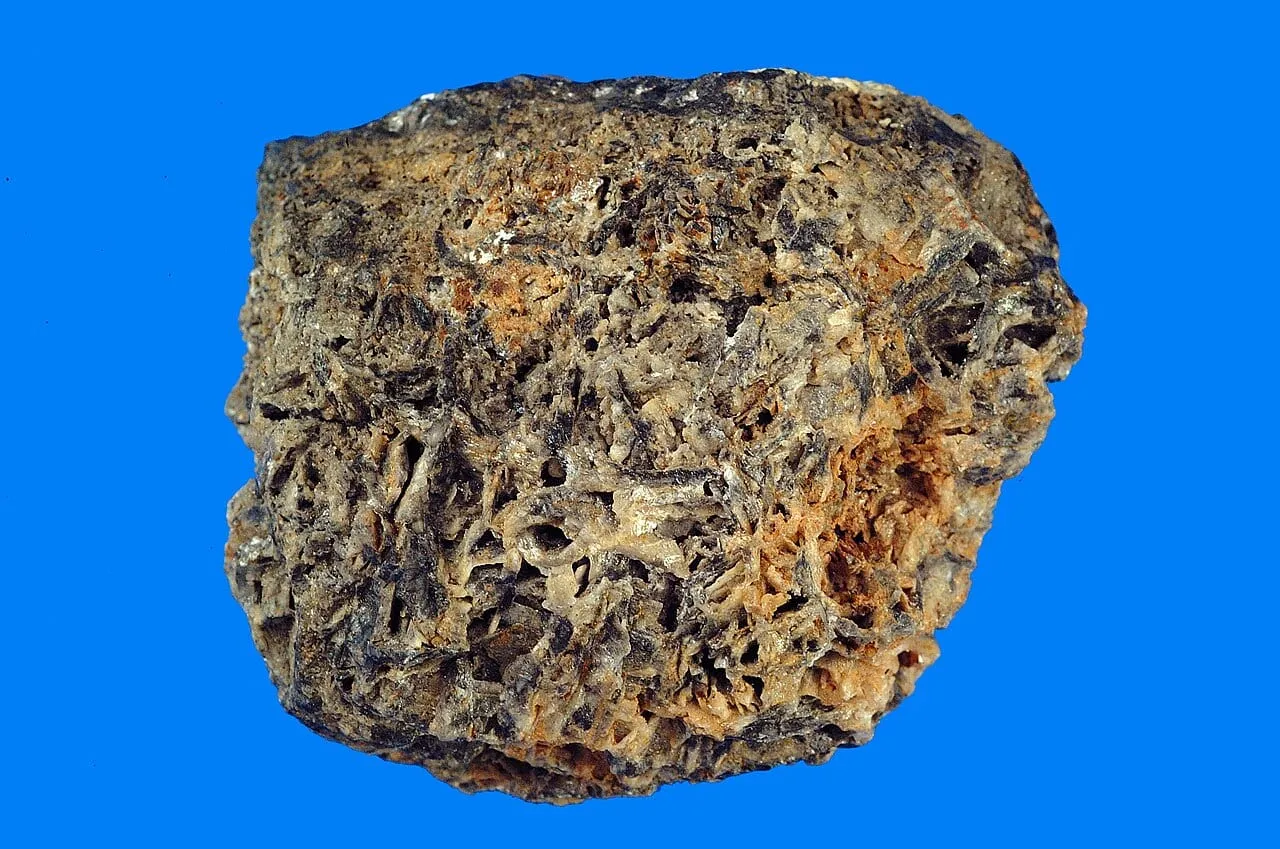
Anglesite
A heavy lead sulfate mineral with a diamond-like shine that grows as a crust around galena; it is named after the island of Anglesey in Wales.
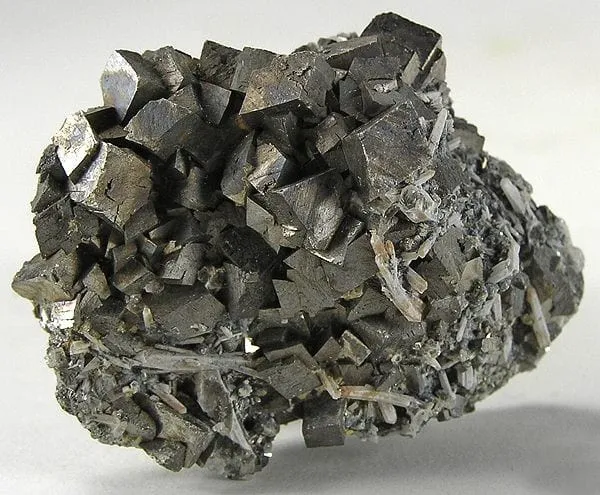
Arsenopyrite
A widespread silvery-grey sulfide containing arsenic: it smells of garlic when struck and is poisonous.
Banded iron formation
An ancient rock of alternating iron-oxide and chert bands: the record of oxygen beginning to build up on Earth, and the main source of iron ore.