Meteorite
Orgueil meteorite
Orgueil meteoriti
A coal-black stone with the same make-up as the Sun: a carbonaceous chondrite that fell in France in 1864, stirring debates about life and a famous hoax.
Also known as: Orgueil
- Popularly: Meteorite

In short
Orgueil is a carbonaceous chondrite that fell near Orgueil in southern France on 14 May 1864. It came down as about 20 stones, and 14 kilograms were collected. It is the largest of the five known CI chondrites, a group whose composition, apart from gases such as hydrogen and helium, is essentially identical to the Sun's. Being so primitive and plentiful, it is one of the most studied meteorites. Its organic matter has fuelled debates about life since the 1860s, and a famous hoax that came to light in 1965.
Photos

How does it form?
Orgueil is a piece of an asteroid that formed at the start of the Solar System and never melted. CI chondrites are among the most primitive meteorites: they carry the non-gaseous components of the nebula that formed the Sun in proportions very close to the Sun’s own. On Orgueil’s parent body, water altered the rock very strongly; its “type 1” label shows this, which is why no chondrules can be seen.
The extremely fine diamond dust inside it is older still than the Solar System: these are “presolar” grains formed around other stars.
What is it used for?
- Composition of the Solar System: CI chondrites are the main reference for working out the abundances of elements in the Solar System.
- Presolar grains: Presolar grains separated from Orgueil are used to study material made in other stars.
- History of science: The debates over the origin of its organic matter, starting in the 1860s, taught important lessons about how claims of alien life should be tested.
History
The meteorite fell on the evening of 14 May 1864. The same year François Stanislas Clöez, a chemist at the natural history museum in Paris, studied its organic matter; whether it could be of biological origin was debated into the 1870s. The “organised elements” reported in 1962 were soon shown to be contamination. Who was behind the seed-capsule hoax uncovered in 1965 is unknown.
What determines its value?
Orgueil's value is scientific: it is one of the rock samples closest in composition to the Sun and a reference for studying the raw material of the Solar System. Its specimens are held by institutions worldwide and lent for justified research. A piece's value depends on its mass and documented origin.
This information is educational, not buying, selling or investment advice. Value varies enormously with quality and treatment.
How to recognise it
- 1
A coal-black stone that contains no round grains (chondrules).
- 2
It has a dull black fusion crust on the outside.
- 3
Only museum records and laboratory analysis can show that a piece really comes from Orgueil.
Myths and misconceptions
MythA plant seed was found inside the Orgueil meteorite.
FactIn 1965 a seed capsule was found in a fragment kept in a sealed jar in Montauban since the fall. But it turned out to be the capsule of a European rush, glued into the fragment and disguised with coal dust, and the outer “fusion crust” was really glue. It is thought to have been a hoax meant to sway the 19th-century debate on spontaneous generation.
MythFossils of alien life were found in Orgueil.
FactThe “organised elements” reported in 1962 were later shown to be contaminating pollen and fungal spores, or crystals of olivine. NASA formally distanced itself from one of its researchers' claims of fossils in Orgueil.
Did you know?
The chemist François Stanislas Clöez, who studied the meteorite the year it fell, wrote that its organic matter held carbon, hydrogen and oxygen in ratios like peat from the Somme valley or lignite near Kassel.
Extremely fine diamond dust older than the Solar System was found in Orgueil; it carries an unusual xenon gas called “xenon-HL”.
The meteorite is far richer in mercury than expected, a main driver of a puzzle scientists call the “mercury paradox”.
Where is it found?
Loading map…
- Orgueil, Tarn-et-Garonne, France · Type localityA few minutes after 20:00 on 14 May 1864, about 20 stones fell over an area of 5–10 square kilometres.
Locations are approximate to protect sites. Red dots mark places in Türkiye. Open in the big map →
Frequently asked questions
What is orgueil meteorite?
Orgueil is a carbonaceous chondrite that fell near Orgueil in southern France on 14 May 1864. It came down as about 20 stones, and 14 kilograms were collected. It is the largest of the five known CI chondrites, a group whose composition, apart from gases such as hydrogen and helium, is essentially identical to the Sun's. Being so primitive and plentiful, it is one of the most studied meteorites. Its organic matter has fuelled debates about life since the 1860s, and a famous hoax that came to light in 1965.
Why is Orgueil so important to science?
CI chondrites have almost the same composition as the Sun apart from gases such as hydrogen and helium, so they are seen as the best samples of the Solar System's original material. Orgueil is the largest member of this group, and because it supplies so much material it is among the most studied meteorites.
What is orgueil meteorite used for?
Composition of the Solar System: CI chondrites are the main reference for working out the abundances of elements in the Solar System. Presolar grains: Presolar grains separated from Orgueil are used to study material made in other stars. History of science: The debates over the origin of its organic matter, starting in the 1860s, taught important lessons about how claims of alien life should be tested.
How hard is orgueil meteorite?
It has a hardness of 2.5–7 on the Mohs scale. It can scratch glass; a steel knife scratches it only with difficulty. Its specific gravity is 2.11 g/cm³.
Where is orgueil meteorite found?
Its best-known localities: Orgueil, Tarn-et-Garonne, France.
How can you tell if orgueil meteorite is real?
A coal-black stone that contains no round grains (chondrules). It has a dull black fusion crust on the outside. Only museum records and laboratory analysis can show that a piece really comes from Orgueil.
Is orgueil meteorite valuable?
On the “street to diamond” value ladder it sits on step 6 of nine: Fine ornamental and collector stone. Orgueil's value is scientific: it is one of the rock samples closest in composition to the Sun and a reference for studying the raw material of the Solar System. Its specimens are held by institutions worldwide and lent for justified research. A piece's value depends on its mass and documented origin.
Sources
- Orgueil (meteorite) · Wikipedia
- CI chondrite · Wikipedia
- Meteorite porosities and densities: a review of trends in the data (D. T. Britt & G. J. Consolmagno), Lunar and Planetary Science XXXV, abstract 2108 · Lunar and Planetary Institute, 2004
- Handbook of Mineralogy: Forsterite · Mineralogical Society of America
External links
Draft: awaiting expert reviewReport an error
On the same step
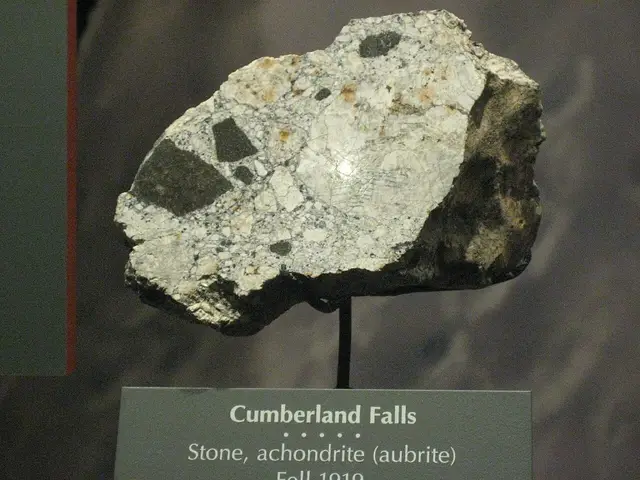
Achondrite
Stony meteorites with no chondrules: rock from melted asteroids, the Moon and Mars, and hard to recognise because they look like Earth rocks.
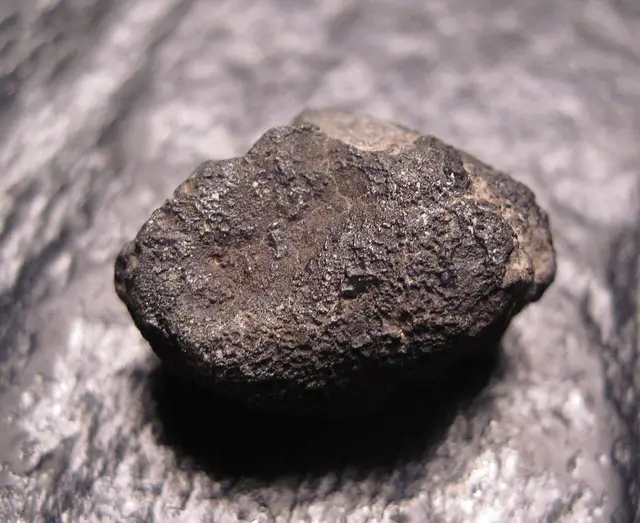
Allende meteorite
The most studied meteorite in history: the largest carbonaceous chondrite, which fell in Mexico in 1969 carrying the first solids of the Solar System.
Amber
Tree resin fossilised over millions of years: a light, warm organic gem that sometimes holds prehistoric insects.