Meteorite
Muonionalusta meteorite
Muonionalusta meteoriti
An iron that has lived through four ice ages: it fell on northern Sweden a million years ago and shows a fine lattice when cut.
Also known as: Muonionalusta
- Popularly: Meteorite

In short
The Muonionalusta meteorite is an iron meteorite that fell in northern Sweden, near the Finnish border, about a million years ago. Its first piece was found in 1906, and about forty pieces are known today. It is a fine octahedrite of group IVA and shows a very fine Widmanstätten pattern when cut and etched. Lead–lead dating gives it an age of 4.5653 billion years. It is also where stishovite, a mineral formed at extremely high pressure, was first found in an iron meteorite.
Photos

How does it form?
Muonionalusta is a piece of the iron core or mantle of a small planet (asteroid). As this metal cooled very slowly, nickel-poor and nickel-rich alloys separated into thin bands, forming the Widmanstätten pattern. Lead–lead dating puts the meteorite’s age at 4.5653 billion years, making it one of the oldest known meteorites.
The parent body went through violent collisions and broke apart. A piece fell on northern Sweden about a million years ago and split into many pieces as it fell. During the ice ages that followed, glaciers carried the pieces and mixed them into glacial moraines.
What is it used for?
- Science: Its great age and the shock it carries tell us about the formation and collision history of asteroids. Stishovite was found in an iron meteorite here for the first time.
- Museums: Many institutions hold pieces, such as the 950-kilogram mass at the Prague Observatory and Planetarium, the Geological Institute in Uppsala and the National Museum of Natural History in Washington.
- Ornament and design: Its fine pattern has led to slices being used in luxury car interiors, commemorative coins and watch dials.
History
The first piece was found in 1906 near the village of Kitkiöjärvi. A. G. Högbom described the meteorite in 1910 and named it after Muonionalusta, a place on the Muonio River. The name is Finnish and means “below Muonio”, that is, downstream from Muonio. The meteorite was studied in 1948 by Professor Nils Göran David Malmqvist.
What determines its value?
Muonionalusta's value is raised by the fine, regular Widmanstätten pattern revealed when it is cut and etched, which is why its slices are also used in decorative and design pieces. A piece's value depends on its mass, the beauty of the pattern, its resistance to rust and its documented origin. Pieces are held by many museums, from Prague to Washington.
This information is educational, not buying, selling or investment advice. Value varies enormously with quality and treatment.
How to recognise it
- 1
Its outer surface is strongly weathered, brown and rusty, with cemented, faceted pebbles stuck to it.
- 2
Cut, polished and etched with acid, it reveals a pattern of very thin silvery bands crossing at angles.
- 3
Being almost entirely iron–nickel, it is very heavy and strongly attracts a magnet.
Myths and misconceptions
MythMuonionalusta is a meteorite that fell recently.
FactAlthough its pieces are found in near-surface glacial moraines, the meteorite fell about a million years ago and has since lived through four ice ages. It is the oldest known meteorite to have hit Earth during the Quaternary.
Did you know?
Since it fell, the meteorite has lived through four ice ages, and it was dug out of a glacial moraine in the northern tundra.
A new mineral, a hydrated nickel chloride formed as the meteorite weathered, was named “muonionalustaite” after it.
Slices of Muonionalusta have been used in the interiors of some luxury cars, in commemorative coins and in watch dials.
Where is it found?
Loading map…
- Pajala district, Norrbotten, Sweden · Type localityThe first piece was found in 1906 near the village of Kitkiöjärvi; about forty pieces are known today. They have been dug from glacial moraines in an area of 25 × 15 km, about 140 km north of the Arctic Circle.
Locations are approximate to protect sites. Red dots mark places in Türkiye. Open in the big map →
Frequently asked questions
What is muonionalusta meteorite?
The Muonionalusta meteorite is an iron meteorite that fell in northern Sweden, near the Finnish border, about a million years ago. Its first piece was found in 1906, and about forty pieces are known today. It is a fine octahedrite of group IVA and shows a very fine Widmanstätten pattern when cut and etched. Lead–lead dating gives it an age of 4.5653 billion years. It is also where stishovite, a mineral formed at extremely high pressure, was first found in an iron meteorite.
Why does the stishovite in Muonionalusta matter?
Stishovite is a very high-pressure form of quartz and is very rare, usually found at meteorite impact structures. The pressure inside an asteroid's core is not enough to make it. So the stishovite in Muonionalusta is thought to have formed in a violent collision on its parent body; one study suggests this may be linked to a break-up event about 400 million years ago.
What is muonionalusta meteorite used for?
Science: Its great age and the shock it carries tell us about the formation and collision history of asteroids. Stishovite was found in an iron meteorite here for the first time. Museums: Many institutions hold pieces, such as the 950-kilogram mass at the Prague Observatory and Planetarium, the Geological Institute in Uppsala and the National Museum of Natural History in Washington. Ornament and design: Its fine pattern has led to slices being used in luxury car interiors, commemorative coins and watch dials.
How hard is muonionalusta meteorite?
It has a hardness of 4–5.5 on the Mohs scale. A fingernail cannot scratch it, but a steel knife can. Its specific gravity is 7–8 g/cm³.
Where is muonionalusta meteorite found?
Its best-known localities: Pajala district, Norrbotten, Sweden.
How can you tell if muonionalusta meteorite is real?
Its outer surface is strongly weathered, brown and rusty, with cemented, faceted pebbles stuck to it. Cut, polished and etched with acid, it reveals a pattern of very thin silvery bands crossing at angles. Being almost entirely iron–nickel, it is very heavy and strongly attracts a magnet.
Is muonionalusta meteorite valuable?
On the “street to diamond” value ladder it sits on step 5 of nine: Ornamental stone. Muonionalusta's value is raised by the fine, regular Widmanstätten pattern revealed when it is cut and etched, which is why its slices are also used in decorative and design pieces. A piece's value depends on its mass, the beauty of the pattern, its resistance to rust and its documented origin. Pieces are held by many museums, from Prague to Washington.
Sources
- Muonionalusta · Wikipedia
- Kamacite Mineral Data · Webmineral.com
- Taenite Mineral Data · Webmineral.com
- Density and specific gravity (R. L. Korotev) · Washington University in St. Louis, Some Meteorite Information
External links
Draft: awaiting expert reviewReport an error
On the same step
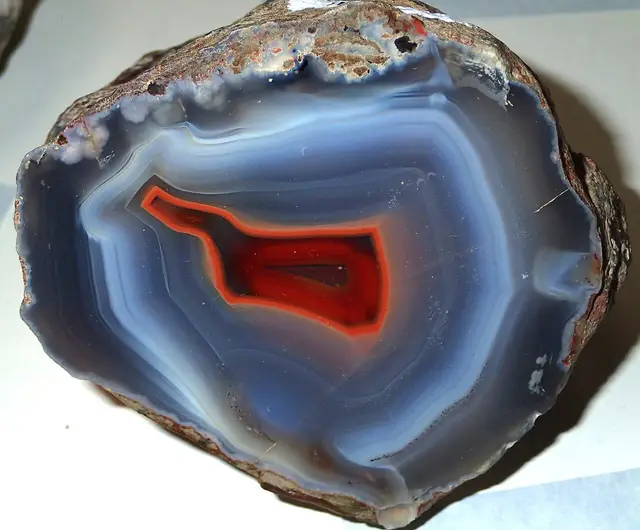
Agate
The banded variety of chalcedony: it grows layer by layer in hollows in volcanic rock and shows a new pattern every time it is cut.

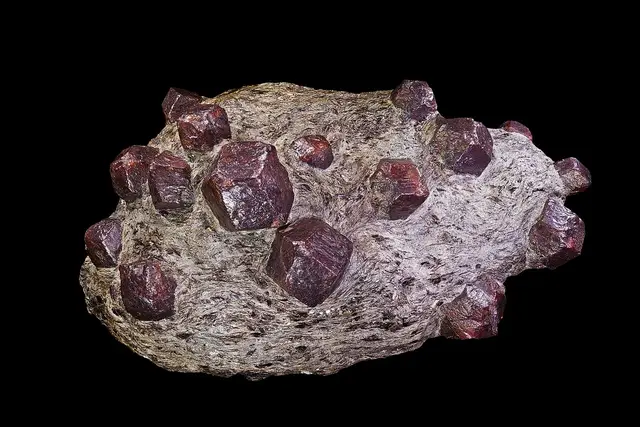
Almandine
The commonest garnet: a deep red, iron-rich stone named after the ancient city of Alabanda in Anatolia, used in jewellery and in sandpaper alike.
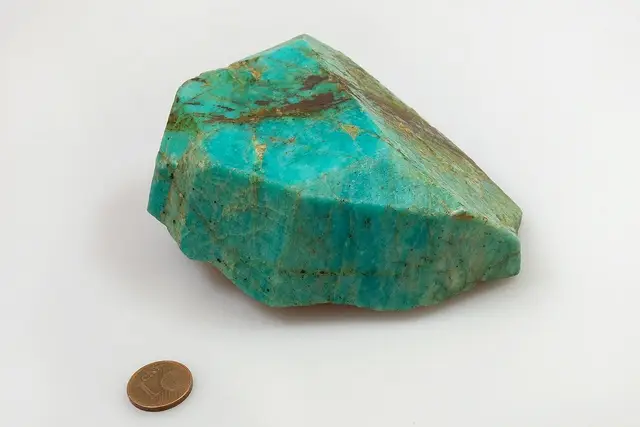
Amazonite
A turquoise-like green-blue feldspar: a variety of microcline worn as jewellery for more than three thousand years, but it can release lead.