Rock
Mudstone
Çamurtaşı
Hardened mud: a fine-grained rock of silt and clay that does not split into sheets; it has even been found on Mars.
- Popularly: Ore and raw material
- Industrial
.jpg)
In short
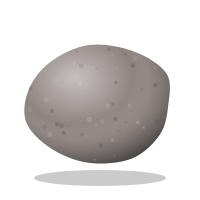
Mudstone is a fine-grained sedimentary rock formed when a mixture of silt- and clay-sized particles is squeezed and hardened. It differs from shale in that it does not split into thin sheets, which means it is massive. Its grains cannot be told apart without a microscope; it looks like hardened clay and can resemble cracked, dried mud. Mudstones and similar rocks make up about half of the sedimentary rocks in the geological record.
Photos

How does it form?
Mudstone forms mostly in oceans and lakes, and on floodplains and deltas, in other words where the water is calm. Silt and clay carried by rivers settle out only in almost still water. As new sediment covers them they are buried, compacted, squeezed free of water and hardened.
The only difference between mudstone and shale is fissility. In mudstone the layers are either not distinct from the start, or burrowing creatures disturbed them as the mud settled.
What is it used for?
- Bricks, tiles and ceramics: Ground mudstone, mixed with water and fired, can be used like clay.
- Oil and gas: The fine grain of mudstones is important in petroleum geology; those rich in organic matter can be a source of hydrocarbons.
- Fossil archive: Fine mud protects fossils from erosion and dissolution, so mudstones are rich in fossils.
- Scientific research: Mudstones on Mars are studied to learn about the planet’s past and the organic compounds preserved there.
What determines its value?
Mudstone is a plentiful, low-value rock, worked by the tonne as a raw material for bricks, tiles and ceramics. As a raw material its value depends on the clay content, the colour and strength it gives when fired, impurities such as lime, and the distance from quarry to factory. For engineering it can cause trouble because it may crumble when wetted and dried. Beds that hold fossils carry scientific and collector value.
This information is educational, not buying, selling or investment advice. Value varies enormously with quality and treatment.
How to recognise it
- 1
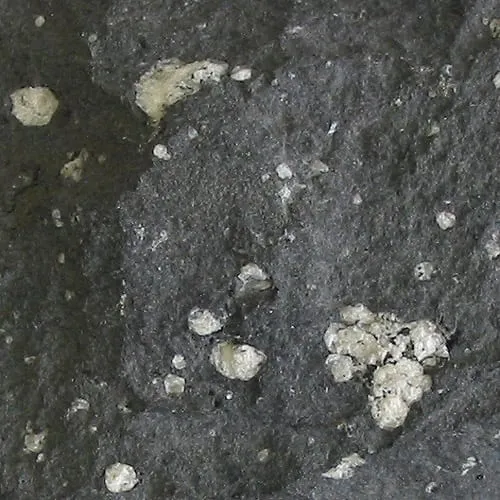
It is very fine-grained: no grains show even with a hand lens, the surface is dull and smooth, and it looks like hardened clay.
- 2
It does not split into thin sheets like shale; it breaks in blocks and sometimes shows cracks like drying mud.
- 3
It is soft, can be scratched with a knife, and may crumble over time in air and water.
- 4
Its colours vary widely: it can be red, purple, brown, yellow, green, grey or black.
Fakes and imitations
What shops usually don’t tell you:
- In the Dunham system for classifying carbonate rocks, a limestone made mostly of lime mud is also called a “mudstone”; this is different from the clay-and-silt rock described here.
- Slate is mudstone transformed by heat and pressure; it is hard, splits into thin plates and does not break down in water, whereas mudstone is soft and does not split.
Myths and misconceptions
MythMudstone and shale are the same rock.
FactBoth are fine-grained rocks of the same family, but shale splits into thin sheets and mudstone does not. The lack of fissility may come from the original texture or from burrowing animals that disturbed the layers as the mud settled.
MythFinding organic matter in Martian mudstone proves there was life on Mars.
FactOrganic compounds can form by non-living processes as well as by living things. The kerogen and complex organic compounds NASA found in Martian mudstones are not evidence of life; they show only that carbon compounds were preserved there for billions of years.
Did you know?
NASA's Curiosity rover found mudstone deposits on Mars; in June 2018 NASA reported kerogen and other complex organic compounds in mudstones about 3.5 billion years old.
Mudstones make up about 50% of the sedimentary rocks in the geological record and are among the commonest sedimentary rocks on Earth.
The Early Jurassic mudstone cliffs at Lyme Regis on England's Dorset coast yield ichthyosaur, plesiosaur and ammonite fossils; the famous fossil collector Mary Anning worked here in the 19th century.
Where is it found?
Loading map…
- Lyme Regis and Charmouth, Dorset, England · Type localityThe type section of the Early Jurassic Charmouth Mudstone Formation is in the cliffs between these two towns. The formation is famous for ammonites, ichthyosaurs and plesiosaurs; Mary Anning collected fossils here in the 19th century.
- Cheshire Basin, England · Known localityThe thickest part of the Triassic Mercia Mudstone Group lies here (over 1,350 m). The rock is reddish brown from iron oxide, and halite (rock salt) beds within it are worked around Northwich.
- Dinosaur Provincial Park, Alberta, Canada · Known localityThe upper part of the Late Cretaceous Dinosaur Park Formation consists of organic-rich mudstones full of root traces; the park, with its dense concentrations of dinosaur skeletons, is a UNESCO World Heritage Site.
- Ischigualasto Provincial Park, San Juan, Argentina · Known localityFloodplain deposits of the Late Triassic Ischigualasto Formation include mudstone layers; fossils of early dinosaurs such as Eoraptor and Herrerasaurus come from here. The park has been a UNESCO World Heritage Site since 2000.
- Petrified Forest National Park, Arizona, USA · Known localityThe colourful bands of mudstone and sandstone in the Late Triassic Chinle Formation give the Painted Desert its multicoloured look; the formation is also famous for petrified wood.
Locations are approximate to protect sites. Red dots mark places in Türkiye. Open in the big map →
Frequently asked questions
What is mudstone?
Mudstone is a fine-grained sedimentary rock formed when a mixture of silt- and clay-sized particles is squeezed and hardened. It differs from shale in that it does not split into thin sheets, which means it is massive. Its grains cannot be told apart without a microscope; it looks like hardened clay and can resemble cracked, dried mud. Mudstones and similar rocks make up about half of the sedimentary rocks in the geological record.
What is mudstone used for?
Bricks, tiles and ceramics: Ground mudstone, mixed with water and fired, can be used like clay. Oil and gas: The fine grain of mudstones is important in petroleum geology; those rich in organic matter can be a source of hydrocarbons. Fossil archive: Fine mud protects fossils from erosion and dissolution, so mudstones are rich in fossils. Scientific research: Mudstones on Mars are studied to learn about the planet's past and the organic compounds preserved there.
How hard is mudstone?
It has a hardness of 2–4 on the Mohs scale. A fingernail cannot scratch it, but a steel knife can. Its specific gravity is 1.9–2.6 g/cm³.
Where is mudstone found?
Its best-known localities: Lyme Regis and Charmouth, Dorset, England; Cheshire Basin, England; Dinosaur Provincial Park, Alberta, Canada; Ischigualasto Provincial Park, San Juan, Argentina; Petrified Forest National Park, Arizona, USA.
How can you tell if mudstone is real?
It is very fine-grained: no grains show even with a hand lens, the surface is dull and smooth, and it looks like hardened clay. It does not split into thin sheets like shale; it breaks in blocks and sometimes shows cracks like drying mud. It is soft, can be scratched with a knife, and may crumble over time in air and water. In the Dunham system for classifying carbonate rocks, a limestone made mostly of lime mud is also called a “mudstone”; this is different from the clay-and-silt rock described here.
Is mudstone valuable?
On the “street to diamond” value ladder it sits on step 2 of nine: Raw material by the tonne. Mudstone is a plentiful, low-value rock, worked by the tonne as a raw material for bricks, tiles and ceramics. As a raw material its value depends on the clay content, the colour and strength it gives when fired, impurities such as lime, and the distance from quarry to factory. For engineering it can cause trouble because it may crumble when wetted and dried. Beds that hold fossils carry scientific and collector value.
Sources
- Mudstone · Wikipedia
- Çamurtaşı · Vikipedi
- Mudstone · Encyclopaedia Britannica
- Rock Density Tables (after Tenzer et al. 2011, A digital rock density map of New Zealand, Computers & Geosciences 37: 1181–1191) · Rocscience, RocFall2 documentation
- Charmouth Mudstone Formation · Wikipedia
- Mercia Mudstone Group · Wikipedia
- Dinosaur Park Formation · Wikipedia
- Ischigualasto Formation · Wikipedia
- Chinle Formation · Wikipedia
External links
Draft: awaiting expert reviewReport an error ↗
On the same step
Actinolite
A green amphibole that grows like rays: a raw material of nephrite jade and cat's-eye stones; its fibrous form is asbestos.
Amphibolite
A dark, heavy, salt-and-pepper metamorphic rock: basalt or gabbro transformed at depth; the stone of Neolithic axes.
Andesite
The rock of volcanic arcs, named after the Andes — and the pink-grey stone of Ankara Castle.