Rock
Marl
Marn
Half clay, half lime: the carbonate mud and rock used to improve fields and make cement, and through which the Channel Tunnel was bored.
Also known as: Marlstone
- Popularly: Ore and raw material

In short
Marl is an earthy material rich in carbonate minerals, clays and silt; when hardened into rock it is called marlstone. It typically contains 35–65 per cent clay and 65–35 per cent carbonate. It forms in marine or freshwater environments, often through the activity of algae. It is used in agriculture to correct acid soils and in the manufacture of Portland cement.
Photos

How does it form?
Marl forms in marine or freshwater environments, often through the activity of algae. In shallow lakes with high pH and alkalinity, the stems and fruiting bodies of the macroalga Chara (stonewort) become calcified. When the alga dies, these calcified parts break down into fine carbonate particles that mingle with silt and clay to produce marl. In the marl ponds of the north-eastern United States, often kettle ponds on limestone bedrock, the skeletons of freshwater molluscs such as Sphaerium and Planorbis also accumulate in the bottom marl.
Marl lakes are found mostly in areas of recent glaciation. In the sea, alternating beds of chalk and marl are common in the Cretaceous rocks of north-western Europe. Glauconitic marl, which contains the green clay mineral glauconite, indicates deposition in marine conditions.
What is it used for?
- Agriculture: Used to correct acid soils and improve soil structure. Its more widespread use from the 16th century on contributed to the early modern agricultural revolution. Early in the 19th century it was gradually replaced by lime and imported fertilisers.
- Cement: Used as a raw material in Portland cement. As a supplementary cementitious material it gives better physical and mechanical properties than metakaolin and can be calcined at a considerably lower temperature.
- Engineering: Some very low-permeability marl beds were used for the Channel Tunnel and are being investigated for nuclear waste storage, for example at Wellenberg in Switzerland. Marl soils, however, behave poorly when alternately wetted and dried; they can be stabilised by adding pozzolan (volcanic ash).
- Aquaculture: In Pamlico Sound, USA, marl has been used to provide an artificial reef-like substrate for oysters.
Where is it found?
The lower part of the cliffs of Dover consists of glauconitic marls and rhythmically banded limestone and marl. In Hungary, the Upper Eocene Buda Marl behaves between rock and soil and is described as both “weak rock and strong soil”. Marl is the dominant rock type of the Vaca Muerta Formation in Argentina. Marl- and opal-rich beds in Spain’s Sorbas Basin have been correlated with Earth’s orbital cycles.
What determines its value?
Marl is an abundant raw material used by the tonne; its value depends on its calcium carbonate content, how close the pit is to where it will be used, and its suitability for cement or farming. Historically it was usually dug close to where it was used.
This information is educational, not buying, selling or investment advice. Value varies enormously with quality and treatment.
How to recognise it
- 1
Earthy, fine-grained and soft; often greenish or grey, sometimes bluish or reddish.
- 2
Because of its calcium carbonate it fizzes with dilute acid; it differs from limestone in containing a substantial amount of clay.
- 3
Hardened marlstone breaks with a blocky, subconchoidal fracture and does not split into thin sheets as readily as shale.
Myths and misconceptions
MythMarl is the same as limestone.
FactIt is not. Marl is a carbonate mud or mudstone containing 35–65 per cent clay; hardened marlstone is most accurately described as an earthy, impure argillaceous limestone. As the calcium carbonate content rises, the rock grades into limestone.
Did you know?
Marl is one of the oldest soil amendments used in agriculture; Pliny the Elder mentioned its use in the 1st century.
In 18th-century Lancashire, England, marl was used so widely that almost every field had a marl pit.
The Channel Tunnel was bored in a marly chalk chosen for its very low permeability, absence of chert and lack of fissures. The underlying, easily recognisable glauconitic marl helped establish the right level for the excavation.
Where is it found?
Loading map…
- White Cliffs of Dover, Kent, England · Known localityThe lower units of the cliffs are glauconitic marls followed by rhythmically banded limestone and marl. The Channel Tunnel follows these marl layers.
- Budapest, Hungary · Known localityThe Upper Eocene Buda Marl, which behaves between rock and soil and is described as both “weak rock and strong soil”.
- Sorbas Basin, Almería, Spain · Known localityTortonian–Messinian marl- and opal-rich cyclic beds that have been correlated with Earth's orbital cycles (Milankovitch forcing).
Locations are approximate to protect sites. Red dots mark places in Türkiye. Open in the big map →
Frequently asked questions
What is marl?
Marl is an earthy material rich in carbonate minerals, clays and silt; when hardened into rock it is called marlstone. It typically contains 35–65 per cent clay and 65–35 per cent carbonate. It forms in marine or freshwater environments, often through the activity of algae. It is used in agriculture to correct acid soils and in the manufacture of Portland cement.
Why is marl spread on fields?
Marl adds calcium to the soil, improves its structure and lowers its acidity, making other nutrients more available to plants. Because its carbonate is mostly calcium carbonate, crops may show magnesium deficiency if magnesium is not added as well, and since it contains less calcium carbonate than straight lime, the amount applied must be adjusted accordingly.
What is marl used for?
Agriculture: Used to correct acid soils and improve soil structure. Its more widespread use from the 16th century on contributed to the early modern agricultural revolution. Early in the 19th century it was gradually replaced by lime and imported fertilisers. Cement: Used as a raw material in Portland cement. As a supplementary cementitious material it gives better physical and mechanical properties than metakaolin and can be calcined at a considerably lower temperature.
How hard is marl?
It has a hardness of 2–3 on the Mohs scale. A fingernail cannot scratch it, but a steel knife can. Its specific gravity is 2.26–2.66 g/cm³.
Where is marl found?
Its best-known localities: White Cliffs of Dover, Kent, England; Budapest, Hungary; Sorbas Basin, Almería, Spain.
How can you tell if marl is real?
Earthy, fine-grained and soft; often greenish or grey, sometimes bluish or reddish. Because of its calcium carbonate it fizzes with dilute acid; it differs from limestone in containing a substantial amount of clay. Hardened marlstone breaks with a blocky, subconchoidal fracture and does not split into thin sheets as readily as shale.
Is marl valuable?
On the “street to diamond” value ladder it sits on step 2 of nine: Raw material by the tonne. Marl is an abundant raw material used by the tonne; its value depends on its calcium carbonate content, how close the pit is to where it will be used, and its suitability for cement or farming. Historically it was usually dug close to where it was used.
Sources
- Marl · Wikipedia
- Marn · Vikipedi
- The peculiarities of composition and geotechnical properties of marls (by example of the Southwest Caucasus) (O. V. Zerkal, E. S. Balandina, E. N. Samarin), Geophysical Research Abstracts 12, EGU2010-14768 · Copernicus / EGU, 2010
- Characterization and mechanical properties of the Eocene Buda Marl (P. Görög), Central European Geology 50 · Akadémiai Kiadó, 2007
- Channel Tunnel · Wikipedia
- White Cliffs of Dover · Wikipedia
- Handbook of Mineralogy: Kaolinite · Mineralogical Society of America
- Handbook of Mineralogy: Calcite · Mineralogical Society of America
External links
Draft: awaiting expert reviewReport an error
On the same step
Actinolite
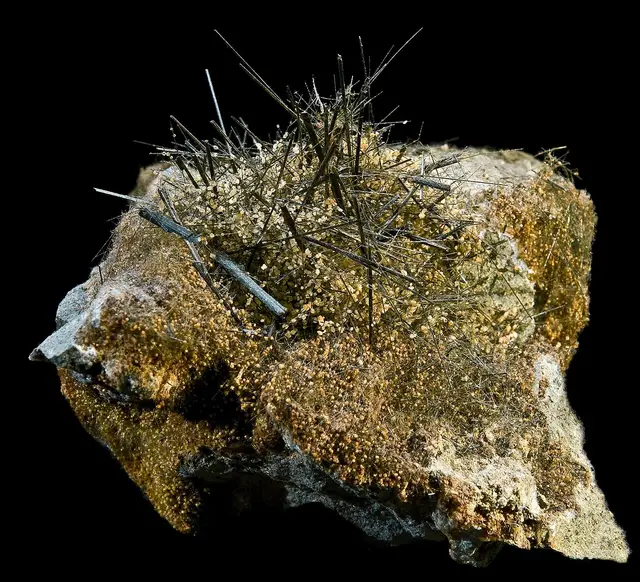
A green amphibole that grows like rays: a raw material of nephrite jade and cat's-eye stones; its fibrous form is asbestos.
Amphibolite
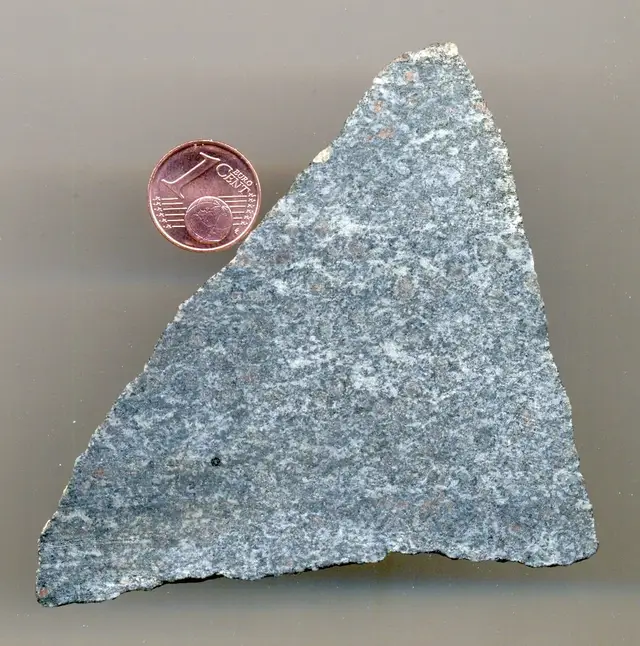
A dark, heavy, salt-and-pepper metamorphic rock: basalt or gabbro transformed at depth; the stone of Neolithic axes.
Anatase
Rutile's sibling in titanium dioxide: its sharp, stretched double pyramids turn into rutile when heated.