Rock
Komatiite
Komatiit
One of the hottest lavas ever erupted: a magnesium-rich volcanic rock, runny as water, that belongs almost entirely to the planet's early ages.
- Popularly: Common stone

In short
Komatiite is a dark green, heavy volcanic rock that formed in the early Earth when the mantle melted at very high temperatures. The lava was far hotter and runnier than any basalt lava today; it flowed with a viscosity thought to be close to that of water. No volcano erupts komatiite today, and almost all known komatiites are more than 2.5 billion years old. The rock is named after the Komati River in South Africa.
Photos

How does it form?
Komatiite comes from a magnesium-rich magma produced when the mantle beneath Earth’s crust melts to a very high degree and at a very high temperature. The magma erupts at the surface as lava. In the Archean the mantle is thought to have been 100-250 degrees hotter than it is now, which explains why komatiite is abundant only from those times.
Komatiite lava is so runny that it spreads across wide areas in thin sheets. Near the cold top and base of a flow, rapid cooling grows long, thin, branching crystals of olivine and pyroxene: this is spinifex texture. Deeper in the flow, heavy olivine crystals settle to the bottom and pile up as a thick, dark layer.
What is it used for?
- Nickel: Nickel-copper sulfide deposits hosted in komatiite supply about 14% of the world’s nickel, mostly from Australia, Canada and South Africa. Their importance was recognised in the 1960s with the discovery of large masses of nickel sulfide at Kambalda in Western Australia.
- Gold: In Australia, Canada, South Africa and the Guiana Shield of South America, komatiites are found together with gold deposits.
- Science: Komatiites are studied to learn how hot the mantle was in the early Earth and how the planet has cooled.
Where can it be seen?
The rock is named after the valley of the Komati River in South Africa, which lies in the Barberton Greenstone Belt, home to the Barberton Makhonjwa Mountains, a UNESCO World Heritage Site since 2008. The Pyke Hill area of the Abitibi Greenstone Belt in Canada and the Belingwe belt in Zimbabwe are among the best places to see komatiite flows and spinifex texture. Gorgona Island in Colombia has the youngest known komatiites.
What determines its value?
Komatiite itself is a very rare rock that is not sought as an ornamental or building stone; its value is scientific and for collectors. For collectors it matters that spinifex texture is clearly visible, that the specimen is fresh and little altered, and that it comes from a famous locality such as Barberton or Pyke Hill. In mining, what has value is not the komatiite but the nickel-copper sulfide deposit inside it: the size of the deposit, its nickel grade (the proportion of nickel in the ore), its depth and the cost of mining it decide.
This information is educational, not buying, selling or investment advice. Value varies enormously with quality and treatment.
How to recognise it
- 1
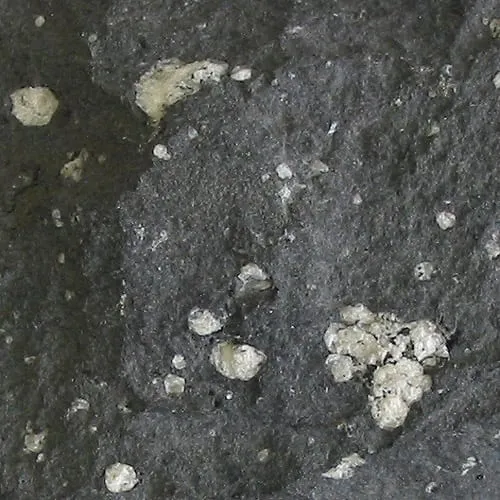
It is a dark green, grey-green or blackish green, fine-grained rock that feels heavy for its size; white feldspar grains cannot be seen with the eye.
- 2
Its most striking feature is spinifex texture: on weathered surfaces you can see thin, long, blade-shaped crystals criss-crossing or fanning out.
- 3
Alongside spinifex-textured parts there are darker, coarser layers built of settled olivine, with no spinifex pattern.
- 4
Almost every exposure has been partly turned into serpentine and chlorite, so the rock is soft, scratches easily and can feel slippery in places.
Fakes and imitations
What shops usually don’t tell you:
- Peridotite, serpentinite and dark basalt can look like komatiite. Calling a rock komatiite means finding out the composition of the lava (at least 18% MgO by weight), which only chemical analysis can do.
Myths and misconceptions
MythKomatiite formed only in the earliest ages of the Earth, and there is no younger komatiite.
FactAlmost all komatiites are Archean, but that is not a rule. Gorgona Island in Colombia has the youngest known komatiites, formed in the Cretaceous, and Canada has rare Proterozoic examples.
MythKomatiite is just another name for peridotite.
FactThe two have similar chemistry, but komatiite is a lava that reached the surface and cooled quickly (fine-grained, with spinifex texture), while peridotite is a coarse-grained rock that mostly cooled slowly at depth or comes from the mantle.
Did you know?
Komatiite lava is calculated to have erupted at up to, and perhaps above, 1,600 °C, while basalt lava erupts at 1,100-1,250 °C. Its viscosity is thought to be close to that of water, so it could spread quickly in very thin sheets.
The name “spinifex” comes from the Australian desert grass Triodia, which grows in branching tussocks; the crystal patterns in the rock resemble those clumps.
The youngest known komatiites are on Gorgona Island off the coast of Colombia and date from the Cretaceous; almost all other komatiite is Archean.
Where is it found?
Loading map…
- Barberton Greenstone Belt and Komati River valley, Mpumalanga, South Africa · Type localityThe type area that gave the rock its name. The Barberton Makhonjwa Mountains part of this 3.5-3.2 billion-year-old belt was inscribed on the UNESCO World Heritage List in 2008.
- Kambalda, Western Australia, Australia · Major depositHome to Australia's first nickel mines after nickel sulfide deposits were found in komatiite in the 1960s; Australia's first nickel mine opened here in 1966.
- Pyke Hill, Munro Township, Ontario, Canada · Major depositWorld-famous exposures of komatiite lava flows and spinifex texture, about 2.7 billion years old (Neoarchean), in the Abitibi Greenstone Belt.
- Belingwe Greenstone Belt (Mberengwa), Zimbabwe · Known localityKomatiite flows of the roughly 2.7 billion-year-old Reliance Formation are exceptionally well preserved.
- Gorgona Island, Colombia · Known localityHome to the youngest known komatiites (Cretaceous); the whole island has been a national park since 1984.
Locations are approximate to protect sites. Red dots mark places in Türkiye. Open in the big map →
Frequently asked questions
What is komatiite?
Komatiite is a dark green, heavy volcanic rock that formed in the early Earth when the mantle melted at very high temperatures. The lava was far hotter and runnier than any basalt lava today; it flowed with a viscosity thought to be close to that of water. No volcano erupts komatiite today, and almost all known komatiites are more than 2.5 billion years old. The rock is named after the Komati River in South Africa.
What is komatiite used for?
Nickel: Nickel-copper sulfide deposits hosted in komatiite supply about 14% of the world's nickel, mostly from Australia, Canada and South Africa. Their importance was recognised in the 1960s with the discovery of large masses of nickel sulfide at Kambalda in Western Australia. Gold: In Australia, Canada, South Africa and the Guiana Shield of South America, komatiites are found together with gold deposits. Science: Komatiites are studied to learn how hot the mantle was in the early Earth and how the planet has cooled.
How hard is komatiite?
It has a hardness of 3–6.5 on the Mohs scale. It can scratch glass; a steel knife scratches it only with difficulty. Its specific gravity is 2.6–3 g/cm³.
Where is komatiite found?
Its best-known localities: Barberton Greenstone Belt and Komati River valley, Mpumalanga, South Africa; Kambalda, Western Australia, Australia; Pyke Hill, Munro Township, Ontario, Canada; Belingwe Greenstone Belt (Mberengwa), Zimbabwe; Gorgona Island, Colombia.
How can you tell if komatiite is real?
It is a dark green, grey-green or blackish green, fine-grained rock that feels heavy for its size; white feldspar grains cannot be seen with the eye. Its most striking feature is spinifex texture: on weathered surfaces you can see thin, long, blade-shaped crystals criss-crossing or fanning out. Alongside spinifex-textured parts there are darker, coarser layers built of settled olivine, with no spinifex pattern. Peridotite, serpentinite and dark basalt can look like komatiite. Calling a rock komatiite means finding out the composition of the lava (at least 18% MgO by weight), which only chemical analysis can do.
Is komatiite valuable?
On the “street to diamond” value ladder it sits on step 2 of nine: Raw material by the tonne. Komatiite itself is a very rare rock that is not sought as an ornamental or building stone; its value is scientific and for collectors. For collectors it matters that spinifex texture is clearly visible, that the specimen is fresh and little altered, and that it comes from a famous locality such as Barberton or Pyke Hill. In mining, what has value is not the komatiite but the nickel-copper sulfide deposit inside it: the size of the deposit, its nickel grade (the proportion of nickel in the ore), its depth and the cost of mining it decide.
Sources
- Komatiite · Wikipedia
- Komatiite · Encyclopaedia Britannica
- Barberton Greenstone Belt · Wikipedia
- Barberton, Mpumalanga · Wikipedia
- Komati River · Wikipedia
- Kambalda, Western Australia · Wikipedia
- Gorgona Island (Colombia) · Wikipedia
- Spinifex komatiite sill in cumulate komatiite lava flow (Pyke Hill, near the Potter Mine, east of Timmins, Ontario, Canada), file description by James St. John · Wikimedia Commons
- Komatiite Flows from the Reliance Formation, Belingwe Belt, Zimbabwe: I. Petrography and Mineralogy · Journal of Petrology, 1994
_27_(40876555433).jpg)
External links
Draft: awaiting expert reviewReport an error ↗
On the same step
Actinolite
A green amphibole that grows like rays: a raw material of nephrite jade and cat's-eye stones; its fibrous form is asbestos.
Amphibolite
A dark, heavy, salt-and-pepper metamorphic rock: basalt or gabbro transformed at depth; the stone of Neolithic axes.
Andesite
The rock of volcanic arcs, named after the Andes — and the pink-grey stone of Ankara Castle.