Rock
Hornfels
Hornfels
Rock baked by magma: heated and hardened beside a hot intrusion, very fine-grained and hard enough to ring when struck.
- Popularly: Natural stone (building and decor)
- Building stone

In short
Hornfels is a hard, fine-grained metamorphic rock that forms where hot magma, most often granite, pushes into the crust and “bakes” the surrounding rocks without melting them. Because pressure plays no part, it shows no foliation; its minerals are arranged at random. The name is German for “horn rock”, after its hardness and texture, which recall animal horn.
Photos

How does it form?
Hornfels is a contact metamorphic rock. A hot mass of magma, most often granite, pushes into cold rocks in the crust. Its heat warms the surrounding rocks by hundreds of degrees but does not melt them; it only “bakes” them. The minerals in the surrounding rock recrystallise and lock together, and the rock becomes harder and denser. The heated zone around the magma is called an aureole (halo).
Without the strong pressure of mountain building, the minerals in hornfels do not line up in layers; the rock shows no foliation. If the original rock was clay or mudstone, minerals such as andalusite, cordierite, biotite and sillimanite grow in it; limestone gives calcium silicates, and basaltic rock gives pyroxene and hornblende. At higher temperatures different mineral assemblages are reached, called hornfels facies (from roughly 300–500 °C to above 800 °C).
What is it used for?
- Crushed stone and aggregate: Being very hard, it is used as aggregate in roads and construction, mostly on a local scale.
- Stone instruments: In England, Skiddaw hornfels was used to build stone instruments called lithophones, because it gives a long, clear note when struck.
- Science: The width of a hornfels zone and the minerals in it help show how much heat an intrusion gave off and how deep it was emplaced.
In Türkiye
In Türkiye, hornfelses are found around granite intrusions. Along the contact of the Beypazarı (Ankara) granite with its wall rocks of phyllite, schist and marble, hornfelses 3–10 metres thick occur. The clay-rich rocks around the Gümüşhane granite pluton reached hornblende-hornfels conditions when the granite was emplaced; this area has been studied as the Kurdoğlu contact metamorphic zone.
What determines its value?
Although very hard and resistant to weathering, hornfels occurs in limited areas, so it is mostly used only locally as crushed stone and aggregate; sold by the tonne it is worth little. Its value depends on how close the quarry is to roads and building sites, on its soundness, and on how hard it is to work. Collectors look for specimens spotted with andalusite or cordierite and for pieces from famous localities.
This information is educational, not buying, selling or investment advice. Value varies enormously with quality and treatment.
How to recognise it
- 1
It is very hard: a steel knife or a coin will not scratch it.
- 2
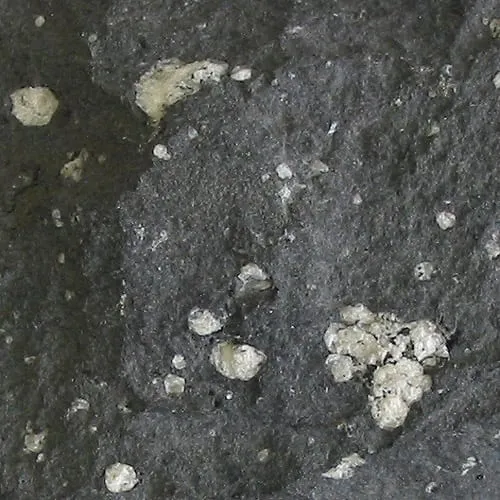
It is a dark grey, black or brown, dense and very fine-grained stone; the broken surface is smooth and curved like a shell.
- 3
It rings like porcelain when struck; in South Africa it is known as “ring-stone” for this reason.
- 4
It shows no foliation and does not split into sheets; when broken it tends to give cube-shaped pieces.
- 5
In some specimens pinkish crystals of andalusite or cordierite show as spots on the dark background.
- 6
It does not fizz in vinegar or dilute acid.
Fakes and imitations
What shops usually don’t tell you:
- It is easily confused with dark, fine-grained igneous rocks such as basalt, gabbro and diabase; the locality and the minerals found with it often decide it. Hornfels forms not from magma but from the baking of the rock beside the magma.
- In some places, such as Skiddaw, rocks known as “slate” (Skiddaw Slate) have actually been turned to hornfels in the part nearest the granite.
Myths and misconceptions
MythHornfels is a rock formed from lava, like basalt.
FactIts dark, fine-grained look makes it easy to mistake for basalt; but hornfels does not form from lava. It forms when the rock beside hot magma is transformed by heat.
MythMagma melts the rock it touches, and hornfels is that melt frozen solid.
FactIn hornfels the rock does not melt; the heat only makes its minerals recrystallise and new minerals (such as andalusite and cordierite) grow. So the rock can still carry traces of the original rock, for example old bedding.
Did you know?
In Keswick, England, there are “Musical Stones of Skiddaw” made of hornfels from the nearby mountain Skiddaw. In 1840 the stonemason Joseph Richardson built an eight-octave lithophone (stone xylophone) from 61 tuned pieces of hornfels; this stone instrument is still on display in the Keswick Museum.
The name hornfels comes from the German words for “horn” (Horn) and “rock” (Fels), inspired by the rock's horn-like hardness and toughness.
Where is it found?
Loading map…
- Skiddaw, Lake District, Cumbria, England · Known localityAround the Skiddaw granite the rocks of the Skiddaw Group have been turned to hornfels. Keswick's famous “Musical Stones of Skiddaw” were made from hornfels of this area.
- Dartmoor, Devon, England · Known localityThe emplacement of the Dartmoor granite created a contact metamorphic aureole of hornfelsed sedimentary rocks around it.
- Land's End, Cornwall, England · Known localityIn the country rocks around the Land's End granite are hornfelses derived from basaltic pillow lavas and greenstones.
- Henry Mountains, Utah, USA · Known localityContact metamorphic aureoles are seen in the sedimentary rocks around the laccoliths that make up the mountains.
- Harz Mountains, Germany · Known localityOne of the known hornfels areas in Germany, used locally as crushed stone.
- Whangārei Heads, Northland, New Zealand · Known localityOne of the places in New Zealand where hornfels occurs next to igneous rocks.
- Beypazarı, Ankara, Türkiye · Known localityAlong the contact of the Beypazarı granite with its wall rocks of phyllite, schist and marble, hornfelses 3–10 m thick are seen.
- Around the Gümüşhane granite pluton (Kurdoğlu zone), Gümüşhane, Türkiye · Known localityThe clay-rich rocks around the Gümüşhane granite pluton reached the hornblende-hornfels facies when the granite was emplaced. The point marks the city of Gümüşhane.
Locations are approximate to protect sites. Red dots mark places in Türkiye. Open in the big map →
Frequently asked questions
What is hornfels?
Hornfels is a hard, fine-grained metamorphic rock that forms where hot magma, most often granite, pushes into the crust and “bakes” the surrounding rocks without melting them. Because pressure plays no part, it shows no foliation; its minerals are arranged at random. The name is German for “horn rock”, after its hardness and texture, which recall animal horn.
What is hornfels used for?
Crushed stone and aggregate: Being very hard, it is used as aggregate in roads and construction, mostly on a local scale. Stone instruments: In England, Skiddaw hornfels was used to build stone instruments called lithophones, because it gives a long, clear note when struck. Science: The width of a hornfels zone and the minerals in it help show how much heat an intrusion gave off and how deep it was emplaced.
How hard is hornfels?
It has a hardness of 6–7 on the Mohs scale. It can scratch glass; a steel knife scratches it only with difficulty. Its specific gravity is 2.7–3 g/cm³.
Where is hornfels found?
Its best-known localities: Skiddaw, Lake District, Cumbria, England; Dartmoor, Devon, England; Land's End, Cornwall, England; Henry Mountains, Utah, USA; Harz Mountains, Germany.
Where is hornfels found in Türkiye?
Known localities in Türkiye: Beypazarı, Ankara, Türkiye; Around the Gümüşhane granite pluton (Kurdoğlu zone), Gümüşhane, Türkiye.
How can you tell if hornfels is real?
It is very hard: a steel knife or a coin will not scratch it. It is a dark grey, black or brown, dense and very fine-grained stone; the broken surface is smooth and curved like a shell. It rings like porcelain when struck; in South Africa it is known as “ring-stone” for this reason. It is easily confused with dark, fine-grained igneous rocks such as basalt, gabbro and diabase; the locality and the minerals found with it often decide it. Hornfels forms not from magma but from the baking of the rock beside the magma.
Is hornfels valuable?
On the “street to diamond” value ladder it sits on step 2 of nine: Raw material by the tonne. Although very hard and resistant to weathering, hornfels occurs in limited areas, so it is mostly used only locally as crushed stone and aggregate; sold by the tonne it is worth little. Its value depends on how close the quarry is to roads and building sites, on its soundness, and on how hard it is to work. Collectors look for specimens spotted with andalusite or cordierite and for pieces from famous localities.
Sources
- Hornfels · Wikipedia
- Hornfels · Encyclopaedia Britannica
- Hornfels: Identification, Properties & Lookalikes · Rockhounding.org
- Hornfels · University of Auckland, Rocks and Minerals
- Hornfels · Gesteinsgalerie, Carl von Ossietzky Universität Oldenburg
- Musical Stones of Skiddaw · Wikipedia
- Grainsgill, Caldew Valley (GCR ID 1409), Geological Conservation Review vol. 17 (Loughlin) · JNCC
- Skiddaw · Wikipedia
- Geology of Dartmoor National Park · Wikipedia
- Land's End · Wikipedia
- Land's End Granite aureole, Geological Conservation Review (Cornubian batholith sites) · JNCC
- Metamorphism (contact metamorphism, Henry Mountains aureole) · Wikipedia
- Henry Mountains · Wikipedia
- Harz · Wikipedia
- Whangārei Heads · Wikipedia
- Beypazarı (Ankara) granitinin jeolojisi, mineralojisi ve petrojenezi (Helvacı & Bozkurt) · Türkiye Jeoloji Bülteni 37 (2), 1994
- Kurdoğlu dokanak metamorfizma kuşağında bazı petrojenetik sorunlar (Yılmaz) · Türkiye Jeoloji Kurumu Bülteni 20, 1977
- Beypazarı · Wikipedia
- Gümüşhane · Wikipedia
External links
Draft: awaiting expert reviewReport an error ↗
On the same step
Actinolite
A green amphibole that grows like rays: a raw material of nephrite jade and cat's-eye stones; its fibrous form is asbestos.
Amphibolite
A dark, heavy, salt-and-pepper metamorphic rock: basalt or gabbro transformed at depth; the stone of Neolithic axes.
Andesite
The rock of volcanic arcs, named after the Andes — and the pink-grey stone of Ankara Castle.