Meteorite
Hoba meteorite
Hoba meteoriti
The largest single-piece meteorite on Earth: an iron–nickel mass of over 60 tonnes lying in a Namibian field exactly where it fell.
Also known as: Hoba · Hoba West
- Popularly: Meteorite

In short
The Hoba meteorite is an iron meteorite on the Hoba West farm near Grootfontein, in the Otjozondjupa Region of Namibia. Its mass is estimated at more than 60 tonnes, making it the largest known intact meteorite and the largest naturally occurring piece of iron known on Earth's surface. Because it is so heavy, it has never been moved from where it fell. Its name comes from a Khoekhoe word meaning “gift”.
Photos

How does it form?
Iron meteorites like Hoba come from the metal cores of small planets (asteroids) that melted and separated into layers early in the Solar System. When these bodies were broken up by collisions, pieces of metal drifted through space, and some fell to Earth.
Hoba is thought to have fallen less than 80,000 years ago. Entering the atmosphere at a typical speed of over 10 kilometres per second, it is calculated to have slowed through air drag to about 2.75 kilometres per second. So it reached the ground whole and dug out very little.
What is it used for?
Hoba is a museum object and a scientific specimen. Iron meteorites are studied to understand how the metal cores of asteroids formed, and Hoba’s high nickel content makes it one of the rare ataxites of group IVB. Today it is one of Namibia’s notable tourist sites and is open to visitors for educational purposes.
History
The meteorite was found in 1920, and Brits’s report published that year can be seen at the Grootfontein Museum. For many years it lay unprotected, and visitors cut off pieces as souvenirs; erosion and scientific sampling also reduced its bulk. On 15 March 1955 the government of South West Africa (now Namibia) declared it a national monument. In 1987 the farm owner donated the meteorite and its site to the state for educational purposes, and with the opening of a visitor centre the cutting stopped.
What determines its value?
Hoba itself cannot be sold: it has been a national monument since 1955 and has belonged to the state since 1987. Its value is scientific and cultural, and thousands of visitors come to see it every year. Pieces cut off illegally before it was protected still change hands; for any meteorite specimen, documented origin and legality also count.
This information is educational, not buying, selling or investment advice. Value varies enormously with quality and treatment.
How to recognise it
- 1
A flat, slab-shaped mass of metal about 2.7 × 2.7 metres across and 0.9 metres thick, with two flat main faces.
- 2
Its surface is covered by a brown crust of iron hydroxides formed by weathering.
- 3
It is a nickel-rich (16%) ataxite: even when cut and etched with acid it does not show the coarse Widmanstätten pattern of many iron meteorites.
Myths and misconceptions
MythHoba blasted a large crater when it hit the ground.
FactThere is no preserved crater around Hoba. The atmosphere is thought to have slowed it so that it struck at a relatively low speed and moved very little earth, and its discovery was pure chance.
MythEvery piece shown in museums as “Hoba” comes from Hoba.
FactLabels can be wrong. A 166 kg meteorite displayed as “Hoba” at Tatton Park in England turned out to be Gibeon, another Namibian iron meteorite.
Did you know?
It was found in 1920 by the farm's owner, Jacobus Hermanus Brits, while ploughing with an ox: the plough stopped dead with a loud metallic scraping sound.
Hoba is thought to have slowed to about 2.75 km/s before hitting the ground, which is why it did not break up and dug almost no crater.
Hoba is roughly twice as heavy as the 31-tonne Ahnighito piece of the Cape York meteorite and the 31-tonne Gancedo piece of Campo del Cielo.
Where is it found?
Loading map…
- Hoba West farm, near Grootfontein, Otjozondjupa, Namibia · Type localityThe meteorite still lies where it fell. It was declared a national monument in 1955, has belonged to the state since 1987, and has a visitor centre.
Locations are approximate to protect sites. Red dots mark places in Türkiye. Open in the big map →
Frequently asked questions
What is hoba meteorite?
The Hoba meteorite is an iron meteorite on the Hoba West farm near Grootfontein, in the Otjozondjupa Region of Namibia. Its mass is estimated at more than 60 tonnes, making it the largest known intact meteorite and the largest naturally occurring piece of iron known on Earth's surface. Because it is so heavy, it has never been moved from where it fell. Its name comes from a Khoekhoe word meaning “gift”.
Why has Hoba never been moved?
At more than 60 tonnes it is too heavy to move. It was also declared a national monument in 1955 to stop attempts to take it away. Today it sits in a visitor area ringed with stone seating.
What is hoba meteorite used for?
Hoba is a museum object and a scientific specimen. Iron meteorites are studied to understand how the metal cores of asteroids formed, and Hoba's high nickel content makes it one of the rare ataxites of group IVB. Today it is one of Namibia's notable tourist sites and is open to visitors for educational purposes.
How hard is hoba meteorite?
It has a hardness of 4–5.5 on the Mohs scale. A fingernail cannot scratch it, but a steel knife can. Its specific gravity is 7–8 g/cm³.
Where is hoba meteorite found?
Its best-known localities: Hoba West farm, near Grootfontein, Otjozondjupa, Namibia.
How can you tell if hoba meteorite is real?
A flat, slab-shaped mass of metal about 2.7 × 2.7 metres across and 0.9 metres thick, with two flat main faces. Its surface is covered by a brown crust of iron hydroxides formed by weathering. It is a nickel-rich (16%) ataxite: even when cut and etched with acid it does not show the coarse Widmanstätten pattern of many iron meteorites.
Is hoba meteorite valuable?
On the “street to diamond” value ladder it sits on step 6 of nine: Fine ornamental and collector stone. Hoba itself cannot be sold: it has been a national monument since 1955 and has belonged to the state since 1987. Its value is scientific and cultural, and thousands of visitors come to see it every year. Pieces cut off illegally before it was protected still change hands; for any meteorite specimen, documented origin and legality also count.
Sources
- Hoba meteorite · Wikipedia
- Hoba (meteorit) · Vikipedi
- Iron meteorite · Wikipedia
- Ataxite · Wikipedia
- Kamacite Mineral Data · Webmineral.com
- Taenite Mineral Data · Webmineral.com
- Density and specific gravity (R. L. Korotev) · Washington University in St. Louis, Some Meteorite Information
External links
Draft: awaiting expert reviewReport an error
On the same step
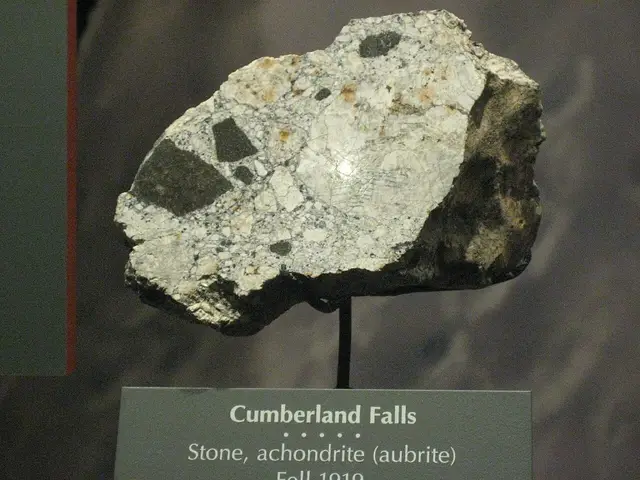
Achondrite
Stony meteorites with no chondrules: rock from melted asteroids, the Moon and Mars, and hard to recognise because they look like Earth rocks.
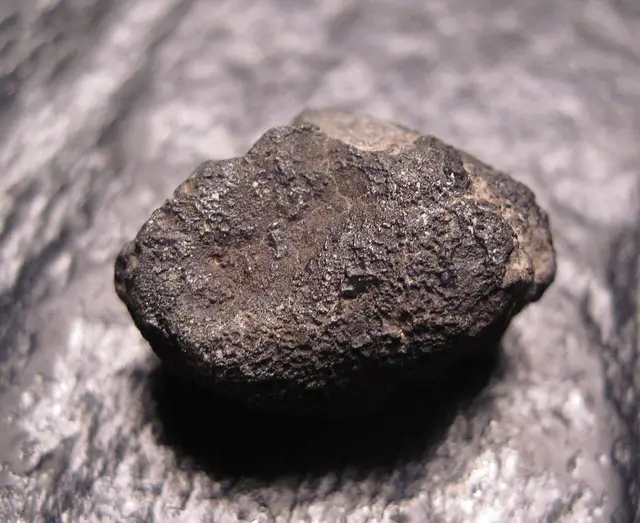
Allende meteorite
The most studied meteorite in history: the largest carbonaceous chondrite, which fell in Mexico in 1969 carrying the first solids of the Solar System.
Amber
Tree resin fossilised over millions of years: a light, warm organic gem that sometimes holds prehistoric insects.