Meteorite
Hexahedrite
Heksahedrit
Nickel-poor iron meteorites made almost wholly of kamacite: etched, they show no bands but fine Neumann lines, traces of ancient impacts.
- Popularly: Meteorite

In short
Hexahedrites are a structural class of iron meteorites. They consist almost entirely of the nickel-poor iron–nickel alloy kamacite and contain less nickel than octahedrites: always below 5.8 per cent. The name comes from the cubic (hexahedral) structure of the kamacite crystal. When etched with acid they show no Widmanstätten pattern, but often show fine parallel lines called Neumann lines.
Photos

How does it form?
At high temperature, iron and nickel form a single alloy called taenite. During cooling, nickel-poor kamacite separates out of the taenite; the lower the nickel content, the more kamacite forms. Hexahedrites are so low in nickel that the metal turns almost entirely into kamacite, and no bands of kamacite and taenite form as in octahedrites.
Most hexahedrites belong to the IIAB chemical group. IIAB irons have the lowest nickel contents of all iron meteorite groups (5.3–6.6 per cent). Of the two clusters merged to form the group, the more nickel-poor IIA forms hexahedrites and IIB forms octahedrites. IIAB irons come from the sulphur- and phosphorus-rich metal core of a parent body that was later destroyed. The IIG group also includes hexahedrites.
When the kamacite crystal is deformed by a shock, this shows up on an etched surface as Neumann lines; the shock is thought to come from impacts on the parent body.
What is it used for?
- Asteroid cores: Hexahedrites help us understand how nickel-poor, sulphur- and phosphorus-rich metal cores crystallised.
- Impact history: Neumann lines record the impacts the parent body went through.
- History of science: The Braunau fall is an early, well-documented fall, thanks to Carl Christian Beinert’s report, which recorded eyewitness interviews and the recovery of each mass in detail.
The Braunau meteorite
The Braunau meteorite fell in two pieces on 14 July 1847 near Broumov (German Braunau), in what is now Czechia. The larger mass, about 23.6 kg, came down at Hejtmánkovice (Hauptmannsdorf); the smaller, about 17.1 kg, near a brick kiln between Broumov and Křinice. Neumann lines were first observed in this meteorite in 1848.
What determines its value?
Hexahedrites are a less common structural class of iron meteorite. A piece's value depends on its mass, its state of preservation, how well Neumann lines show on an etched face, and whether it belongs to a historic fall such as Braunau.
This information is educational, not buying, selling or investment advice. Value varies enormously with quality and treatment.
How to recognise it
- 1
Very heavy; the outside weathers to a rusty brown, and a cut surface is steel grey.
- 2
When a cut, polished face is etched with acid, no criss-crossing bands appear; instead, fine parallel lines crossing at various angles (Neumann lines) may show up.
- 3
Only analysis of nickel and of trace elements such as gallium, germanium and iridium can confirm that a piece of iron is a meteorite and which group it belongs to.
Myths and misconceptions
MythThere are sharp boundaries between the structural classes of iron meteorites.
FactThe boundaries are not always sharp. The Ainsworth meteorite, found in Nebraska in 1907, for example, is described both as a “coarsest octahedrite” and as a “granular hexahedrite”. Scientific classification therefore also uses chemical groups based on nickel and trace elements alongside the structural class.
Did you know?
Neumann lines were discovered in 1848 by Johann Georg Neumann, after whom they are named, in a hexahedrite that had fallen the year before near Broumov (Braunau) in today's Czechia.
The Braunau meteorite fell at about 3.45 in the morning on 14 July 1847, rousing villagers with ground-shaking detonations. The larger mass, recovered by Joseph Tepper hours after the fall, was still very warm.
The larger Braunau mass was soon cut up and distributed; the smaller one was kept in the local abbey and eventually reached the Natural History Museum in Prague.
Where is it found?
Loading map…
- Hejtmánkovice and Křinice, near Broumov, Czechia · Historic sourceThe Braunau meteorite, which fell on the morning of 14 July 1847: two masses of about 23.6 and 17.1 kg. Neumann lines were first observed in this meteorite in 1848.
Locations are approximate to protect sites. Red dots mark places in Türkiye. Open in the big map →
Frequently asked questions
What is hexahedrite?
Hexahedrites are a structural class of iron meteorites. They consist almost entirely of the nickel-poor iron–nickel alloy kamacite and contain less nickel than octahedrites: always below 5.8 per cent. The name comes from the cubic (hexahedral) structure of the kamacite crystal. When etched with acid they show no Widmanstätten pattern, but often show fine parallel lines called Neumann lines.
What do Neumann lines show?
They show that the kamacite crystal was deformed by a shock, thought to come from impacts on the meteorite's parent body. They are seen mostly in hexahedrites, but can also appear in octahedrites where the kamacite phase is about 30 micrometres wide.
What is hexahedrite used for?
Asteroid cores: Hexahedrites help us understand how nickel-poor, sulphur- and phosphorus-rich metal cores crystallised. Impact history: Neumann lines record the impacts the parent body went through. History of science: The Braunau fall is an early, well-documented fall, thanks to Carl Christian Beinert's report, which recorded eyewitness interviews and the recovery of each mass in detail.
How hard is hexahedrite?
It has a hardness of 4 on the Mohs scale. A fingernail cannot scratch it, but a steel knife can. Its specific gravity is 7–8 g/cm³.
Where is hexahedrite found?
Its best-known localities: Hejtmánkovice and Křinice, near Broumov, Czechia.
How can you tell if hexahedrite is real?
Very heavy; the outside weathers to a rusty brown, and a cut surface is steel grey. When a cut, polished face is etched with acid, no criss-crossing bands appear; instead, fine parallel lines crossing at various angles (Neumann lines) may show up. Only analysis of nickel and of trace elements such as gallium, germanium and iridium can confirm that a piece of iron is a meteorite and which group it belongs to.
Is hexahedrite valuable?
On the “street to diamond” value ladder it sits on step 5 of nine: Ornamental stone. Hexahedrites are a less common structural class of iron meteorite. A piece's value depends on its mass, its state of preservation, how well Neumann lines show on an etched face, and whether it belongs to a historic fall such as Braunau.
Sources
- Hexahedrite · Wikipedia
- Neumann lines · Wikipedia
- IIAB meteorites · Wikipedia
- Braunau, IIAB · Meteorite Gallery
- Ainsworth meteorite, pattern.jpg (photo and description by James St. John, Field Museum) · Wikimedia Commons
- Broumov · Wikipedia
- Kamacite Mineral Data · Webmineral.com
- Density and specific gravity (R. L. Korotev) · Washington University in St. Louis, Some Meteorite Information

External links
Draft: awaiting expert reviewReport an error
On the same step
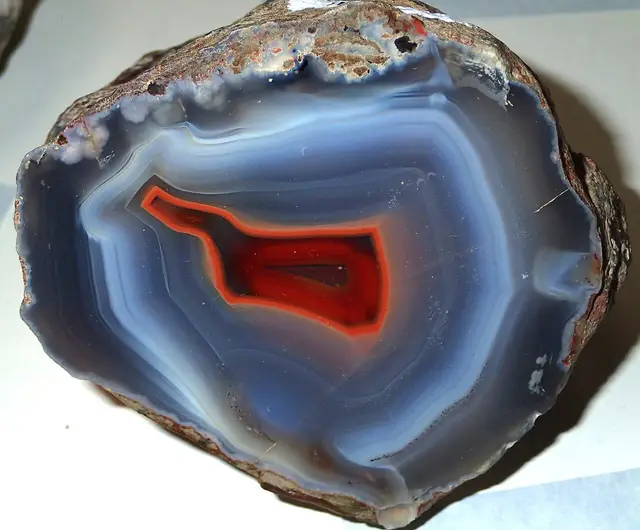
Agate
The banded variety of chalcedony: it grows layer by layer in hollows in volcanic rock and shows a new pattern every time it is cut.

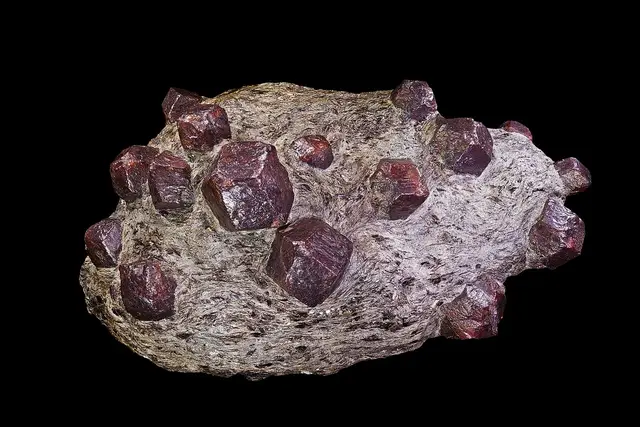
Almandine
The commonest garnet: a deep red, iron-rich stone named after the ancient city of Alabanda in Anatolia, used in jewellery and in sandpaper alike.
Amazonite
A turquoise-like green-blue feldspar: a variety of microcline worn as jewellery for more than three thousand years, but it can release lead.