VarietyA variety of Muscovite
Fuchsite
K(Al,Cr)₂(AlSi₃O₁₀)(OH)₂Fuksit
The green, chromium-bearing variety of muscovite mica: it colours green aventurine, makes up verdite and surrounds the rubies in “ruby in fuchsite”.
Also known as: Chrome mica · Chromian muscovite
- Popularly: Semi-precious stone
In short
Fuchsite is the chromium-rich, green variety of muscovite, the common white mica. Chromium takes the place of some of the aluminium in the crystal structure, and the more chromium there is, the deeper the colour, from pale green to emerald green. It is a soft mineral that splits into thin, flexible sheets. It is rarely cut on its own, but it is the reason behind the sparkle of green aventurine, the South African carving stone verdite and India’s “ruby in fuchsite”.
Photos
How does it form?
Fuchsite forms in rocks transformed by heat and pressure deep in the Earth’s crust. It is most common in metamorphic rocks such as phyllite and schist that were altered at relatively low temperatures (the conditions known as the greenschist facies). If chromium is present while muscovite crystals grow, the chromium enters the crystal structure in place of aluminium and the mica turns green.
Fuchsite often forms when hot fluids alter the surrounding rock (hydrothermal alteration). In the old gold districts of Canada, chrome mica was studied in detail in 1946 and found to be common in iron-rich carbonate alteration zones near faults and alongside gold-bearing quartz veins. According to that study, some of the chromium may locally come from chromium-rich rocks such as serpentinite, but in most cases it appears to have been carried by hot fluids rising from cooling magmas at depth. When serpentinites are altered, they can turn into a carbonate-and-quartz rock called listwaenite, which may contain flakes of fuchsite. Fuchsite is also found in schists together with corundum (ruby), biotite and kyanite, as in India.
What is it used for?
- Green aventurine: Flakes of fuchsite scattered through quartz give green aventurine, widely sold as cabochons and tumbled stones, its colour and sparkle.
- Verdite carving: Verdite, made mostly of fuchsite, is quarried as a carving stone in South Africa, Eswatini and Zimbabwe; it is soft and even-textured, which suits sculpture. It has also been used for decorative mouldings and wall tiles in London’s Bank of England and South Africa House.
- Ruby in fuchsite: In southern India, ruby crystals set in green fuchsite are made into spheres, cabochons and ornaments.
- Ornamental and cladding stone: In Brazil, green fuchsite quartzite has been studied as an ornamental stone suitable for interior and exterior cladding, crafts and jewellery.
- Pigment: In the past it was used as a green pigment in painting.
Where does the green come from?
Muscovite is normally colourless or silvery white. In fuchsite, trivalent chromium replaces some of the aluminium atoms in the crystal structure. With little chromium the colour is pale green; with a lot it is a deep emerald green. The 1946 study also found that fuchsite bends light more strongly as its chromium content rises.
In Türkiye
A scientific study of the ophiolite rocks of the Gevaş district of Van identified fuchsite among the primary minerals of the listwaenites formed by the alteration of serpentinites. In these rocks fuchsite occurs with minerals such as dolomite, quartz, chalcedony and chromite.
What determines its value?
Fuchsite is an inexpensive ornamental and collector’s stone. Its value depends mostly on how vivid the colour is (a deep emerald green is the most sought after) and how much it sparkles. Because it is very soft and crumbles easily, pieces for jewellery are often backed or stabilised before they are worked. In ruby in fuchsite, the size and colour of the ruby crystals and their contrast with the green matrix matter; in collector’s specimens, well-formed crystals with large sheets are what count.
This information is educational, not buying, selling or investment advice. Value varies enormously with quality and treatment.
How to recognise it
- 1
Like other micas, it splits into thin sheets; the sheets are flexible and elastic, springing back when bent.
- 2
It is soft (Mohs 2–3): a steel knife scratches it easily, and even a fingernail can leave a mark.
- 3
Its colour ranges from light green to emerald green, and it glitters in the light with a lustre between pearly and glassy.
- 4
In quartz-rich rocks it shows up as small green flakes that catch the light; larger pieces form leafy stacks that look like the pages of a book.
Myths and misconceptions
MythFuchsite is a mineral species of its own.
FactFuchsite is a chromium-bearing variety of muscovite. X-ray studies have shown that its structure is the same as that of muscovite, and a study published in 1946 therefore recommended the name “chromian muscovite”.
MythRuby in fuchsite and ruby in zoisite are the same stone.
FactThey are different and often confused. Fuchsite is very soft (2–3) and a knife scratches it, while zoisite is harder than 6. In ruby in fuchsite the rubies often have a bluish rim; ruby in zoisite contains black hornblende crystals.
MythVerdite is a kind of “African jade”.
FactVerdite is a green metamorphic rock coloured by abundant fuchsite and is sometimes sold as “African jade”; but it is not jadeite or nephrite, the minerals that make up jade, and it is much softer than they are (3–4).
Did you know?
It is named after the German chemist and mineralogist Johann Nepomuk von Fuchs (1774–1856); the original fuchsite was described from Schwarzenstein in Austria’s Ziller valley. According to Geology.com, it is one of the most commonly misspelled mineral names, often written as “fuschite”.
Fuchsite contains roughly 1 to 5 percent chromium; that small amount is enough to turn colourless muscovite bright green.
According to the German Wikipedia, fuchsite was used as a green pigment in painting and is known from its use in Indigenous art objects from Guatemala.
Where is it found?
Loading map…
- Schwarzenstein, Zemmgrund, Zillertal, Tyrol, Austria · Type localitySource of the original fuchsite; Schafhäutl's analysis found more than 5% chromium oxide
- Barberton, Mpumalanga, South Africa · Major depositArchean verdite, made mostly of fuchsite and used for carving
- Madikeri, Kodagu, Karnataka, India · Major depositRubies occur in corundum–fuchsite–mica schists
- Lajes, Rio Grande do Norte, Brazil · Known localityEmerald-green fuchsite quartzite studied as an ornamental stone
- Porcupine gold district, Timmins, Ontario, Canada · Known localityChrome mica with gold-bearing quartz veins and ankerite alteration zones
- Pointe du Bois, Manitoba, Canada · Known localityFuchsite schist used for a chemical analysis published in 1946
- Gevaş, Van, Türkiye · Known localityOne of the primary minerals of the listwaenites in the Gevaş ophiolite
Locations are approximate to protect sites. Red dots mark places in Türkiye. Open in the big map →
Frequently asked questions
What is fuchsite?
Fuchsite is the chromium-rich, green variety of muscovite, the common white mica. Chromium takes the place of some of the aluminium in the crystal structure, and the more chromium there is, the deeper the colour, from pale green to emerald green. It is a soft mineral that splits into thin, flexible sheets. It is rarely cut on its own, but it is the reason behind the sparkle of green aventurine, the South African carving stone verdite and India’s “ruby in fuchsite”.
Are green aventurine and fuchsite the same stone?
No. Green aventurine is a quartz stone; tiny flakes of fuchsite scattered through it give it its green colour and its glittering look. In other words, fuchsite is the mineral inside aventurine that provides the colour.
What is fuchsite used for?
Green aventurine: Flakes of fuchsite scattered through quartz give green aventurine, widely sold as cabochons and tumbled stones, its colour and sparkle. Verdite carving: Verdite, made mostly of fuchsite, is quarried as a carving stone in South Africa, Eswatini and Zimbabwe; it is soft and even-textured, which suits sculpture. It has also been used for decorative mouldings and wall tiles in London’s Bank of England and South Africa House. Ruby in fuchsite: In southern India, ruby crystals set in green fuchsite are made into spheres, cabochons and ornaments.
How hard is fuchsite?
It has a hardness of 2–3 on the Mohs scale. A fingernail cannot scratch it, but a steel knife can. Its specific gravity is 2.8–2.9 g/cm³.
Where is fuchsite found?
Its best-known localities: Schwarzenstein, Zemmgrund, Zillertal, Tyrol, Austria; Barberton, Mpumalanga, South Africa; Madikeri, Kodagu, Karnataka, India; Lajes, Rio Grande do Norte, Brazil; Porcupine gold district, Timmins, Ontario, Canada.
Where is fuchsite found in Türkiye?
Known localities in Türkiye: Gevaş, Van, Türkiye.
How can you tell if fuchsite is real?
Like other micas, it splits into thin sheets; the sheets are flexible and elastic, springing back when bent. It is soft (Mohs 2–3): a steel knife scratches it easily, and even a fingernail can leave a mark. Its colour ranges from light green to emerald green, and it glitters in the light with a lustre between pearly and glassy.
Is fuchsite valuable?
On the “street to diamond” value ladder it sits on step 5 of nine: Ornamental stone. Fuchsite is an inexpensive ornamental and collector’s stone. Its value depends mostly on how vivid the colour is (a deep emerald green is the most sought after) and how much it sparkles. Because it is very soft and crumbles easily, pieces for jewellery are often backed or stabilised before they are worked. In ruby in fuchsite, the size and colour of the ruby crystals and their contrast with the green matrix matter; in collector’s specimens, well-formed crystals with large sheets are what count.
Family


Sources
- Fuchsite · Wikipedia
- Fuchsite · Geology.com
- Verdite · Geology.com
- Fuchsite, the green variety of muscovite · Amethyst Galleries (galleries.com)
- Chrome micas (Whitmore, Berry & Hawley), American Mineralogist 31 (1–2): 1–21 · Mineralogical Society of America, 1946
- Muskovit · Wikipedia (de)
- Aventurine · Wikipedia
- Indian ruby mining, Gems & Gemology 50(1), Gem News International · GIA, 2014
- Considerações tecnológicas e avaliação de reservas da ocorrência de quartzito ornamental (Verde Esmeralda) na região de Lajes-RN (Cavalcanti, Menor & Souza), Estudos Geológicos 19(1) · Universidade Federal de Pernambuco, 2009
- Geology and geochemical characteristics of Gevaş listwaenites (Van-Turkey) (A. R. Çolakoğlu), Yerbilimleri 30(1): 59–81 · Hacettepe Üniversitesi, 2009
External links
Draft: awaiting expert reviewReport an error
On the same step
Agate
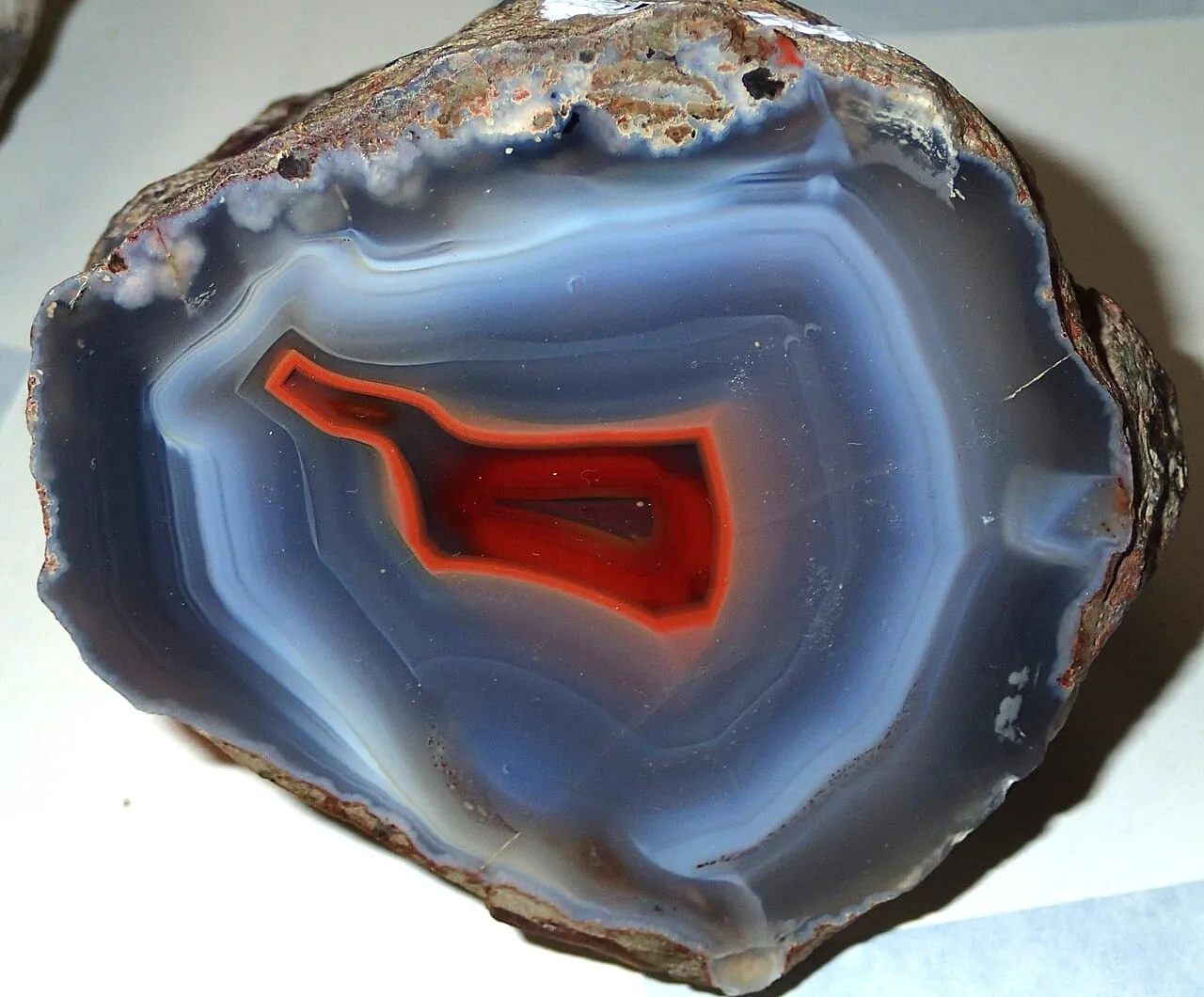
The banded variety of chalcedony: it grows layer by layer in hollows in volcanic rock and shows a new pattern every time it is cut.

Almandine
The commonest garnet: a deep red, iron-rich stone named after the ancient city of Alabanda in Anatolia, used in jewellery and in sandpaper alike.
Amazonite
A turquoise-like green-blue feldspar: a variety of microcline worn as jewellery for more than three thousand years, but it can release lead.