Meteorite
Enstatite chondrite
Enstatit kondrit
The most oxygen-starved rocks in the Solar System: rare chondrites with Earth- and Moon-like isotopes that may have brought water to Earth.
Also known as: E chondrite · E-type chondrite · EH chondrite · EL chondrite
- Popularly: Meteorite

In short
Enstatite chondrites are a rare kind of stony meteorite rich in the mineral enstatite: with about 200 known, they make up only about 2% of the chondrites that fall on Earth. They are among the most chemically reduced, that is oxygen-poor, rocks known; nearly all their iron is metal or sulfide. By iron content they are split into EH (high iron) and EL (low iron). Their oxygen isotopic compositions are similar to rocks from the Earth and the Moon.
Photos

How does it form?
Enstatite chondrites formed in a very oxygen-poor part of the cloud of gas and dust that gave birth to the Sun, probably very close to the Sun, inside the orbit of Mercury. That is why their minerals hold almost no iron oxide; the iron is present as metal or sulfide. They contain minerals that form only under highly reducing conditions, such as oldhamite (CaS) and niningerite (MgS).
Most enstatite chondrites were metamorphosed by heating on their parent asteroids. Spectral studies have suggested that the asteroid 16 Psyche may be their common parent, and the largest E-type chondrite body in the asteroid belt may be 21 Lutetia, about 100 kilometres across.
What is it used for?
- Earth’s building blocks: Because their isotopes resemble Earth’s, they are studied to understand the material our planet formed from.
- Source of water: Their hydrogen matters in debates on the origin of Earth’s water.
- Rare minerals: Their sulfide and silicide minerals, formed without oxygen, are unique examples for mineralogy.
Famous enstatite chondrites
Abee (EH4, 1952, Canada) is the largest recorded enstatite chondrite fall; a large piece is on display at the Royal Ontario Museum. Neuschwanstein (EL6, 2002, Germany) was among the first meteorites tracked by fireball networks and then recovered.
What determines its value?
Being rare, enstatite chondrites are more sought after than ordinary chondrites. A piece's value depends on its mass, freshness, whether it is EH or EL, and whether it belongs to a famous fall such as Abee or Neuschwanstein.
This information is educational, not buying, selling or investment advice. Value varies enormously with quality and treatment.
How to recognise it
- 1
A black fusion crust outside; grey inside, with abundant shiny metal and sulfide grains.
- 2
Its chondrules are rich in enstatite, and the dusty matrix between them is scarce.
- 3
Because of its unusual sulfide minerals and metal, only laboratory analysis can confirm it is an enstatite chondrite.
Myths and misconceptions
MythRocks formed close to Earth are dry; Earth's water must have come only from distant comets.
FactEnstatite chondrites were long thought to be the driest objects in the Solar System, but a study showed they hold enough hydrogen to have delivered at least three times the mass of Earth's ocean water.
Did you know?
The largest known enstatite chondrite fall happened at Abee, Alberta, Canada, in 1952: the 107-kilogram stone made a pit 1.5 metres deep in a wheat field.
They were long thought to be the driest objects in the Solar System, but a study showed they hold enough hydrogen to have delivered to Earth at least three times the mass of water in its oceans.
The Neuschwanstein meteorite, which fell in Germany in 2002, was the first German meteorite tracked by the cameras of the European Fireball Network and recovered; it is an EL6 enstatite chondrite.
Where is it found?
Loading map…
- Abee, Alberta, Canada · Known localityA 107 kg EH4 chondrite that fell in a wheat field in 1952; the largest recorded enstatite chondrite fall, it made a pit 1.5 m deep.
- Near Neuschwanstein Castle, Bavaria, Germany · Known localityAn EL6 chondrite that fell on 6 April 2002; the first German meteorite tracked by the cameras of the European Fireball Network, its path calculated and pieces recovered.
Locations are approximate to protect sites. Red dots mark places in Türkiye. Open in the big map →
Frequently asked questions
What is enstatite chondrite?
Enstatite chondrites are a rare kind of stony meteorite rich in the mineral enstatite: with about 200 known, they make up only about 2% of the chondrites that fall on Earth. They are among the most chemically reduced, that is oxygen-poor, rocks known; nearly all their iron is metal or sulfide. By iron content they are split into EH (high iron) and EL (low iron). Their oxygen isotopic compositions are similar to rocks from the Earth and the Moon.
Why are enstatite chondrites important for Earth?
Their oxygen isotopic compositions resemble Earth and Moon rocks, and their extreme lack of oxygen suggests they formed very close to the Sun, perhaps inside the orbit of Mercury. So they may resemble the material that built the Earth. Their hydrogen also suggests that some of Earth's water may have come from such material.
What is enstatite chondrite used for?
Earth's building blocks: Because their isotopes resemble Earth's, they are studied to understand the material our planet formed from. Source of water: Their hydrogen matters in debates on the origin of Earth's water. Rare minerals: Their sulfide and silicide minerals, formed without oxygen, are unique examples for mineralogy.
How hard is enstatite chondrite?
It has a hardness of 4–6 on the Mohs scale. It can scratch glass; a steel knife scratches it only with difficulty. Its specific gravity is 3.45–3.74 g/cm³.
Where is enstatite chondrite found?
Its best-known localities: Abee, Alberta, Canada; Near Neuschwanstein Castle, Bavaria, Germany.
How can you tell if enstatite chondrite is real?
A black fusion crust outside; grey inside, with abundant shiny metal and sulfide grains. Its chondrules are rich in enstatite, and the dusty matrix between them is scarce. Because of its unusual sulfide minerals and metal, only laboratory analysis can confirm it is an enstatite chondrite.
Is enstatite chondrite valuable?
On the “street to diamond” value ladder it sits on step 6 of nine: Fine ornamental and collector stone. Being rare, enstatite chondrites are more sought after than ordinary chondrites. A piece's value depends on its mass, freshness, whether it is EH or EL, and whether it belongs to a famous fall such as Abee or Neuschwanstein.
Sources
- Enstatite chondrite · Wikipedia
- Neuschwanstein (meteorite) · Wikipedia
- Abee · Wikipedia
- Meteorite porosities and densities: a review of trends in the data (D. T. Britt & G. J. Consolmagno), Lunar and Planetary Science XXXV, abstract 2108 · Lunar and Planetary Institute, 2004
- Handbook of Mineralogy: Enstatite · Mineralogical Society of America
- Kamacite Mineral Data · Webmineral.com
External links
Draft: awaiting expert reviewReport an error
On the same step
Achondrite
Stony meteorites with no chondrules: rock from melted asteroids, the Moon and Mars, and hard to recognise because they look like Earth rocks.
Allende meteorite
The most studied meteorite in history: the largest carbonaceous chondrite, which fell in Mexico in 1969 carrying the first solids of the Solar System.
Amber
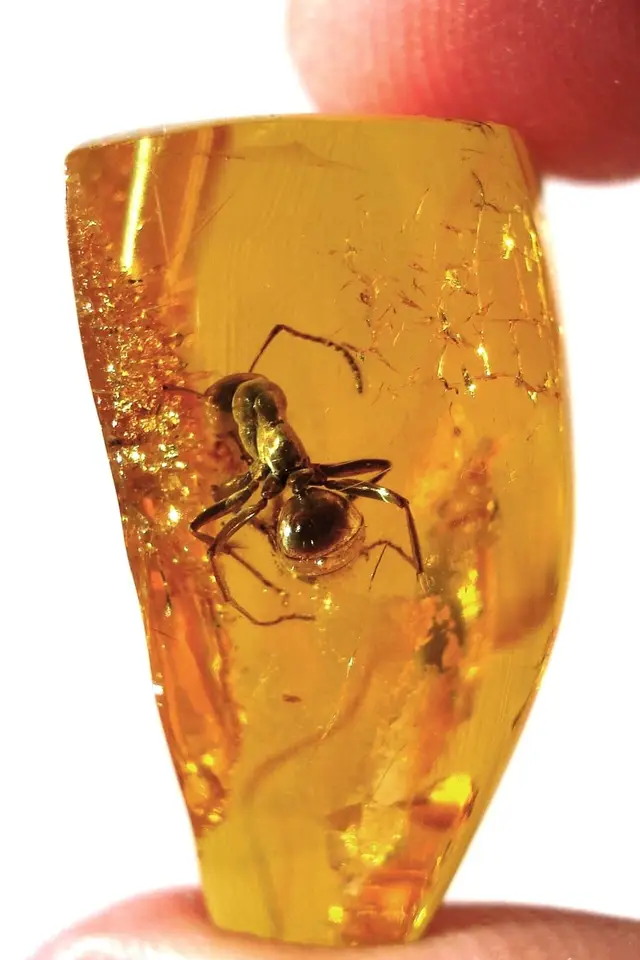
Tree resin fossilised over millions of years: a light, warm organic gem that sometimes holds prehistoric insects.