Meteorite
CM chondrite
CM kondrit
The commonest carbonaceous chondrites: dark, water-altered stones rich in organic matter, Murchison among them.
Also known as: Mighei-type carbonaceous chondrite · C2M chondrite
- Popularly: Meteorite

In short
CM chondrites are carbonaceous chondrites that resemble their type specimen, the Mighei meteorite (Ukraine, 1889). They are the most commonly recovered group of carbonaceous chondrites, though still far rarer than ordinary chondrites. Nearly all are petrologic type 2: they were altered by water on their parent body, and some of their chondrules dissolved. They are rich in carbon and organic matter; the Murchison meteorite, famous for its amino acids, is a CM chondrite.
Photos

How does it form?
CM chondrites come from an asteroid rich in carbon and volatiles that formed at the start of the Solar System. On their parent body, liquid water altered the rock: part of the chondrules, the olivine and pyroxene grains and the metal turned into water-bearing matrix minerals. The degree of alteration varies from specimen to specimen, so subtypes from CM2.0 (more altered, CI-like) to CM2.9 (little altered, CO-like) have been proposed.
CM chondrites most resemble the CI and CO chondrites; all three carry anomalous titanium-50 and chromium-54 isotopes. Most are porous breccias, broken and rejoined by collisions.
What is it used for?
- Water and organic matter: They are studied to understand the history of water and organic compounds on asteroids.
- Building blocks of life: Amino acids, sugars and nucleobases have been found in CM chondrites such as Murchison.
Famous CM chondrites
Murchison (Australia, 1969) is among the most studied meteorites. Murray (Kentucky, 1950) exploded and broke up more than 45 kilometres up. Winchcombe (England, 2021) is a fall quickly recovered after a public appeal. Mighei, which gave the group its name, fell in Ukraine in 1889.
What determines its value?
Being far rarer than ordinary chondrites, CM chondrites are more sought after. A piece's value depends on its mass, freshness, whether it belongs to a famous fall (such as Murchison, Murray or Winchcombe) and its documented origin. Their scientific value comes from the water and organic matter they hold.
This information is educational, not buying, selling or investment advice. Value varies enormously with quality and treatment.
How to recognise it
- 1
A black fusion crust outside; dark grey to black inside.
- 2
Small light-coloured chondrules and inclusions can be seen in the dark, porous matrix.
- 3
Their density is low (about 2.1 g/cm³), clearly lighter than an ordinary chondrite of the same size.
Myths and misconceptions
MythMeteorites stay unchanged for years after they fall.
FactWater-rich, porous meteorites such as CM chondrites can alter quickly in Earth's damp environment. That is why a public appeal was made to recover the Winchcombe fragments quickly, before they degraded.
Did you know?
The 2000 edition of the Catalogue of Meteorites listed 15 CM falls and 146 CM finds; for the next group, CO, the figures were 5 and 80.
The Winchcombe meteorite, which fell in England in 2021, was recovered within days, before it degraded, thanks to a public appeal.
Researchers have described CM matrix as “spongy”; because it long resisted identification, it was called the “poorly characterized phase” (PCP).
Where is it found?
Loading map…
- Murchison, Victoria, Australia · Major depositA CM2 chondrite that fell in 1969, with over 100 kg recovered, famous for its amino acids; one of the most studied meteorites.
- Murray, Kentucky, USA · Known localityA CM2 chondrite that exploded more than 45 km above western Kentucky early on 20 September 1950; 12.6 kg in total.
- Winchcombe, Gloucestershire, England · Known localityA CM2 chondrite seen as a green fireball on 28 February 2021; thanks to a public appeal, the pieces were recovered quickly, before they degraded.
Locations are approximate to protect sites. Red dots mark places in Türkiye. Open in the big map →
Frequently asked questions
What is cM chondrite?
CM chondrites are carbonaceous chondrites that resemble their type specimen, the Mighei meteorite (Ukraine, 1889). They are the most commonly recovered group of carbonaceous chondrites, though still far rarer than ordinary chondrites. Nearly all are petrologic type 2: they were altered by water on their parent body, and some of their chondrules dissolved. They are rich in carbon and organic matter; the Murchison meteorite, famous for its amino acids, is a CM chondrite.
Why do CM chondrites have few chondrules?
On their parent body, liquid water dissolved some of the chondrules and of the olivine, pyroxene and metal grains, or turned them into matrix minerals. Small chondrules may have vanished entirely while large ones partly survived, which is why the remaining chondrules are often ringed by altered material.
What is cM chondrite used for?
Water and organic matter: They are studied to understand the history of water and organic compounds on asteroids. Building blocks of life: Amino acids, sugars and nucleobases have been found in CM chondrites such as Murchison.
How hard is cM chondrite?
It has a hardness of 2.5–7 on the Mohs scale. It can scratch glass; a steel knife scratches it only with difficulty. Its specific gravity is 1.86–2.38 g/cm³.
Where is cM chondrite found?
Its best-known localities: Murchison, Victoria, Australia; Murray, Kentucky, USA; Winchcombe, Gloucestershire, England.
How can you tell if cM chondrite is real?
A black fusion crust outside; dark grey to black inside. Small light-coloured chondrules and inclusions can be seen in the dark, porous matrix. Their density is low (about 2.1 g/cm³), clearly lighter than an ordinary chondrite of the same size.
Is cM chondrite valuable?
On the “street to diamond” value ladder it sits on step 6 of nine: Fine ornamental and collector stone. Being far rarer than ordinary chondrites, CM chondrites are more sought after. A piece's value depends on its mass, freshness, whether it belongs to a famous fall (such as Murchison, Murray or Winchcombe) and its documented origin. Their scientific value comes from the water and organic matter they hold.
Sources
- CM chondrite · Wikipedia
- Murchison meteorite · Wikipedia
- Murray meteorite · Wikipedia
- Winchcombe meteorite · Wikipedia
- Meteorite porosities and densities: a review of trends in the data (D. T. Britt & G. J. Consolmagno), Lunar and Planetary Science XXXV, abstract 2108 · Lunar and Planetary Institute, 2004
- Handbook of Mineralogy: Forsterite · Mineralogical Society of America
External links
Draft: awaiting expert reviewReport an error
On the same step
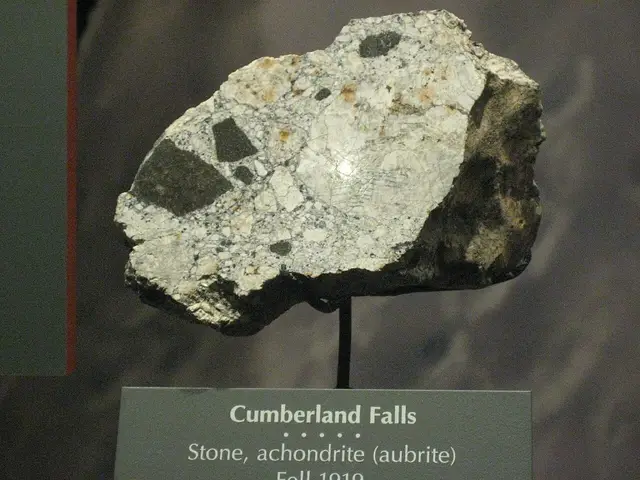
Achondrite
Stony meteorites with no chondrules: rock from melted asteroids, the Moon and Mars, and hard to recognise because they look like Earth rocks.
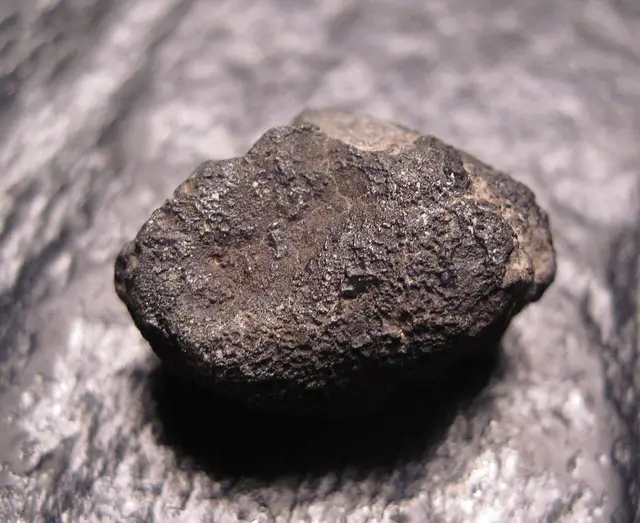
Allende meteorite
The most studied meteorite in history: the largest carbonaceous chondrite, which fell in Mexico in 1969 carrying the first solids of the Solar System.
Amber
Tree resin fossilised over millions of years: a light, warm organic gem that sometimes holds prehistoric insects.