Rock
Carbonatite
Karbonatit
A rare rock that looks like marble but is born from magma: one of the chief sources of rare earth elements and niobium.
- Popularly: Ore and raw material
- Ore
- Industrial
- Important in Türkiye

In short
Carbonatite is a rare igneous rock made not of silicates but of carbonate minerals, mostly calcite. It crystallises from a carbonate-rich magma that comes from the mantle, and most occurrences lie in continental rifts together with alkaline rocks. At first sight it looks like marble, but it is not metamorphosed limestone as marble is. A large part of the world's niobium and rare earth elements comes from carbonatites. In Türkiye it occurs in the Kızılcaören complex in Eskişehir.
Photos

How does it form?
Carbonatites come from a carbonate-rich magma formed by partial melting of rock in the mantle. They lie mostly in continental rift zones, where continents are splitting apart, and are usually found with alkaline rocks, that is, igneous rocks poor in silica and rich in sodium and potassium (such as phonolite and syenite). They cool slowly at depth and form coarse-grained masses, dikes and ring-shaped intrusions. Very rarely they reach the surface as lava: of about 527 known carbonatite occurrences, only 49 are extrusive (volcanic).
The main carbonate mineral of carbonatite magma is calcite. The coarse-grained, calcite-rich kind is called sövite and the fine-grained kind alvikite. That is why carbonatites are sometimes called “igneous limestones”.
What is it used for?
- Rare earth elements: Some carbonatites, such as Mountain Pass in the USA, are major deposits from which rare earth elements are won from the mineral bastnäsite. For more, see the bastnäsite page.
- Niobium: According to the US Geological Survey (USGS), most of the world’s known niobium resources are in the mineral pyrochlore in carbonatites. Thanks to carbonatite complexes such as Araxá, Brazil supplies about 93% of world production. Niobium is added to high-strength steels and superalloys.
- Phosphate and copper: Carbonatite complexes such as Phalaborwa in South Africa yield phosphate from apatite, and copper.
- Science: Carbonatites are studied to learn how carbon and rare elements are carried from the mantle to the surface.
Carbonatite in Türkiye
Türkiye’s best-known carbonatite occurrence is the Kızılcaören complex in the Beylikova district of Eskişehir. According to the 2014 study by Nikiforov and colleagues, the complex formed in three stages: first stocks of phonolite and trachyte, then carbonatite and carbonate-silicate dike-like bodies, and finally fluorite-baryte-bastnäsite ore in cracks and breccias. The silicate rocks and carbonatites formed at the end of the Oligocene, about 25-24 million years ago. The ore is thought to have formed after this igneous stage, from hot fluids. The veins at Kızılcaören make up Türkiye’s main rare earth deposit; for the claims made about the size of the deposit, see the bastnäsite page.
What determines its value?
Carbonatite itself is not sought as a decorative or building stone; its value depends on the ore in it. The grade (proportion in the rock) of rare earth elements, niobium (in the mineral pyrochlore), phosphate (in apatite), copper and iron, the size of the deposit, how easy the ore is to concentrate, the cost of mining and the market demand decide. Radioactive elements such as thorium and uranium in the same rock also affect mining and waste management.
This information is educational, not buying, selling or investment advice. Value varies enormously with quality and treatment.
How to recognise it
- 1
It is a coarse-grained rock of white, grey or beige calcite crystals that looks very much like marble or limestone.
- 2
It differs from marble in containing scattered igneous minerals such as black magnetite, green olivine, flakes of mica or apatite, and in often occurring with alkaline rocks such as syenite and phonolite.
- 3
The calcite-rich kinds fizz in dilute acid, like marble and limestone, so an acid test cannot tell them apart.
- 4
A firm identification needs chemical analysis and a study of the minerals.
Fakes and imitations
What shops usually don’t tell you:
- Marble and limestone look very like carbonatite; they are sedimentary or metamorphic rocks and usually contain no igneous minerals. Geochemical analysis is used to tell carbonatite from them.
Myths and misconceptions
MythCarbonatite is just another name for marble or limestone.
FactCarbonatite can resemble marble, but marble is metamorphosed limestone, while carbonatite is an igneous rock that crystallised from a carbonate magma coming from the mantle. Geochemical analysis is needed to tell them apart.
MythLava is always a glowing red stream at over 1,000 °C.
FactThe carbonatite lava of Ol Doinyo Lengai is only about 500-600 °C; in daylight it looks black or brown, and on contact with air it begins to turn white within hours.
Did you know?
Ol Doinyo Lengai in Tanzania is the only known active carbonatite volcano. Its lava erupts at about 500-600 °C, the coolest lava known; black or brown at first, it begins to turn white within hours. The Maasai call the volcano the “Mountain of God”.
The oldest known carbonatite, at Tupertalik in Greenland, is about 3 billion years old, while Ol Doinyo Lengai is still erupting carbonatite today.
The name carbonatite goes back to the descriptions made by the Norwegian geologist W. C. Brøgger in 1921 in the Fen area of Telemark.
Where is it found?
Loading map…
- Ol Doinyo Lengai, Arusha Region, Tanzania · Major depositThe world's only known active carbonatite volcano. Its natrocarbonatite lava erupts at about 500-600 °C, the coolest lava known; the black or brown lava begins to turn white within hours.
- Fen Complex, Telemark, Norway · Type localityThis roughly 3 km-wide circular area is the classic locality of the carbonatite types described by W. C. Brøgger in 1921; the carbonatites formed about 539 million years ago.
- Mountain Pass, California, USA · Major depositA carbonatite about 1.4 billion years old, intruded into gneiss; a major US rare earth mine works bastnäsite ore here.
- Bayan Obo, Inner Mongolia, China · Major depositOne of the world's largest rare earth, iron and niobium deposits. Its origin is still debated; it is often described as carbonatite-related, but there is no full agreement among scientists.
- Phalaborwa, Limpopo, South Africa · Major depositAn igneous complex with a carbonatite about 2.06 billion years old; copper, phosphate and magnetite are mined.
- Araxá, Minas Gerais, Brazil · Major depositThe Barreiro alkali-carbonatite complex, about 4.5 km across and intruded about 87 million years ago, is the world's largest niobium deposit; the niobium is in the mineral pyrochlore. Brazil supplies about 93% of world niobium production.
- Kızılcaören, Beylikova, Eskişehir, Türkiye · Known localityCarbonatite and carbonate-silicate dike-like bodies, which followed stocks of phonolite and trachyte, formed here about 25-24 million years ago. The fluorite-baryte-bastnäsite veins of the same complex form Türkiye's main rare earth deposit.
Locations are approximate to protect sites. Red dots mark places in Türkiye. Open in the big map →
Frequently asked questions
What is carbonatite?
Carbonatite is a rare igneous rock made not of silicates but of carbonate minerals, mostly calcite. It crystallises from a carbonate-rich magma that comes from the mantle, and most occurrences lie in continental rifts together with alkaline rocks. At first sight it looks like marble, but it is not metamorphosed limestone as marble is. A large part of the world's niobium and rare earth elements comes from carbonatites. In Türkiye it occurs in the Kızılcaören complex in Eskişehir.
What is carbonatite used for?
Rare earth elements: Some carbonatites, such as Mountain Pass in the USA, are major deposits from which rare earth elements are won from the mineral bastnäsite. For more, see the bastnäsite page. Niobium: According to the US Geological Survey (USGS), most of the world's known niobium resources are in the mineral pyrochlore in carbonatites. Thanks to carbonatite complexes such as Araxá, Brazil supplies about 93% of world production. Niobium is added to high-strength steels and superalloys.
How hard is carbonatite?
It has a hardness of 3–4 on the Mohs scale. A fingernail cannot scratch it, but a steel knife can. Its specific gravity is 2.7–3.2 g/cm³.
Where is carbonatite found?
Its best-known localities: Fen Complex, Telemark, Norway; Ol Doinyo Lengai, Arusha Region, Tanzania; Mountain Pass, California, USA; Bayan Obo, Inner Mongolia, China; Phalaborwa, Limpopo, South Africa.
Where is carbonatite found in Türkiye?
Known localities in Türkiye: Kızılcaören, Beylikova, Eskişehir, Türkiye.
How can you tell if carbonatite is real?
It is a coarse-grained rock of white, grey or beige calcite crystals that looks very much like marble or limestone. It differs from marble in containing scattered igneous minerals such as black magnetite, green olivine, flakes of mica or apatite, and in often occurring with alkaline rocks such as syenite and phonolite. The calcite-rich kinds fizz in dilute acid, like marble and limestone, so an acid test cannot tell them apart. Marble and limestone look very like carbonatite; they are sedimentary or metamorphic rocks and usually contain no igneous minerals. Geochemical analysis is used to tell carbonatite from them.
Is carbonatite valuable?
On the “street to diamond” value ladder it sits on step 4 of nine: Fine dimension stone and ore. Carbonatite itself is not sought as a decorative or building stone; its value depends on the ore in it. The grade (proportion in the rock) of rare earth elements, niobium (in the mineral pyrochlore), phosphate (in apatite), copper and iron, the size of the deposit, how easy the ore is to concentrate, the cost of mining and the market demand decide. Radioactive elements such as thorium and uranium in the same rock also affect mining and waste management.
Sources
- Carbonatite · Wikipedia
- Karbonatit · Vikipedi
- Ol Doinyo Lengai · Wikipedia
- Fen Complex · Wikipedia
- Mountain Pass Rare Earth Mine · Wikipedia
- Bayan Obo Mining District · Wikipedia
- Phalaborwa · Wikipedia
- Araxá · Wikipedia
- Main minerals of the Araxá alkali-carbonatite complex, Minas Gerais State, Brazil · Journal of South American Earth Sciences, 2023
- Palabora Mining Company · Wikipedia
- Mineral Commodity Summaries 2026: Niobium · U.S. Geological Survey, 2026
- Mineral Commodity Summaries 2026: Rare Earths · U.S. Geological Survey, 2026
- Kizilcaoren ore-bearing complex with carbonatites (northwestern Anatolia, Turkey): formation time and mineralogy of rocks (Nikiforov, Öztürk, Altuncu & Lebedev), Geology of Ore Deposits 56(1): 35–60 · Pleiades Publishing, 2014
- Carbonatite from Phalabowra in South Africa (file description by James St. John) · Wikimedia Commons
External links
Draft: awaiting expert reviewReport an error ↗
On the same step
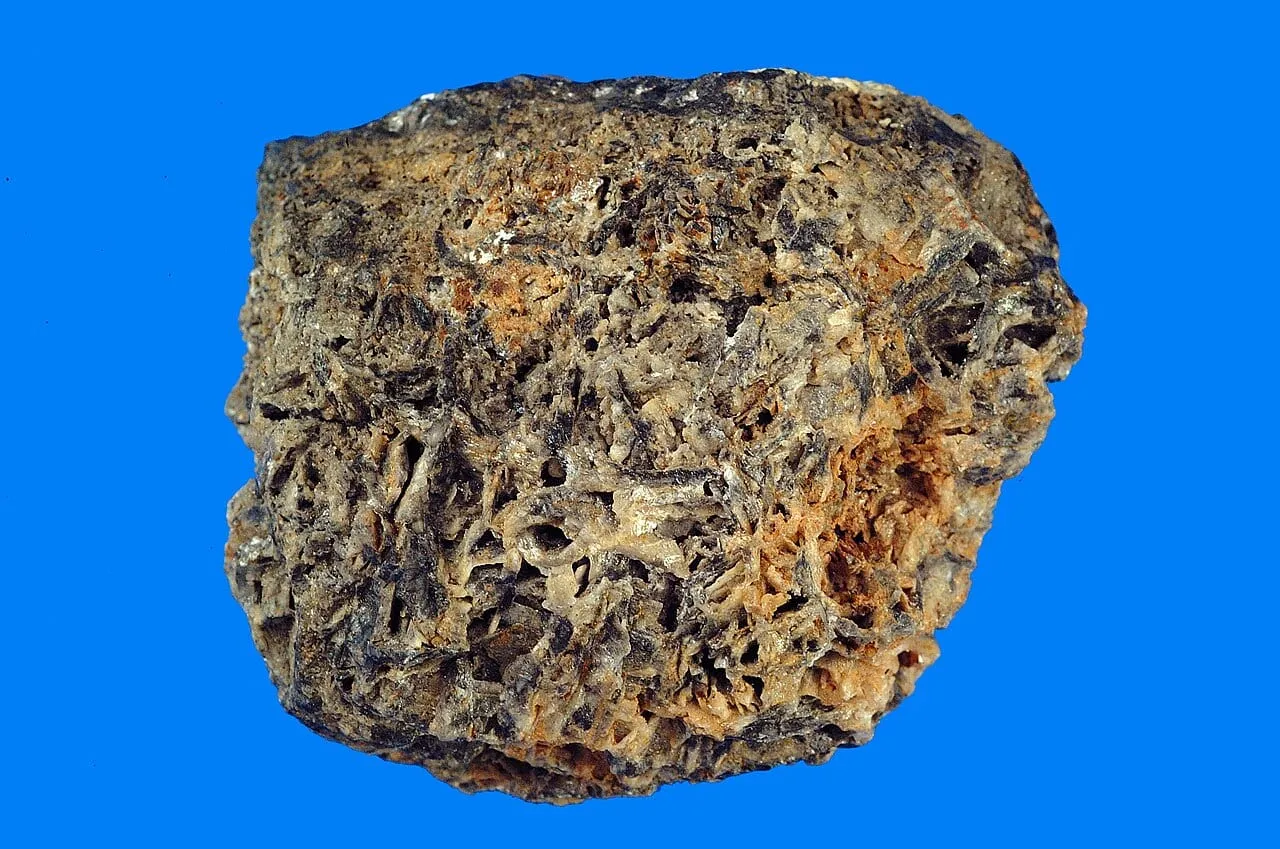
Anglesite
A heavy lead sulfate mineral with a diamond-like shine that grows as a crust around galena; it is named after the island of Anglesey in Wales.
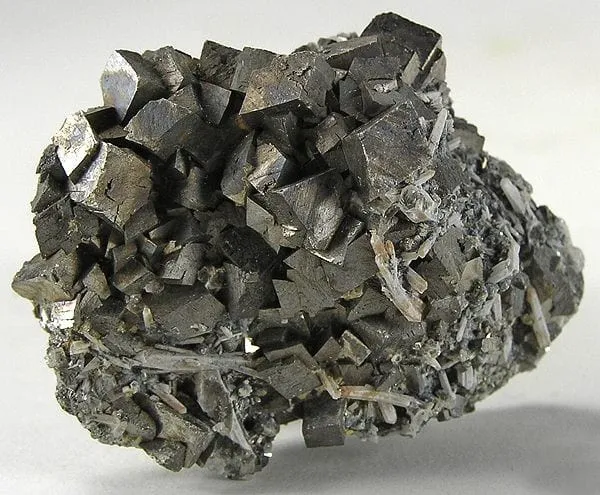
Arsenopyrite
A widespread silvery-grey sulfide containing arsenic: it smells of garlic when struck and is poisonous.
Banded iron formation
An ancient rock of alternating iron-oxide and chert bands: the record of oxygen beginning to build up on Earth, and the main source of iron ore.