Rock
Caen stone
Caen taşı
The cream limestone William the Conqueror shipped from Normandy to England: from the abbeys of Caen to Canterbury Cathedral and the Tower of London.
Also known as: Pierre de Caen · Calcaire de Caen · Caenstone
- Popularly: Natural stone (building and decor)

In short
Caen stone is a fine-grained, pale cream to light yellow limestone quarried around the city of Caen in Normandy, north-western France. It formed about 167 million years ago in a shallow, warm sea. Because it is even-textured and easy to carve, it has been loved for sculpture and decoration since the Middle Ages; after 1066 the Normans shipped it to England for buildings such as Canterbury Cathedral, Westminster Abbey and the Tower of London.
Photos

How does it form?
Caen stone formed in the Middle Jurassic, during the Bathonian stage, about 167 million years ago. Normandy then lay on the edge of a shallow, warm sea; English Wikipedia describes the setting as shallow lagoons, French Wikipedia as shallow marine environments resembling mangrove swamps. Shell fragments, pieces of crinoids (sea lilies) and tiny lime pellets left by sea creatures piled up in these waters and were cemented by fine crystalline calcite and lime mud into stone.
The stone is taken from the upper part of the rock unit geologists call the Calcaire de Caen (Caen Limestone) Formation, and it formed at the same time as England’s Bath stone. The more shell fragments it contains, the harder and paler the stone; softer kinds are yellowish and less resistant to the weather.
What is it used for?
- Roman and medieval Normandy: In Gallo-Roman times it was taken from open quarries for sarcophagi and temple parts. In the 11th century William the Conqueror and his wife Matilda of Flanders built the two great abbeys of Caen, the Abbaye aux Hommes and the Abbaye aux Dames, in it.
- Norman England: After the conquest of 1066 the stone was shipped to England down the River Orne and across the sea. It was used in the cathedrals of Canterbury, Durham, Norwich, Chichester and Rochester, in Westminster Abbey and in the Tower of London.
- Later centuries: In England it was also used in buildings such as Eton College, Hatfield House and Oxford Castle. Southern England began importing it in large amounts again in the 19th century, and in the 19th and 20th centuries it was also used in decoration at Cologne Cathedral, in the Royal Palace of Brussels and in American cathedrals.
- Today: It is used to repair historic buildings and for sculpture and carving. Stone for the facade of the Caen Memorial, the city’s peace museum, came from a quarry reopened in 1986.
Where is it found?
Caen stone is quarried in the Calvados department of Normandy, in and around the city of Caen: the main places are the city’s Vaucelles, Saint-Julien and La Maladrerie districts and Mondeville, Bretteville-sur-Odon, Carpiquet, Fleury-sur-Orne and Cintheaux. Underground quarrying developed in the 19th century, but in the 20th century cheaper stone and concrete undermined the trade, and production stopped in the early 1960s. During the Battle of Caen in the summer of 1944, the underground quarries of Caen, Fleury, Mondeville and Colombelles sheltered local people. Quarrying started again in the 1980s; since 2004 the quarry at Cintheaux has been allowed to produce up to 9,000 tonnes of stone a year.
What determines its value?
As a building and carving stone, its value depends on the paleness and evenness of the colour, whether large, flawless blocks can be extracted, how easily it carves and how well it lasts outdoors. Kinds richer in shell fragments are harder and paler, while softer, yellowish kinds stand up less well to the weather. Because most quarries have closed, finding suitable stone for repairing historic buildings matters, which makes today's production valuable.
This information is educational, not buying, selling or investment advice. Value varies enormously with quality and treatment.
How to recognise it
- 1
Its colour is a plain pale cream or light yellow; freshly cut faces may turn whitish at the surface on exposure to air.
- 2
It is fine-grained and even-textured; up close, small pores and shell fragments can be seen.
- 3
Outdoors it gradually gains a grey coating of algae and fungi; where the coating flakes away, the stone beneath looks creamy and crumbly.
- 4
Being a limestone, it fizzes in dilute acid and is easily scratched by a steel knife.
Fakes and imitations
What shops usually don’t tell you:
- In the 19th century Caen stone was so fashionable that plasters imitating it were made: painted wall plasters called “Caen stone”, such as samples from the administration building at Floyd Bennett Field in Brooklyn, New York, are not real stone.
- England's Bath stone, formed in the same period (Middle Jurassic), is also a cream-yellow limestone; the two look alike, but Bath stone has distinctly coarse ooid grains.
Myths and misconceptions
MythEvery wall that looks like Caen stone is real Caen stone.
FactIn the 19th century, plasters and wall finishes imitating this stone, and called “Caen stone”, were common. Like the Brooklyn samples in the University of Pennsylvania's collection, these finishes are painted plaster, not natural stone.
Did you know?
In 1835, bones of a meat-eating dinosaur called Poekilopleuron were found in the La Maladrerie quarry in Caen. The fossil was destroyed, together with the museum, in the bombing of 1944.
According to French Wikipedia, in 1278 alone 89,200 blocks of Caen stone were shipped in 75 boats for the Tower of London.
In 2010 about 80 hectares of old quarry galleries ran beneath the city of Caen.
The stone was also used in St Patrick's Cathedral in New York, for the high altar of Washington National Cathedral and in Osgoode Hall in Toronto.
Where is it found?
Loading map…
- Caen (La Maladrerie, Vaucelles, Saint-Julien), Calvados, France · Type localityThe city that gave the stone its name; in 2010 a network of old quarry galleries covering 80 hectares ran beneath it. La Maladrerie quarry was reopened in 1986 and supplied the stone for the Caen Memorial.
- Cintheaux, Calvados, France · Major depositThe present-day quarry, authorised in 2004 to produce up to 9,000 tonnes of Caen stone a year.
- Fleury-sur-Orne, Calvados, France · Historic sourceIts underground stone quarries sheltered local people during the Battle of Caen in the summer of 1944.
- Mondeville, Calvados, France · Historic sourceEast of Caen; underground quarries here supplied the stone and were used as shelters in 1944.
- Bretteville-sur-Odon, Calvados, France · Historic sourceWest of Caen, one of the places with old Caen stone quarries.
Locations are approximate to protect sites. Red dots mark places in Türkiye. Open in the big map →
Frequently asked questions
What is caen stone?
Caen stone is a fine-grained, pale cream to light yellow limestone quarried around the city of Caen in Normandy, north-western France. It formed about 167 million years ago in a shallow, warm sea. Because it is even-textured and easy to carve, it has been loved for sculpture and decoration since the Middle Ages; after 1066 the Normans shipped it to England for buildings such as Canterbury Cathedral, Westminster Abbey and the Tower of London.
What is caen stone used for?
Roman and medieval Normandy: In Gallo-Roman times it was taken from open quarries for sarcophagi and temple parts. In the 11th century William the Conqueror and his wife Matilda of Flanders built the two great abbeys of Caen, the Abbaye aux Hommes and the Abbaye aux Dames, in it. Norman England: After the conquest of 1066 the stone was shipped to England down the River Orne and across the sea. It was used in the cathedrals of Canterbury, Durham, Norwich, Chichester and Rochester, in Westminster Abbey and in the Tower of London.
How hard is caen stone?
It has a hardness of 3 on the Mohs scale. A fingernail cannot scratch it, but a steel knife can. Its specific gravity is 2.05–2.28 g/cm³.
Where is caen stone found?
Its best-known localities: Caen (La Maladrerie, Vaucelles, Saint-Julien), Calvados, France; Cintheaux, Calvados, France; Fleury-sur-Orne, Calvados, France; Mondeville, Calvados, France; Bretteville-sur-Odon, Calvados, France.
How can you tell if caen stone is real?
Its colour is a plain pale cream or light yellow; freshly cut faces may turn whitish at the surface on exposure to air. It is fine-grained and even-textured; up close, small pores and shell fragments can be seen. Outdoors it gradually gains a grey coating of algae and fungi; where the coating flakes away, the stone beneath looks creamy and crumbly. In the 19th century Caen stone was so fashionable that plasters imitating it were made: painted wall plasters called “Caen stone”, such as samples from the administration building at Floyd Bennett Field in Brooklyn, New York, are not real stone.
Is caen stone valuable?
On the “street to diamond” value ladder it sits on step 4 of nine: Fine dimension stone and ore. As a building and carving stone, its value depends on the paleness and evenness of the colour, whether large, flawless blocks can be extracted, how easily it carves and how well it lasts outdoors. Kinds richer in shell fragments are harder and paler, while softer, yellowish kinds stand up less well to the weather. Because most quarries have closed, finding suitable stone for repairing historic buildings matters, which makes today's production valuable.
Sources
- Caen stone · Wikipedia
- Pierre de Caen · Wikipédia (French)
- Pierre de Caen (Caen Stone): Middle Jurassic, NW France · Dorset Building Stone
- BP Métiers de la pierre, session 2018, E11 dossier ressources: fiches techniques pierre ferme et pierre 1/2 ferme de Caen (Cintheaux) · Réseau Canopé, Base nationale des sujets d'examens, 2018
- Imitation caenstone · University of Pennsylvania, Architectural Conservation Laboratory
- Poekilopleuron · Wikipedia
- White Tower (Tower of London) · Wikipedia
- Caen · Wikipedia
- Cintheaux · Wikipedia
- Fleury-sur-Orne · Wikipedia
- Mondeville, Calvados · Wikipedia
- Bretteville-sur-Odon · Wikipedia
- Limestone · Geology.com
External links
Draft: awaiting expert reviewReport an error
On the same step
Alabaster
The fine-grained, translucent form of gypsum: a white stone soft enough to scratch with a fingernail, carved into statues, vessels and lamps for thousands of years.
Anglesite
A heavy lead sulfate mineral with a diamond-like shine that grows as a crust around galena; it is named after the island of Anglesey in Wales.
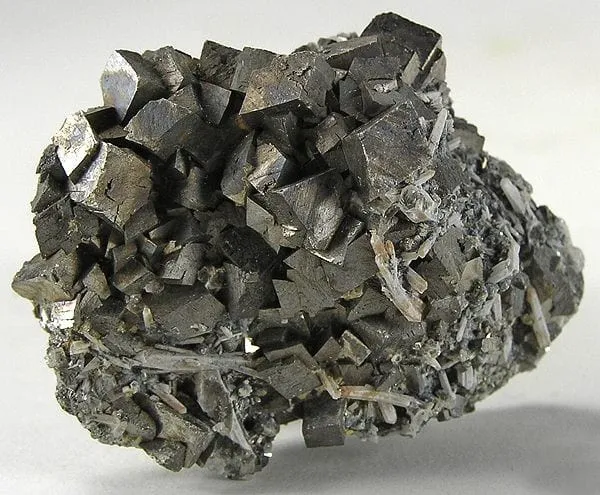
Arsenopyrite
A widespread silvery-grey sulfide containing arsenic: it smells of garlic when struck and is poisonous.