Meteorite
Campo del Cielo
Campo del Cielo meteoriti
The “Field of Heaven”: an iron meteorite that rained on Argentina about 4,500 years ago, made 26 craters and has yielded over 100 tonnes of pieces.
Also known as: Piguem Nonralta · Mesón de Fierro · El Chaco · Gancedo · Otumpa
- Popularly: Meteorite

In short
Campo del Cielo (Spanish for “Field of Heaven”) is the name of a group of iron meteorites and of the area between Argentina's Chaco and Santiago del Estero provinces where they were found. About 4,200–4,700 years ago a large body broke up in the atmosphere and made at least 26 craters. About 100 tonnes of fragments have been recovered, the most of any meteorite. Its two largest pieces, the 30.8-tonne Gancedo and the 28.8-tonne El Chaco, are among the heaviest single meteorite masses recovered on Earth.
Photos

How does it form?
Campo del Cielo is an iron meteorite that formed with the Solar System about 4.5 billion years ago. About 4,200–4,700 years ago a large body more than 4 metres across entered the atmosphere and broke up as it fell. The unusual spread of craters and fragments shows that the body split into many pieces in the atmosphere. Its unusually high number of inclusions for an iron meteorite may have helped the original body break apart.
What is it used for?
Pieces of Campo del Cielo are held in many museums and collections around the world; the 634-kilogram Otumpa piece, taken to Buenos Aires in 1813, was donated to the British Museum. The crater field is an important example for studying how a body that breaks up in the atmosphere forms a strewn field. The fragments are used in research on the chemistry and structure of iron meteorites.
History
In 1576 the governor of a province in northern Argentina sent soldiers to look for a huge mass of iron that the native people used for weapons. The expedition found a large mass of metal sticking out of the soil, and the report was sent to the General Archive of the Indies in Spain, but it was soon forgotten. The mass was found again in 1774. Since then hundreds of pieces from a few milligrams to more than 30 tonnes have been recovered. El Chaco was found 5 metres below the surface with a metal detector in 1969 and extracted in 1980; Gancedo was unearthed in 2016 and named after the nearby town of Gancedo, which lent equipment for the work.
What determines its value?
Because so much of it has been found, Campo del Cielo is one of the most widespread and relatively accessible iron meteorites. A piece's value depends on its mass, its shape, the condition of its surface and its documented origin. Large masses are protected by law; in 2015 four people were arrested trying to steal protected meteorites.
This information is educational, not buying, selling or investment advice. Value varies enormously with quality and treatment.
How to recognise it
- 1
The pieces are heavy masses of rusty brown or blackish metal; some have natural holes and hollows.
- 2
Being almost entirely iron–nickel, they are much heavier than a stone of the same size and strongly attract a magnet.
- 3
Cut and etched with acid, they may show a coarse Widmanstätten pattern or a finer-grained structure; they hold many inclusions for an iron meteorite.
Myths and misconceptions
MythThe iron at Campo del Cielo formed in a volcanic eruption or in an iron vein.
FactIn the 18th century Maguna, who found the mass, took it for the tip of an iron vein, and Rubin de Celis thought it volcanic. The samples Celis sent turned out to contain 90% iron and 10% nickel, and the mass proved to be a meteorite.
MythEl Chaco is Campo del Cielo's largest piece, weighing 37 tonnes.
FactWhen El Chaco was extracted in 1980 it was estimated at about 37 tonnes. After the 30.8-tonne Gancedo was found in 2016, El Chaco was reweighed with the same instruments and came in at 28.84 tonnes; Gancedo is now the largest piece.
Did you know?
The native people said the iron had fallen from the sky and used it for weapons; their name for the place was translated into Spanish as “Campo del Cielo”.
In 1783 Rubin de Celis abandoned the “Mesón de Fierro” (Table of Iron), which he estimated at 15 tonnes, as worthless, but sent samples to the Royal Society in London; they turned out to be 90% iron and 10% nickel.
In 1990 an Argentine highway police officer foiled a plot to steal El Chaco; the meteorite is now protected by provincial law.
Where is it found?
Loading map…
- Campo del Cielo crater field, Chaco and Santiago del Estero, Argentina · Type localityAt least 26 craters lie in an area of 18.5 × 3 km, the largest 115 × 91 m. The strewn field of smaller pieces stretches another 60 km. It lies about 1,000 km north-northwest of Buenos Aires.
Locations are approximate to protect sites. Red dots mark places in Türkiye. Open in the big map →
Frequently asked questions
What is campo del Cielo?
Campo del Cielo (Spanish for “Field of Heaven”) is the name of a group of iron meteorites and of the area between Argentina's Chaco and Santiago del Estero provinces where they were found. About 4,200–4,700 years ago a large body broke up in the atmosphere and made at least 26 craters. About 100 tonnes of fragments have been recovered, the most of any meteorite. Its two largest pieces, the 30.8-tonne Gancedo and the 28.8-tonne El Chaco, are among the heaviest single meteorite masses recovered on Earth.
When did Campo del Cielo fall?
Carbon-14 dating of charred wood found beneath the meteorite fragments shows that the fall happened about 4,200–4,700 years ago, between 2700 and 2200 BC. The meteorite itself formed with the Solar System about 4.5 billion years ago.
What is campo del Cielo used for?
Pieces of Campo del Cielo are held in many museums and collections around the world; the 634-kilogram Otumpa piece, taken to Buenos Aires in 1813, was donated to the British Museum. The crater field is an important example for studying how a body that breaks up in the atmosphere forms a strewn field. The fragments are used in research on the chemistry and structure of iron meteorites.
How hard is campo del Cielo?
It has a hardness of 4–5.5 on the Mohs scale. A fingernail cannot scratch it, but a steel knife can. Its specific gravity is 7–8 g/cm³.
Where is campo del Cielo found?
Its best-known localities: Campo del Cielo crater field, Chaco and Santiago del Estero, Argentina.
How can you tell if campo del Cielo is real?
The pieces are heavy masses of rusty brown or blackish metal; some have natural holes and hollows. Being almost entirely iron–nickel, they are much heavier than a stone of the same size and strongly attract a magnet. Cut and etched with acid, they may show a coarse Widmanstätten pattern or a finer-grained structure; they hold many inclusions for an iron meteorite.
Is campo del Cielo valuable?
On the “street to diamond” value ladder it sits on step 5 of nine: Ornamental stone. Because so much of it has been found, Campo del Cielo is one of the most widespread and relatively accessible iron meteorites. A piece's value depends on its mass, its shape, the condition of its surface and its documented origin. Large masses are protected by law; in 2015 four people were arrested trying to steal protected meteorites.
Sources
- Campo del Cielo · Wikipedia
- Kamacite Mineral Data · Webmineral.com
- Taenite Mineral Data · Webmineral.com
- Density and specific gravity (R. L. Korotev) · Washington University in St. Louis, Some Meteorite Information
External links
Draft: awaiting expert reviewReport an error
On the same step
Agate
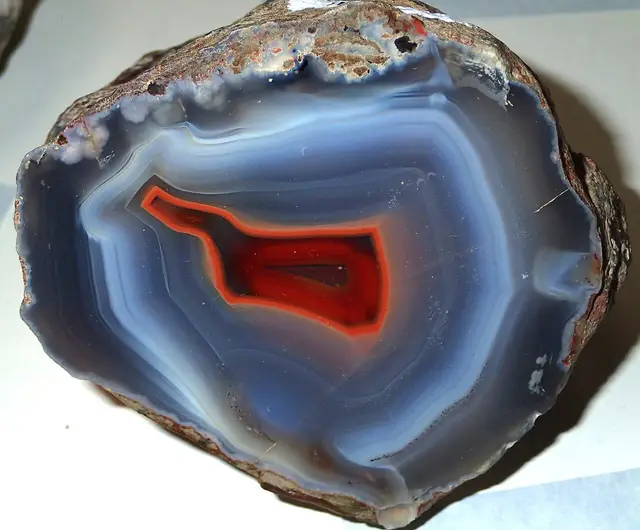
The banded variety of chalcedony: it grows layer by layer in hollows in volcanic rock and shows a new pattern every time it is cut.

Almandine
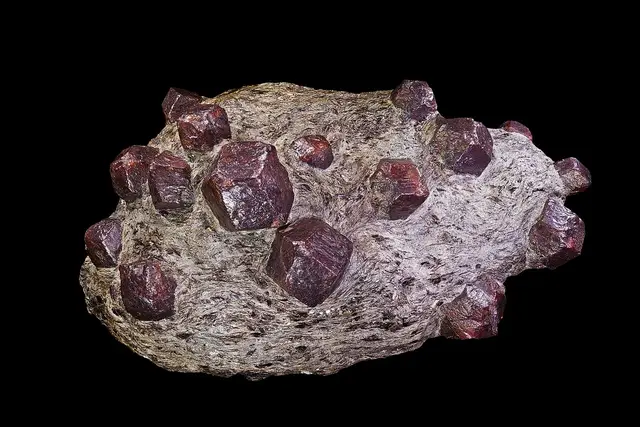
The commonest garnet: a deep red, iron-rich stone named after the ancient city of Alabanda in Anatolia, used in jewellery and in sandpaper alike.
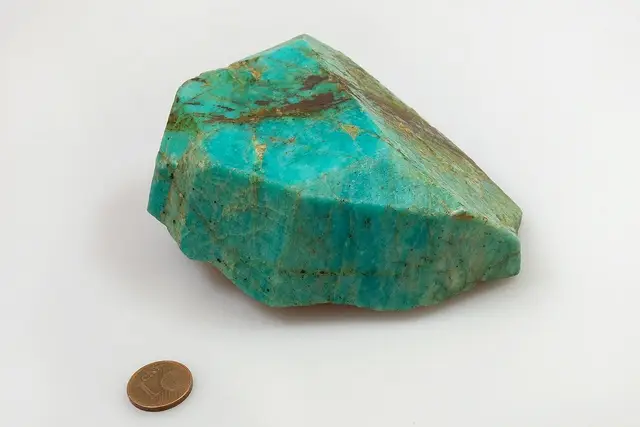
Amazonite
A turquoise-like green-blue feldspar: a variety of microcline worn as jewellery for more than three thousand years, but it can release lead.