Rock
Bentonite
Bentonit
Volcanic ash turned to clay: this water-swelling clay is the raw material of drilling mud, foundry sand and cat litter. Türkiye is one of the world's top three producers.
Also known as: Soap clay · Volcanic clay · Fuller's earth (calcium bentonite) · Sodium bentonite (Wyoming type, the strongly swelling kind)
- Popularly: Ore and raw material
- Industrial
- Important in Türkiye

In short
Bentonite is a soft, soapy rock made mostly of the clay mineral montmorillonite, formed in most cases when volcanic ash altered to clay where it lay. It soaks up water and swells; the sodium type is famous for growing many times in volume. That makes it useful in oil and water drilling, metal casting moulds, iron-ore pelletising, cat litter and oil bleaching. According to the USGS, Türkiye is among the world's largest bentonite producers.
Photos

How does it form?
Bentonite forms when ash, tuff or lava rich in volcanic glass chemically alters to clay. According to the İMİB report, this happens in three ways: under the action of volcanic gases and steam, when tuff and ash alter in the waters of sedimentary basins, or when tuff and ash weather under rain, wind and other climatic conditions. The unstable glass reacts with water and rearranges into the clay mineral montmorillonite; silica, dissolved metal ions and often zeolite appear as by-products. Britannica says bentonite occurs in rocks from the Ordovician to the Neogene.
Bentonite occurs as lenses, pockets and thin beds between other rock layers. Depending on the parent rock, the montmorillonite is sodium-, calcium- or potassium-rich. Not every bentonite shows traces of volcanic ash: Murray (2005) writes that India’s Kachchh and Barmer bentonites show no relict ash structures and no Tertiary volcanic activity in the area, and that they formed from weathered older rocks that were then transported and deposited.
What is it used for?
- Drilling mud: In oil, gas and water drilling, bentonite mud carries the cut rock chips to the surface, lays a thin film on the borehole wall to reduce friction and protects the drill bit.
- Foundry sand: Added to silica sand at 4–6 percent, bentonite holds the casting mould together and stops it from expanding and distorting.
- Iron-ore pellets: It is the binder that rolls fine ore dust into balls.
- Cat litter and absorbents: According to the USGS, about 48 percent of US bentonite goes into absorbents such as pet litter and 22 percent into drilling mud.
- Clarifying oils and drinks: Acid-activated calcium bentonite holds the colouring matter of edible oils (bleaching earth). According to Wikipedia, bentonite is also used to clarify wine and oil.
- Engineering: Because it blocks water and swells, bentonite serves as a sealing layer in waste-storage sites and in dam and trench walls.
- Agriculture, paper and others: Used as a fertiliser carrier and animal-feed additive, and in the paper and ceramics industries.
Sodium and calcium bentonite
Bentonites fall into three main groups by the exchangeable ion of the montmorillonite. Sodium bentonite (Wyoming type) swells strongly and is sought for drilling, foundry work and pelletising. Calcium bentonite swells little but absorbs well; this type, commonly called fuller’s earth, is used in cat litter and oil bleaching. The third group is the mixed (Na-Ca) bentonite, a blend of the two. To raise quality, bentonite is treated with soda to give “sodium-activated bentonite”, and calcium bentonite with acid to give “activated bleaching earth” (İMİB).
In Türkiye
Türkiye is among the world’s big bentonite producers. According to the U.S. Geological Survey (USGS) it mined about 2.5 million tons in 2024, and the 2025 estimate is also about 2.5 million tons. That puts it third for 2025, behind the United States (4.1 million tons) and India (3.7 million tons); world output is about 20 million tons. The ranking moves from year to year: according to the İMİB report Türkiye was third in 2015 with 3.13 million tons and had slipped to fifth in 2018 with 1.33 million tons. The report says about 35–40 percent of output is exported, mainly to the Netherlands, Germany and Italy. According to İMİB, Türkiye’s bentonite reserve is about 240 million tons, and in February 2021 there were 63 mining licences, 14 of them in Ordu, 11 in Çankırı and 6 in Edirne.
The İMİB report lists the main known deposits as Enez in Edirne, Çankırı, Çanakkale, Kütahya, Manisa, Reşadiye in Tokat, Kalecik in Ankara, Ünye–Fatsa in Ordu and Tirebolu in Giresun. Sodium bentonite is scarce in Türkiye, while reserves of calcium and mixed types are large. The deposits fall into four groups by use: drilling, foundry, bleaching and white (detergent) bentonite.
- Reşadiye, Tokat: The bentonites in the Bereketli Member of the Upper Cretaceous Reşadiye Formation formed when rhyolitic, dacitic and trachyandesitic volcanic fragments altered in place in a shallow sea, shortly after they were deposited. According to Kadir and colleagues (2021) they contain sodium and sodium-calcium smectite and are mined in Türkiye for the drilling and foundry industries. İMİB rates Reşadiye bentonite for pelletising and drilling.
- Ünye–Fatsa, Ordu: Calcium and calcium-sodium bentonites formed by the alteration of Upper Cretaceous dacitic-andesitic volcanic rocks. According to Özdamar and colleagues (2014), the bentonite of the Uzunisa deposit is mostly calcium montmorillonite. The İMİB report says the large calcium deposits used for bleaching and cat litter lie in this area.
- Çankırı: According to the report, Çankırı bentonite is rated as foundry bentonite; the Çankırı, Ankara and Tokat areas are also productive for drilling bentonite.
- Edirne and Balıkesir: Bentonites suited to paper, detergent and oil bleaching lie in the Edirne, Ordu and Balıkesir areas.
MTA says Turkish bentonites occur irregularly as lenses, pockets, masses and thin beds within igneous rocks and volcanic-rich sedimentary units. Open-pit mining is the usual method; according to İMİB, crushing, grinding and activation plants are built near the drying area and the bentonite is usually ground to 200–325 mesh.
What determines its value?
Bentonite is an industrial raw material sold by the ton, and its value depends on the use. Drilling and foundry work want strongly swelling, clean sodium bentonite; Türkiye has little natural sodium bentonite; to raise its quality, bentonite is activated with soda (sodium carbonate). Oil bleaching wants acid-activated calcium bentonite, and the paper industry wants high brightness and swelling. The size of the deposit, the thickness of the cover above it, the purity of the clay (few companions such as quartz, calcite and feldspar) and the distance to consumers matter too. Bentonite is bulky and cheap, so transport cost weighs heavily on what it is worth.
This information is educational, not buying, selling or investment advice. Value varies enormously with quality and treatment.
How to recognise it
- 1
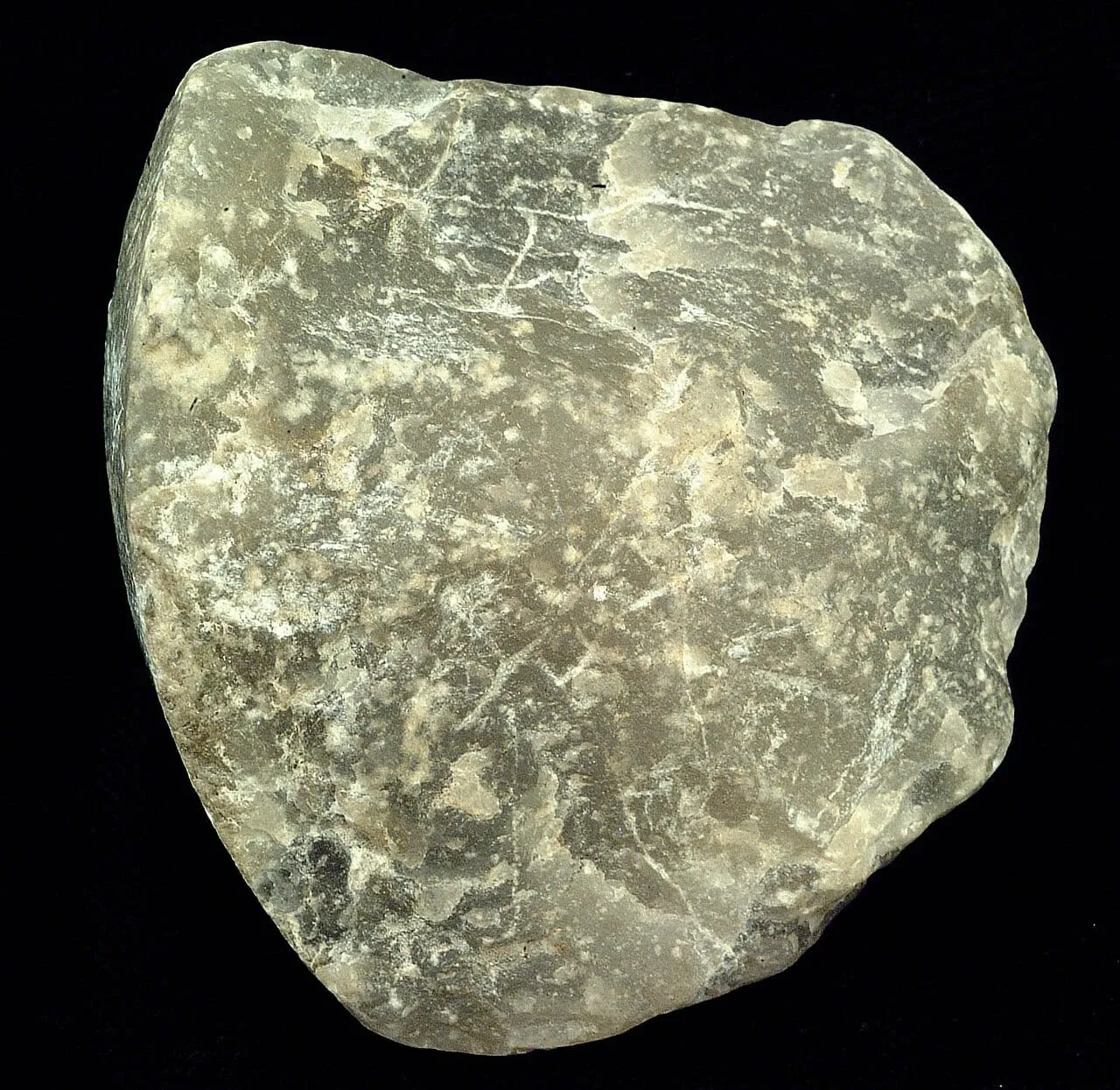
Very fine-grained and very soft (Mohs hardness 1–2, scratched by a fingernail); white, cream, light grey or pale greenish, turning yellow, red and brown where weathered. It feels soapy or greasy to the touch.
- 2
Dropped in water, it swells and makes a cloudy, gel-like mud. According to MTA, sodium bentonite swells to 8–10 times its volume in water, calcium bentonite only to 2–3 times.
- 3
On an outcrop its surface forms a bumpy, cracked, popcorn-like crust as the clay swells and shrinks with wetting and drying. It is very slippery and sticky when wet, hard and cracked when dry.
- 4
Telling it from other clays such as kaolinite or illite for certain takes laboratory methods such as X-ray diffraction (XRD); by hand and eye you can only guess at bentonite from how it swells and how soapy it feels.
Fakes and imitations
What shops usually don’t tell you:
- Kaolin (white clay) and chalk can look like bentonite. Kaolin becomes workable without swelling when wet, and chalk fizzes in dilute acid; bentonite behaves like neither and swells noticeably in water.
- Not every product sold as cat litter is bentonite; absorbent clays such as sepiolite and attapulgite are used for the same job (İMİB). Bentonite is one of the main clays used for it.
Safety
Bentonite is harmless to handle. The fine dust raised in mining, grinding and pouring should not be breathed; crystalline silica minerals such as quartz and cristobalite can accompany bentonite. Wet bentonite is very slippery, so take care on quarry and store floors. Drilling, foundry or cat-litter grades are not made for eating or for skin care and should not be swallowed or applied to the skin.
Myths and misconceptions
MythBentonite and montmorillonite are the same thing.
FactMontmorillonite is a clay mineral; bentonite is a clay rock made mostly of montmorillonite. The rock also holds other minerals such as quartz, feldspar, mica, calcite, cristobalite and even zeolite. The Reşadiye bentonites in Tokat, for example, contain heulandite-clinoptilolite, kaolinite and opal-CT.
MythBecause bentonite is a natural clay, every bentonite product is harmless to eat or put on the skin.
FactBentonite is mined rock and products differ; drilling or foundry bentonite is not made for eating. Natural clays can also contain heavy metals such as lead: in 2016 the US Food and Drug Administration (FDA) told consumers not to use a bentonite product sold as safe to swallow and to apply to hair and skin, because of its lead content.
What is it believed to be good for?
This section reports beliefs; it is not health information. There is no scientific evidence for these claims and no stone replaces medical treatment.
The meanings people give this stone, and who holds them:
- Herbal-product and “natural living” sellers claim that drinking or eating bentonite clay mixed in water binds “toxins” and heavy metals in the body and carries them out, and improves digestion.
- In the skincare world, bentonite masks are said to “purify” the skin of “toxins”.
What science says
Bentonite really does soak up oil and dirt, which is why it is used in masks; Wikipedia also notes that it has been prescribed in medicine as a bulk laxative and is the base of some skin medicines. But there is no evidence that bentonite swallowed or drunk pulls “toxins” out of the body: montmorillonite has been shown in the laboratory to hold heavy metals, but what that does for human health is unknown. Clays on sale can also be contaminated; in 2016 the FDA reported high lead in a bentonite product marketed as safe to swallow and told consumers not to use it.
Did you know?
Bentonite takes its name from the Benton Shale in the United States. According to the Wyoming State Geological Survey, Wilbur C. Knight coined the name in 1898 for deposits in the Benton Shale near Rock River.
According to the Wyoming State Geological Survey, Wyoming's sodium bentonite can swell to as much as 16 times its original size and absorb up to 10 times its own weight in water.
As volcanic glass turns to clay, the silica and ions it releases can form zeolites in the pores of the clay (İMİB). The Reşadiye bentonites of Tokat also contain the zeolites heulandite-clinoptilolite.
Bentonite is used as a binder when fine iron-ore powder is made into pellets, which lets low-grade or crumbly ore be used in blast furnaces (İMİB).
Where is it found?
Loading map…
- Rock River, Albany County, Wyoming, USA · Type localityThe name bentonite was given in 1898 by Wilbur C. Knight for the deposits in the Benton Shale near Rock River (Wyoming Geological Survey). The point is the position of the town of Rock River.
- Upton area, Weston County, Wyoming, USA · Major depositWyoming's best bentonite lies in the Upper Cretaceous Mowry Shale; the Clay Spur district in the southern Black Hills is one of the main producing districts, and the Handbook of Mineralogy also lists Upton among its standard-material localities. According to the Wyoming Mining Association, the state holds up to 70 percent of the world's known bentonite. The point is the position of the town of Upton.
- Belle Fourche, Butte County, South Dakota, USA · Known localityThe Handbook of Mineralogy lists Belle Fourche (South Dakota) among the places that supplied standard montmorillonite material. The Turkish Wikipedia names the Black Hills among the production centres of high-grade sodium bentonite. The point is the position of the town of Belle Fourche.
- Milos Island, Cyclades, Greece · Major depositAccording to Wikipedia, bentonite is quarried on the island in open pits. According to Murray (2005), Greece's largest and best-known calcium bentonite is on Milos; it is Pleistocene in age and formed from pyroclastic flows. According to the USGS, Greece produced about 1 million tons of bentonite in 2024.
- Kachchh (Kutch) district, Gujarat, India · Major depositAccording to the Indian Bureau of Mines, Bhavnagar and Kachchh in Gujarat and Barmer in Rajasthan are India's main bentonite-producing areas; Gujarat produced about 3.4 million tons in 2018-19. According to Murray (2005) the deposits here are Lower Tertiary in age. The USGS puts India at about 3.7 million tons in 2024. The point is the general position of the region.
- Barmer, Rajasthan, India · Known localityThe sodium bentonite mined in Rajasthan is of lower quality and used mostly in foundry sand (Indian Bureau of Mines). The point is the position of the town of Barmer.
- Mainburg–Moosburg–Landshut area, Bavaria, Germany · Major depositAccording to Murray (2005), the relatively pure Upper Miocene calcium bentonites near Moosburg and Landshut are important commercial bentonites in the European and world markets; they formed when acid volcanic tuffs altered in small ponds and lakes. The point is the general position of the area.
- Sardinia, Italy · Known localityAccording to Murray (2005), Sardinia has two kinds of calcium bentonite: a Miocene sedimentary bentonite from volcanic ash altered in the sea, and a hydrothermally altered trachytic tuff. The point is the general position of the island.
- Zhejiang Province, China · Major depositAccording to Murray (2005), China's largest calcium bentonite deposits lie in Zhejiang, Hubei, Anhui, Shandong, Sichuan and Liaoning provinces; the more important ones are sediments derived from volcanic ash and tuff deposited in lake or shallow-sea settings. According to the USGS, China produced about 2.1 million tons of bentonite in 2024. The point is the general position of the province.
- Reşadiye, Tokat, Türkiye · Major depositBentonites in the Bereketli Member of the Upper Cretaceous Reşadiye Formation; they contain sodium and sodium-calcium smectite and are mined for the drilling and foundry industries (Kadir et al., 2021). The point is the position of the town of Reşadiye.
- Ünye–Fatsa area, Ordu, Türkiye · Major depositCalcium and calcium-sodium bentonites formed by the alteration of Upper Cretaceous dacitic-andesitic volcanic rocks; according to the İMİB report the large deposits used as bleaching earth and cat litter lie here. The point lies between Ünye and Fatsa.
- Eldivan–Kurşunlu area, Çankırı, Türkiye · Known localityThe İMİB report describes Çankırı bentonite as foundry bentonite; Çankırı province held 11 bentonite mining licences (February 2021). The point lies between Eldivan and Kurşunlu.
- Enez, Edirne, Türkiye · Known localityThe İMİB report counts Edirne–Enez among Türkiye's known bentonite deposits; Edirne held 6 mining licences (February 2021). The point is the position of the town of Enez.
Locations are approximate to protect sites. Red dots mark places in Türkiye. Open in the big map →
Frequently asked questions
What is bentonite?
Bentonite is a soft, soapy rock made mostly of the clay mineral montmorillonite, formed in most cases when volcanic ash altered to clay where it lay. It soaks up water and swells; the sodium type is famous for growing many times in volume. That makes it useful in oil and water drilling, metal casting moulds, iron-ore pelletising, cat litter and oil bleaching. According to the USGS, Türkiye is among the world's largest bentonite producers.
What is bentonite used for?
Drilling mud: In oil, gas and water drilling, bentonite mud carries the cut rock chips to the surface, lays a thin film on the borehole wall to reduce friction and protects the drill bit. Foundry sand: Added to silica sand at 4–6 percent, bentonite holds the casting mould together and stops it from expanding and distorting. Iron-ore pellets: It is the binder that rolls fine ore dust into balls. Cat litter and absorbents: According to the USGS, about 48 percent of US bentonite goes into absorbents such as pet litter and 22 percent into drilling mud.
How hard is bentonite?
It has a hardness of 1–2 on the Mohs scale. It is soft enough to scratch with a fingernail. Its specific gravity is 2–3 g/cm³.
Where is bentonite found?
Its best-known localities: Rock River, Albany County, Wyoming, USA; Upton area, Weston County, Wyoming, USA; Milos Island, Cyclades, Greece; Kachchh (Kutch) district, Gujarat, India; Mainburg–Moosburg–Landshut area, Bavaria, Germany.
Where is bentonite found in Türkiye?
Known localities in Türkiye: Reşadiye, Tokat, Türkiye; Ünye–Fatsa area, Ordu, Türkiye; Eldivan–Kurşunlu area, Çankırı, Türkiye; Enez, Edirne, Türkiye.
How can you tell if bentonite is real?
Very fine-grained and very soft (Mohs hardness 1–2, scratched by a fingernail); white, cream, light grey or pale greenish, turning yellow, red and brown where weathered. It feels soapy or greasy to the touch. Dropped in water, it swells and makes a cloudy, gel-like mud. According to MTA, sodium bentonite swells to 8–10 times its volume in water, calcium bentonite only to 2–3 times. On an outcrop its surface forms a bumpy, cracked, popcorn-like crust as the clay swells and shrinks with wetting and drying. It is very slippery and sticky when wet, hard and cracked when dry. Kaolin (white clay) and chalk can look like bentonite. Kaolin becomes workable without swelling when wet, and chalk fizzes in dilute acid; bentonite behaves like neither and swells noticeably in water.
Is bentonite valuable?
On the “street to diamond” value ladder it sits on step 3 of nine: Building and industrial stone. Bentonite is an industrial raw material sold by the ton, and its value depends on the use. Drilling and foundry work want strongly swelling, clean sodium bentonite; Türkiye has little natural sodium bentonite; to raise its quality, bentonite is activated with soda (sodium carbonate). Oil bleaching wants acid-activated calcium bentonite, and the paper industry wants high brightness and swelling. The size of the deposit, the thickness of the cover above it, the purity of the clay (few companions such as quartz, calcite and feldspar) and the distance to consumers matter too. Bentonite is bulky and cheap, so transport cost weighs heavily on what it is worth.
What is bentonite good for?
Herbal-product and “natural living” sellers claim that drinking or eating bentonite clay mixed in water binds “toxins” and heavy metals in the body and carries them out, and improves digestion. In the skincare world, bentonite masks are said to “purify” the skin of “toxins”. Bentonite really does soak up oil and dirt, which is why it is used in masks; Wikipedia also notes that it has been prescribed in medicine as a bulk laxative and is the base of some skin medicines. But there is no evidence that bentonite swallowed or drunk pulls “toxins” out of the body: montmorillonite has been shown in the laboratory to hold heavy metals, but what that does for human health is unknown. Clays on sale can also be contaminated; in 2016 the FDA reported high lead in a bentonite product marketed as safe to swallow and told consumers not to use it. This section reports beliefs; it is not health information. There is no scientific evidence for these claims and no stone replaces medical treatment.
Is bentonite dangerous?
Bentonite is harmless to handle. The fine dust raised in mining, grinding and pouring should not be breathed; crystalline silica minerals such as quartz and cristobalite can accompany bentonite. Wet bentonite is very slippery, so take care on quarry and store floors. Drilling, foundry or cat-litter grades are not made for eating or for skin care and should not be swallowed or applied to the skin.
Sources
- Türkiye'de Bentonit Yataklarının Durumu, İşletmeciliği ve Geleceği (Türkiye İçin Önem Arz Eden Madenler Çalışması) · İstanbul Maden İhracatçıları Birliği (İMİB), 2021
- Bentonit · MTA Genel Müdürlüğü, Bilgi Merkezi
- Mineral Commodity Summaries 2026: Clays · U.S. Geological Survey, 2026
- Mineralogy, geochemistry and genesis of bentonites in Upper Cretaceous pyroclastics of the Bereketli Member of the Reşadiye Formation, Reşadiye, Tokat, Turkey (Kadir, Külah, Erkoyun, Uyanık, Eren, Elliott), Applied Clay Science 204 · Elsevier, 2021
- Element mobility during the formation of the Uzunisa-Ordu bentonite, NE Turkey, and potential applications (Özdamar ve ark.), Clay Minerals 49(5) · Mineralogical Society of Great Britain and Ireland, 2014
- Bentonite · Wyoming State Geological Survey
- Handbook of Mineralogy: Montmorillonite · Mineralogical Society of America
- Indian Minerals Yearbook 2019: Bentonite · Indian Bureau of Mines, 2022
- Bentonite · Encyclopaedia Britannica
- Clay sorbents: the mineralogy, processing and applications (H. H. Murray), Acta Geodynamica et Geomaterialia 2(2) · Institute of Rock Structure and Mechanics, Czech Academy of Sciences, 2005
- Bentonite · Wikipedia
- Bentonit · Vikipedi
- Milos · Wikipedia
- FDA warns consumers about health risks with Alikay Naturals – Bentonite Me Baby – Bentonite Clay · U.S. Food and Drug Administration, 2016
External links
Draft: awaiting expert reviewReport an error ↗
On the same step
Albite
The white, sodium end of the feldspars: with its deposits at Çine–Milas, a glass and ceramics raw material that makes Türkiye one of the world’s main feldspar producers.
Alunite
The “alum stone” from which alum was made for centuries. Foça, Şaphane in Kütahya and Şebinkarahisar are Türkiye's old alum homelands.
Anhydrite
Gypsum without its water: a calcium sulfate mineral, whose blue-grey Peruvian form is sold as “angelite”.