Meteorite
Ataxite
Ataksit
“Structureless” iron meteorites: so rich in nickel that they show no Widmanstätten pattern when etched; Hoba, the largest meteorite on Earth, is one.
- Popularly: Meteorite

In short
Ataxites are a structural class of iron meteorites. Their name comes from the Greek for “without structure”: when cut and etched with acid they show none of the Widmanstätten pattern seen in other iron meteorites. They are the most nickel-rich meteorites known and usually contain more than 18 per cent nickel. They are a rare class, yet the largest meteorite known, the 60-tonne Hoba, is an ataxite.
Photos

How does it form?
Like most other iron meteorites, ataxites come from the metal cores of asteroids that were once molten. They consist mainly of the nickel-rich mineral taenite, with minor plessite, troilite and microscopic lamellae of kamacite.
Because the nickel content is so high, kamacite can separate from taenite only below about 600 °C as the metal cools. At that temperature diffusion is already too slow, so the large bands seen in octahedrites cannot form. Most ataxites belong to group IVB or are classified as “iron, ungrouped” because they fit none of the recognised groups; a few belong to the IAB complex and to groups IIF, IVA, IIAB and IIIAB.
What is it used for?
- Asteroid cores: Ataxites help us understand how very nickel-rich metal cores cooled and crystallised.
- Museums and education: Giant ataxites such as Hoba are important natural monuments that visitors can see where they lie.
- Cultural history: The story of the “Iron Man” statue shows how chemical analysis can trace the origin of meteoritic material, but also that historical and art-historical study is needed to date an object.
Famous ataxites
Hoba (Namibia), at about 60 tonnes the largest meteorite known, was found in 1920. Chinga (Tuva, Russia) was found in 1913; it contains about 16.6 per cent nickel, and 209.4 kg have been collected in all. Classified in 2000 as an anomalous member of group IVB, it was reclassified as an ungrouped iron in 2006. Dronino (Ryazan, Russia) was found in 2000, and about 3 tonnes of fragments were collected in all; because there are no historical descriptions of its fall, it is estimated to have fallen before the first settlements in the region were founded in 1200. Pieces of the Gebel Kamil crater are also ataxites.
What determines its value?
Ataxites are a rare class of iron meteorite. A piece's value depends on its mass, its state of preservation and whether it belongs to a well-known meteorite such as Hoba, Chinga or Dronino. Hoba itself has been a national monument since 1955 and cannot be sold.
This information is educational, not buying, selling or investment advice. Value varies enormously with quality and treatment.
How to recognise it
- 1
Very heavy and strongly attracted to a magnet; the outside weathers to a rusty brown.
- 2
When a cut, polished face is etched with nitric acid, no criss-crossing bands appear as in octahedrites; the surface stays plain or very fine-grained.
- 3
Only chemical analyses, such as of the nickel content, can confirm that a piece of iron is a meteorite and which group it belongs to.
Myths and misconceptions
MythThe “Iron Man” statue carved from meteoritic iron is a thousand-year-old Buddhist statue brought from Tibet by the Nazis.
FactThe 24 cm, 10 kg statue is thought to have been carved from an ataxite, perhaps a fragment of the Chinga meteorite. But no evidence was ever presented that it came back with the SS expedition to Tibet of 1938–1939. The Buddhologist Achim Bayer argued that it was made between 1920 and 1970, probably in Germany, and the Tibetologist Isrun Engelhardt argued that it was most probably designed and made for the Russian painter Nicholas Roerich.
MythEvery ataxite is rich in nickel.
FactMost ataxites are nickel-rich, but Santiago Papasquiero, found in Mexico in 1958, contains only 7.5 per cent nickel. It is an octahedrite that was completely metamorphosed and recrystallised, keeping no trace of its Widmanstätten pattern.
Did you know?
None of the roughly 50 observed iron meteorite falls is an ataxite; yet the largest meteorite known, the 60-tonne Hoba found in Namibia in 1920, is one.
The Russian Dronino meteorite was spotted in July 2000 by Oleg Gus'kov on his way home from collecting mushrooms. He came back the next day with a shovel and a wheelbarrow, and the stone lay in his garden for the next two years.
Fragments of the Chinga meteorite were found in 1913 by gold diggers near the Chinge River in Tuva. Nikolay Chernevich, the mining engineer supervising them, sent thirty pieces, the heaviest weighing 20.5 kg, to the Russian Academy of Sciences.
Where is it found?
Loading map…
- Hoba West farm, near Grootfontein, Namibia · Major depositThe Hoba meteorite, about 60 tonnes and found in 1920, is the largest meteorite known and an ataxite.
- Chinge River, Tuva, Russia · Known localityFragments of the Chinga meteorite were found by gold diggers in 1913; 209.4 kg have been collected in all. It is estimated to have fallen about 10,000 to 20,000 years ago.
- Dronino, Ryazan Oblast, Russia · Known localityAn ataxite noticed in July 2000 by Oleg Gus'kov, on his way home from collecting mushrooms, as a rusty piece of iron sticking out of the ground; later searches collected about 3 tonnes in all.
Locations are approximate to protect sites. Red dots mark places in Türkiye. Open in the big map →
Frequently asked questions
What is ataxite?
Ataxites are a structural class of iron meteorites. Their name comes from the Greek for “without structure”: when cut and etched with acid they show none of the Widmanstätten pattern seen in other iron meteorites. They are the most nickel-rich meteorites known and usually contain more than 18 per cent nickel. They are a rare class, yet the largest meteorite known, the 60-tonne Hoba, is an ataxite.
Why do ataxites show no Widmanstätten pattern?
The pattern forms when nickel-poor kamacite separates out of nickel-rich taenite during cooling. When the nickel content is very high, kamacite can only separate below about 600 °C, where diffusion of atoms through the metal is already too slow. So no visible bands can form.
What is ataxite used for?
Asteroid cores: Ataxites help us understand how very nickel-rich metal cores cooled and crystallised. Museums and education: Giant ataxites such as Hoba are important natural monuments that visitors can see where they lie. Cultural history: The story of the “Iron Man” statue shows how chemical analysis can trace the origin of meteoritic material, but also that historical and art-historical study is needed to date an object.
How hard is ataxite?
It has a hardness of 4–5.5 on the Mohs scale. A fingernail cannot scratch it, but a steel knife can. Its specific gravity is 7–8 g/cm³.
Where is ataxite found?
Its best-known localities: Hoba West farm, near Grootfontein, Namibia; Chinge River, Tuva, Russia; Dronino, Ryazan Oblast, Russia.
How can you tell if ataxite is real?
Very heavy and strongly attracted to a magnet; the outside weathers to a rusty brown. When a cut, polished face is etched with nitric acid, no criss-crossing bands appear as in octahedrites; the surface stays plain or very fine-grained. Only chemical analyses, such as of the nickel content, can confirm that a piece of iron is a meteorite and which group it belongs to.
Is ataxite valuable?
On the “street to diamond” value ladder it sits on step 5 of nine: Ornamental stone. Ataxites are a rare class of iron meteorite. A piece's value depends on its mass, its state of preservation and whether it belongs to a well-known meteorite such as Hoba, Chinga or Dronino. Hoba itself has been a national monument since 1955 and cannot be sold.
Sources
- Ataxite · Wikipedia
- Hoba meteorite · Wikipedia
- Chinga meteorite · Wikipedia
- Dronino meteorite · Wikipedia
- Iron Man (Buddhist statue) · Wikipedia
- Ataxite (Santiago Papasquiero Meteorite) (photo and description by James St. John) · Wikimedia Commons
- Kamacite Mineral Data · Webmineral.com
- Taenite Mineral Data · Webmineral.com
- Density and specific gravity (R. L. Korotev) · Washington University in St. Louis, Some Meteorite Information
External links
Draft: awaiting expert reviewReport an error
On the same step
Agate
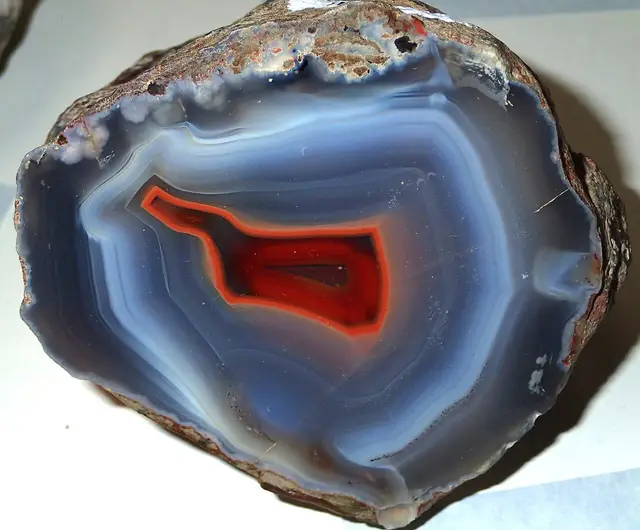
The banded variety of chalcedony: it grows layer by layer in hollows in volcanic rock and shows a new pattern every time it is cut.

Almandine
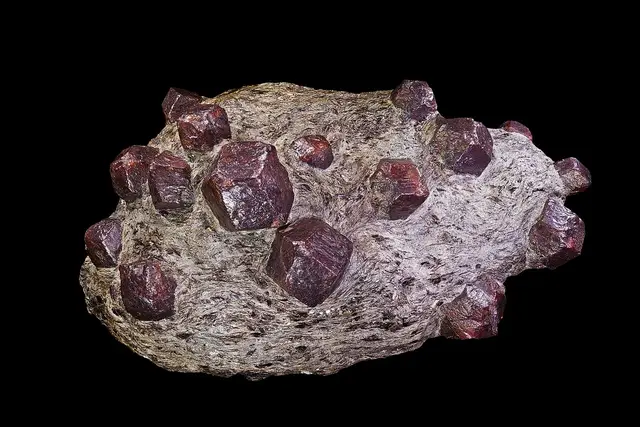
The commonest garnet: a deep red, iron-rich stone named after the ancient city of Alabanda in Anatolia, used in jewellery and in sandpaper alike.
Amazonite
A turquoise-like green-blue feldspar: a variety of microcline worn as jewellery for more than three thousand years, but it can release lead.