Rock
Yule Marble
Yule mermeri
The white stone of the Lincoln Memorial: a very pure marble quarried underground, 2,800 metres up in the mountains of Colorado.
Also known as: Colorado Yule Marble
- Popularly: Natural stone (building and decor)

In short
Yule Marble is a white marble found in the Yule Creek Valley, southeast of the town of Marble in Colorado, USA. It is 99.5% calcite, and its fine, tight grain gives it a smooth, uniform and luminous surface. The exterior of the Lincoln Memorial in Washington and the Tomb of the Unknown Soldier at Arlington National Cemetery are made of it. It has been Colorado's official state rock since 2004.
Photos

How does it form?
Yule Marble began as the Leadville Limestone, laid down in a shallow sea early in the Carboniferous (Mississippian, about 350–324 million years ago). That limestone covers hundreds of square kilometres of Colorado, but it turned into marble only in the Yule Creek Valley.
The change came between the end of the Eocene and the Oligocene (about 34–28 million years ago). Hot granitic magma rising into the nearby Treasure Mountain Dome heated the limestone and recrystallised it. This is contact metamorphism: the rock is transformed around a single body of magma rather than during the building of a whole mountain range. Vermont and Georgia marbles formed by regional metamorphism instead, which sets Yule apart from other American marbles. The rising dome also tilted the marble bed into the mountain at 35–50 degrees.
What is it used for?
- Monuments: Architect Henry Bacon persuaded the builders to clad the whole exterior of the Lincoln Memorial in Washington in Yule Marble, even though it was the most expensive material. The Tomb of the Unknown Soldier at Arlington National Cemetery is also Yule Marble.
- Public buildings: Its first major use was the Colorado State Capitol in Denver in 1895. Yule Marble quarried between 1907 and 1941 went into banks, libraries, schools and government buildings from Seattle to Los Angeles, and as far as the Equitable Building skyscraper in New York.
- Today: The quarry, closed in 1941, reopened in 1990, and the marble is now also shipped abroad.
History
The geologist Sylvester Richardson first found the marble in the spring of 1873; the prospector George Yule rediscovered it the next year, and the stone took his name. The Colorado-Yule Marble Company, which arrived in 1905, opened today’s quarry, built one of the world’s largest marble mills in the town and shipped the blocks by rail. The company went bankrupt in 1917, and the quarry closed and reopened several times after that. These booms and busts are seen as a textbook case of the ups and downs of a one-industry town.
What determines its value?
Its value lies in its very high purity, the luminous, uniform look given by its fine, interlocking grain, and the large, sound blocks the deposit can yield. Against that, working underground, high in the mountains and under deep snow makes it very expensive to quarry; Yule was the costliest option when it was chosen for the Lincoln Memorial. For restoring historic buildings, stone from the same quarry is also prized.
This information is educational, not buying, selling or investment advice. Value varies enormously with quality and treatment.
How to recognise it
- 1
Very white and even; polished, it takes on a slightly translucent, luminous surface.
- 2
Some grades show thin golden veins (from iron or manganese) and grey clouds (quartz inclusions).
- 3
Being calcite, it is scratched by a steel knife and fizzes in dilute acid.
Myths and misconceptions
MythYule Marble is named after Christmas (Yule).
FactIt is named after the prospector George Yule, who rediscovered the marble in 1874. The geologist Sylvester Richardson had first found it in 1873.
MythThe cracked marble block of the Tomb of the Unknown Soldier was replaced with a new one.
FactCracks appeared in the main block soon after the tomb was finished in 1932, and replacing it was debated. The US Senate barred a replacement in 2007; the cracks were repaired in 2010 and again in 2011.
Did you know?
Most marble is quarried in open pits; Yule Marble is taken from inside a mountain, about 2,800 metres above sea level.
The roughly 56-ton block cut for the Tomb of the Unknown Soldier in 1931 was the largest single piece of marble ever quarried up to that time.
Yule Marble became Colorado's official state rock on 9 March 2004, after a petition to the state legislature by a Girl Scout troop from Lakewood.
Where is it found?
Loading map…
- Yule quarry, Yule Creek Valley, near Marble, Colorado, USA · Type localityThe only known deposit of Yule Marble. The quarry is underground at about 2,800 m above sea level; opened in 1905, it is still worked today.
- Town of Marble, Crystal River Valley, Colorado, USA · Historic sourceThe town where a huge mill finished the blocks brought down from the quarry. Between 1906 and 1941 the marble left here by rail for the whole country.
Locations are approximate to protect sites. Red dots mark places in Türkiye. Open in the big map →
Frequently asked questions
What is yule Marble?
Yule Marble is a white marble found in the Yule Creek Valley, southeast of the town of Marble in Colorado, USA. It is 99.5% calcite, and its fine, tight grain gives it a smooth, uniform and luminous surface. The exterior of the Lincoln Memorial in Washington and the Tomb of the Unknown Soldier at Arlington National Cemetery are made of it. It has been Colorado's official state rock since 2004.
Why is Yule Marble so expensive?
The quarry is underground, about 2,800 metres up in the Colorado mountains. Steep slopes, deep snow and mudslides limit when work can be done, and bringing blocks down the mountain is hard. Technology has reduced this cost but has not removed it.
What is yule Marble used for?
Monuments: Architect Henry Bacon persuaded the builders to clad the whole exterior of the Lincoln Memorial in Washington in Yule Marble, even though it was the most expensive material. The Tomb of the Unknown Soldier at Arlington National Cemetery is also Yule Marble. Public buildings: Its first major use was the Colorado State Capitol in Denver in 1895. Yule Marble quarried between 1907 and 1941 went into banks, libraries, schools and government buildings from Seattle to Los Angeles, and as far as the Equitable Building skyscraper in New York.
How hard is yule Marble?
It has a hardness of 3 on the Mohs scale. A fingernail cannot scratch it, but a steel knife can. Its specific gravity is 2.7 g/cm³.
Where is yule Marble found?
Its best-known localities: Yule quarry, Yule Creek Valley, near Marble, Colorado, USA; Town of Marble, Crystal River Valley, Colorado, USA.
How can you tell if yule Marble is real?
Very white and even; polished, it takes on a slightly translucent, luminous surface. Some grades show thin golden veins (from iron or manganese) and grey clouds (quartz inclusions). Being calcite, it is scratched by a steel knife and fizzes in dilute acid.
Is yule Marble valuable?
On the “street to diamond” value ladder it sits on step 4 of nine: Fine dimension stone and ore. Its value lies in its very high purity, the luminous, uniform look given by its fine, interlocking grain, and the large, sound blocks the deposit can yield. Against that, working underground, high in the mountains and under deep snow makes it very expensive to quarry; Yule was the costliest option when it was chosen for the Lincoln Memorial. For restoring historic buildings, stone from the same quarry is also prized.
Sources
- Yule Marble · Wikipedia
- Marble, Colorado · Wikipedia
- Calcite · Wikipedia
External links
Draft: awaiting expert reviewReport an error
On the same step
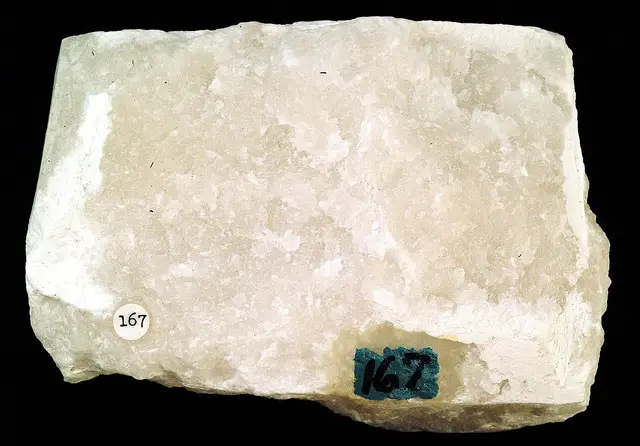
Alabaster
The fine-grained, translucent form of gypsum: a white stone soft enough to scratch with a fingernail, carved into statues, vessels and lamps for thousands of years.
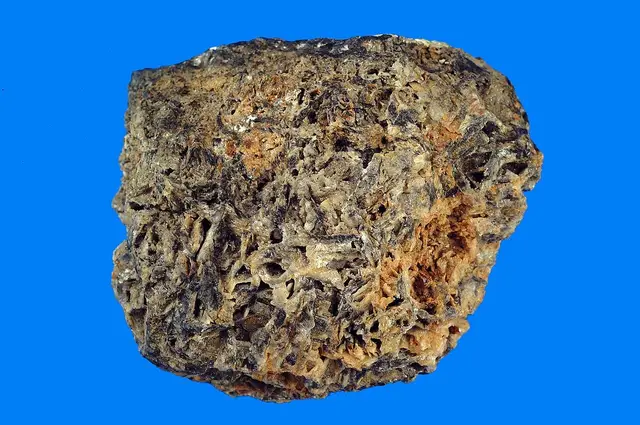
Anglesite
A heavy lead sulfate mineral with a diamond-like shine that grows as a crust around galena; it is named after the island of Anglesey in Wales.
Arsenopyrite
A widespread silvery-grey sulfide containing arsenic: it smells of garlic when struck and is poisonous.