Mineral
Wollastonite
CaSiO₃Vollastonit
A white, fibrous calcium silicate formed at limestone contacts: an additive in ceramics, paint and plastics, and a substitute for asbestos. Türkiye has small deposits.
- Popularly: Ore and raw material
- Industrial
- Important in Türkiye

In short
Wollastonite is a white, needle-like or fibrous mineral made of calcium, silicon and oxygen (CaSiO₃). It forms when impure limestone is heated by contact with hot magma, so it is found with minerals such as garnet and diopside in the skarn zone between limestone and igneous rock. It is an industrial raw material because it reduces shrinkage and gas release in ceramic firing, serves as a filler in paint and plastics and can replace asbestos. China produces most of the world's wollastonite; the deposits in Türkiye are small.
Photos

How does it form?
Wollastonite mostly forms by contact metamorphism of impure, that is silica-bearing, limestone: when hot magma intrudes limestone, calcite reacts with quartz and wollastonite and carbon dioxide result. This happens at the boundary between limestone and igneous rock (skarn); the Handbook of Mineralogy says wollastonite is common in thermally metamorphosed siliceous carbonates, in the intruding igneous rock and in the skarn deposits along their contact, and also occurs in some alkalic igneous rocks and carbonatites. The USGS adds that economic deposits also form when siliceous limestone is thermally metamorphosed during regional deformation, or when siliceous hot fluids alter limestone along faults or contacts; Özkol and Kulaksız likewise divide Türkiye’s wollastonites into products of contact and of regional metamorphism.
Wollastonite is often accompanied by calcite, garnet (grossular), diopside, vesuvianite and epidote. These companions make the ore harder to concentrate.
What is it used for?
- Ceramics: According to the USGS, wollastonite reduces shrinkage and gas release during firing, raises green and fired strength, allows fast firing and reduces glaze defects. It is used in wall tiles, tableware, electrical insulators and floor tiles.
- Paint: It gives paint low oil absorption, whiteness and brightness and a more durable paint film, and acts as a pH buffer.
- Plastics and rubber: It improves tensile and flexural strength and thermal and dimensional stability, and cuts resin consumption.
- Metallurgy: Used as a welding flux, a source of calcium oxide and a slag conditioner; it protects the surface of molten metal in the continuous casting of steel.
- In place of asbestos: It replaces asbestos in floor tiles, brake linings and friction products, insulating board, paint, plastics and roofing products; it resists chemical attack and high temperature.
- Other: Also used in adhesives, concrete, glass and sealants (USGS).
In Türkiye
Türkiye’s wollastonite deposits are small and are generally the product of contact metamorphism. The USGS counts Türkiye among the countries with smaller but significant deposits. In the table that Çınku and colleagues (1997) compiled from MTA records, the known wollastonite occurrences in Türkiye are in Balıkesir, Çanakkale, Bursa, Akdağmadeni (Yozgat) and Kırşehir; reserves range from a few thousand tons to about 1 million tons at most. According to Özkol and Kulaksız (1995), the areas rated economic in desk surveys are the surroundings of the Uludağ Massif and Sivrihisar.
- Serçeören (Kepsut, Balıkesir): According to Erdinç (1984), Türkiye’s first wollastonite was produced here in 1968. In the contact-metamorphic zone north-west of the village, wollastonite occurs in calc-silicate rocks with garnet, diopside, forsterite, vesuvianite and tremolite. About 500,000 tons of wollastonite reserves are estimated; about 100,000 tons of pure wollastonite have been mined intermittently for the ceramics industry, and about 50 percent of the remaining rock is wollastonite-bearing calc-silicate rock.
- Tahtaköprü (İnegöl, Bursa): In the table of Çınku and colleagues, this deposit holds the largest recorded reserve, about 1.07 million tons (probable). According to Demange et al. (1998), the wollastonite-garnet skarns of Demir Tepe are developed in graphitic marbles that form roof pendants in the Tertiary Göynükbelen granodiorite pluton.
- Karaköy (Bayramiç, Çanakkale): In the Kurcatepe–Katırlıkuyu pit 3 km north-east of Karaköy, in the Karakaya series of the Evciler pluton on the Biga Peninsula, fibrous wollastonite occurs with actinolite, garnet, epidote and calcite. The visible reserve was put at only 7,500 tons in 1996. Researchers from İstanbul University made a concentrate of 54–57 percent SiO₂ and 41 percent CaO, close to wall-tile quality, from this ore by crushing, grinding, magnetic separation and flotation (Çınku et al., 1997).
- Kırşehir Massif: According to Özkol and Kulaksız (1995), 10–40 percent of the marble-like and calc-schist rocks of the Tamadağ Formation is wollastonite; the bands extend about 1000 × 50–150 m. The authors treat the area as a possible source of industrial raw material.
- Other places: The table also lists small deposits of a few thousand tons at Yenice in Çanakkale (Kurtlar and Kireçlitepe), Yeşilköy in Bayramiç and Mustafakemalpaşa in Bursa (Paşalar village). Özkol and Kulaksız also name the Akdağmadeni, Gümüşhane–Akdağ, Sivrihisar, Susurluk–Çataldağ, Kozak, Edremit–Kazdağ, Bandırma–Kapıdağ, Uludağ and Istranca massifs as possible areas.
Türkiye’s current wollastonite output cannot be told from these sources; in the USGS’s 2026 table world output is led by China (about 600,000 tons), India (120,000 tons) and Mexico (100,000 tons), and Türkiye does not have a line of its own.
What determines its value?
Wollastonite is an industrial raw material sold by the ton, and its value depends on its purity, whiteness, iron content and grain shape. According to Çınku and colleagues, high-quality ceramics call for at least 49 percent SiO₂ and 45 percent CaO, at most 0.25 percent Fe₂O₃ and at most 1.5 percent loss on ignition; paint needs a grade and whiteness above 90 percent, and plastics at least 90 percent grade and 85–90 percent whiteness. The USGS notes that finer-grained and acicular (long and thin) particles, and surface treatment, raise the price. Türkiye's deposits are small and mixed with minerals such as garnet and diopside, so they need magnetic separation and flotation; the size of the deposit also counts.
This information is educational, not buying, selling or investment advice. Value varies enormously with quality and treatment.
How to recognise it
- 1
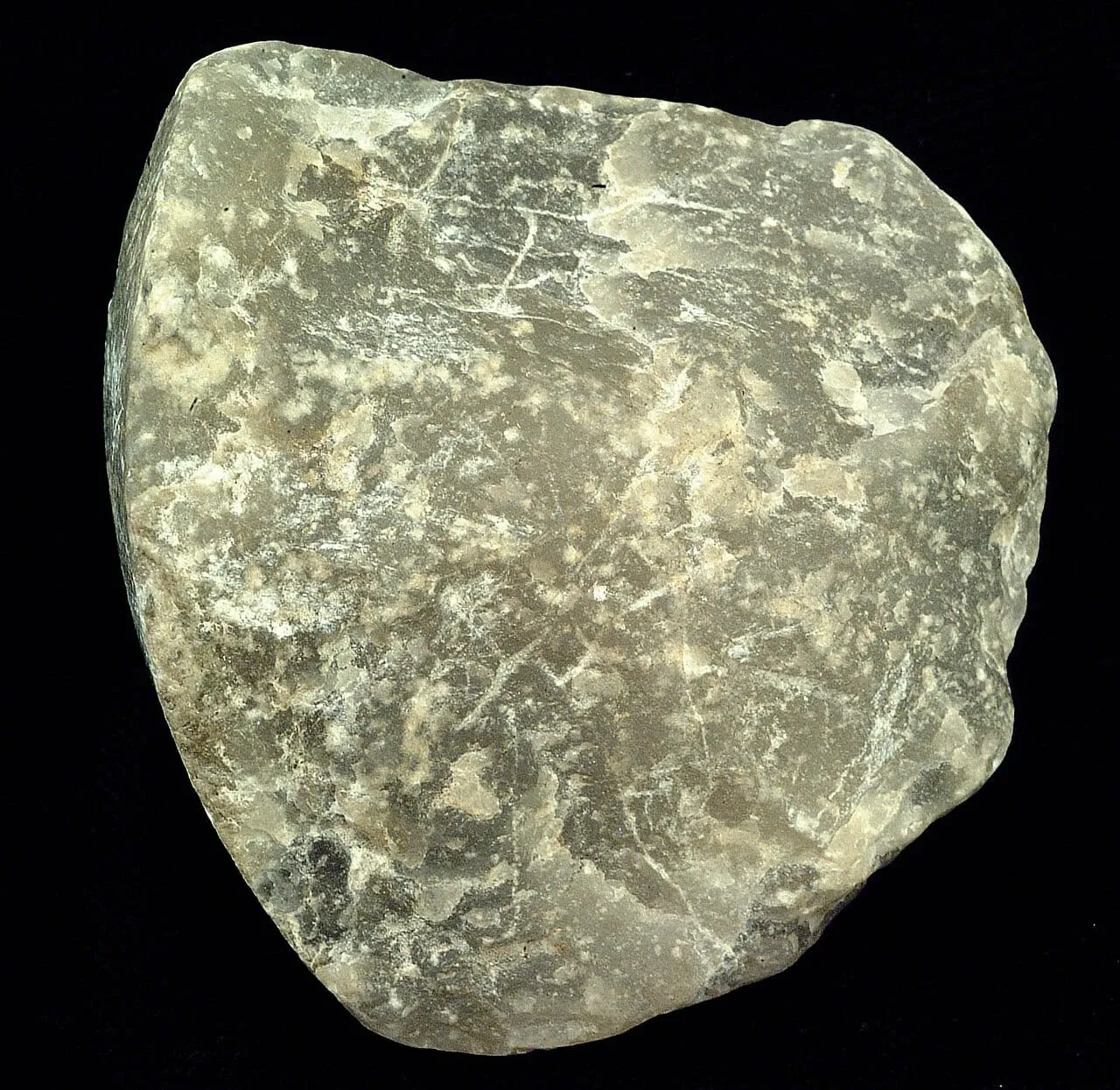
White, colourless or grey-white (it can also be brown, yellow, red or pale green); it often forms long bundles of silky or glassy needles and tabular masses. Pearly lustre shows on cleavage faces.
- 2
Mohs hardness is 4.5–5: the tip of a steel knife scratches it, but it does not scratch glass. Its density is about 2.9–3 g/cm³.
- 3
Fibrous masses split easily along their fibres; the Handbook of Mineralogy speaks of parallel fibrous masses with perfect cleavage. The streak is white.
- 4
It is usually intergrown with minerals such as calcite, garnet (grossular), diopside, vesuvianite and epidote at the boundary of limestone and igneous rock. A microscope or X-ray diffraction is needed for a sure identification.
Fakes and imitations
What shops usually don’t tell you:
- White fibrous tremolite, gypsum (satin spar) and white calcite can look like wollastonite. Gypsum is scratched by a fingernail (hardness 2). Calcite fizzes in dilute acid; pure wollastonite holds no carbonate and does not fizz, so fizzing points to a calcite admixture.
- Wollastonite is not asbestos, but because of its needle-like habit it is used in place of asbestos (USGS). The fibrous dust should still not be breathed.
Safety
Wollastonite is harmless to handle. It is a calcium silicate, not asbestos, and is used in place of asbestos (USGS); even so, the fine, needle-like dust raised in mining, grinding and pouring should not be breathed, and a dust mask should be worn for dusty work.
Myths and misconceptions
MythWollastonite is a kind of asbestos.
FactWollastonite is not asbestos but a calcium silicate mineral (CaSiO₃, of the pyroxenoid group). Because its needle-like habit resembles asbestos, it is used in place of asbestos in floor tiles, brake linings, insulating board, paint, plastics and roofing products (USGS, Wikipedia).
MythWollastonite is a calcium carbonate like calcite.
FactWollastonite is a calcium silicate, not a carbonate; it holds no carbon. The calcite in limestone reacts with quartz and releases carbon dioxide as it turns into wollastonite. It is useful in ceramics partly because, unlike calcite, it gives off no gas during firing.
Did you know?
Wollastonite is named after the English chemist and mineralogist William Hyde Wollaston (1766–1828).
According to Çınku and colleagues, adding 50 percent wollastonite to a ceramic body can cut the firing time from 20–70 hours to 1–2 hours, saving a great deal of energy and time.
Wollastonite forms from the reaction of quartz with limestone: SiO₂ + CaCO₃ → CaSiO₃ + CO₂. The carbon dioxide of the limestone escapes in the process, which is why it is an advantage in ceramics that wollastonite gives off no gas.
According to the USGS, the March 2024 ban by the US Environmental Protection Agency (EPA) on the remaining uses of chrysotile asbestos could increase the use of wollastonite in brake and friction products.
Where is it found?
Loading map…
- Willsboro, Essex County, New York, USA · Major depositAccording to Wikipedia, wollastonite in the USA is mined in Willsboro and Gouverneur, New York; according to the USGS, New York is the only state with long-term continuous mining. The point is the position of the town of Willsboro.
- Lappeenranta, South Karelia, Finland · Major depositLappeenranta in south-eastern Finland is among the places whose commercial wollastonite is often analysed in the literature (Çınku et al., 1997); the USGS counts Finland among the countries with large wollastonite deposits. The point is the position of the city of Lappeenranta.
- Pilares deposit, 55 km north of Hermosillo, Sonora, Mexico · Major depositThe Handbook of Mineralogy lists the Pilares deposit, 55 km north of Hermosillo, as one of the large deposits in Mexico. According to the USGS, Mexico produced about 112,000 tons of wollastonite in 2024. The point is an approximate match for that description.
- Rajasthan (Sirohi, Dungarpur, Udaipur, Pali and Ajmer districts), India · Major depositAccording to the Indian Bureau of Mines the main deposits lie in the Ajmer, Dungarpur, Pali, Sirohi and Udaipur districts of Rajasthan; the output of about 108,000 tons in 2021-22 came entirely from private-sector mines in Rajasthan. The point is the general position of the region.
- Dognecea, Caraș-Severin County, Romania · Historic sourceThe Handbook of Mineralogy lists Dognecea and Csiklova (Ciclova) in the Banat region of Romania among the prominent wollastonite localities. The point is the position of the village of Dognecea.
- Monte Somma and Vesuvius, Campania, Italy · Historic sourceThe Handbook of Mineralogy lists Sarrabus in Sardinia and Monte Somma and Vesuvius among the prominent Italian wollastonite localities. The point is the position of Vesuvius.
- Serçeören village area, Kepsut, Balıkesir, Türkiye · Major depositAccording to Erdinç (1984), Türkiye's first wollastonite production came from here in 1968; in the contact-metamorphic zone north-west of the village, wollastonite occurs in calc-silicate rocks with garnet, diopside, forsterite, vesuvianite and tremolite. About 500,000 tons of reserves are estimated and about 100,000 tons of pure wollastonite have been mined intermittently for the ceramics industry. The point is the position of the town of Kepsut.
- Tahtaköprü area (Demir Tepe), İnegöl, Bursa, Türkiye · Known localityAccording to Demange et al. (1998), the wollastonite-garnet skarns of Demir Tepe are developed in graphitic marbles that form roof pendants in the Tertiary Göynükbelen granodiorite pluton. In the table of Çınku et al. (1997) the Meşrutiye–Tahtaköprü deposit, at about 1.07 million tons (probable reserve), is Türkiye's largest recorded wollastonite reserve. The point is the position of the town of İnegöl.
- Karaköy area, Bayramiç, Çanakkale, Türkiye · Known localityAccording to Çınku et al. (1997), in the Kurcatepe–Katırlıkuyu pit 3 km north-east of Karaköy, in the Karakaya series of the Evciler pluton on the Biga Peninsula, fibrous wollastonite occurs with actinolite, garnet, epidote and calcite. The visible reserve was put at only 7,500 tons in 1996. The point is the position of the town of Bayramiç.
- Kırşehir Massif (Tamadağ Formation), Türkiye · Known localityAccording to Özkol and Kulaksız (1995), in the Kırşehir Massif, especially the Tamadağ Formation, 10–40 percent of the marble-like and calc-schist rocks is wollastonite; the occurrences form bands 1000 × 50–150 m in extent. The authors treat the area as a possible source of industrial raw material. The point is the position of the city of Kırşehir.
Locations are approximate to protect sites. Red dots mark places in Türkiye. Open in the big map →
Frequently asked questions
What is wollastonite?
Wollastonite is a white, needle-like or fibrous mineral made of calcium, silicon and oxygen (CaSiO₃). It forms when impure limestone is heated by contact with hot magma, so it is found with minerals such as garnet and diopside in the skarn zone between limestone and igneous rock. It is an industrial raw material because it reduces shrinkage and gas release in ceramic firing, serves as a filler in paint and plastics and can replace asbestos. China produces most of the world's wollastonite; the deposits in Türkiye are small.
What is wollastonite used for?
Ceramics: According to the USGS, wollastonite reduces shrinkage and gas release during firing, raises green and fired strength, allows fast firing and reduces glaze defects. It is used in wall tiles, tableware, electrical insulators and floor tiles. Paint: It gives paint low oil absorption, whiteness and brightness and a more durable paint film, and acts as a pH buffer. Plastics and rubber: It improves tensile and flexural strength and thermal and dimensional stability, and cuts resin consumption.
How hard is wollastonite?
It has a hardness of 4.5–5 on the Mohs scale. A fingernail cannot scratch it, but a steel knife can. Its specific gravity is 2.86–3.09 g/cm³.
Where is wollastonite found?
Its best-known localities: Willsboro, Essex County, New York, USA; Lappeenranta, South Karelia, Finland; Pilares deposit, 55 km north of Hermosillo, Sonora, Mexico; Rajasthan (Sirohi, Dungarpur, Udaipur, Pali and Ajmer districts), India; Serçeören village area, Kepsut, Balıkesir, Türkiye.
Where is wollastonite found in Türkiye?
Known localities in Türkiye: Serçeören village area, Kepsut, Balıkesir, Türkiye; Tahtaköprü area (Demir Tepe), İnegöl, Bursa, Türkiye; Karaköy area, Bayramiç, Çanakkale, Türkiye; Kırşehir Massif (Tamadağ Formation), Türkiye.
How can you tell if wollastonite is real?
White, colourless or grey-white (it can also be brown, yellow, red or pale green); it often forms long bundles of silky or glassy needles and tabular masses. Pearly lustre shows on cleavage faces. Mohs hardness is 4.5–5: the tip of a steel knife scratches it, but it does not scratch glass. Its density is about 2.9–3 g/cm³. Fibrous masses split easily along their fibres; the Handbook of Mineralogy speaks of parallel fibrous masses with perfect cleavage. The streak is white. White fibrous tremolite, gypsum (satin spar) and white calcite can look like wollastonite. Gypsum is scratched by a fingernail (hardness 2). Calcite fizzes in dilute acid; pure wollastonite holds no carbonate and does not fizz, so fizzing points to a calcite admixture.
Is wollastonite valuable?
On the “street to diamond” value ladder it sits on step 3 of nine: Building and industrial stone. Wollastonite is an industrial raw material sold by the ton, and its value depends on its purity, whiteness, iron content and grain shape. According to Çınku and colleagues, high-quality ceramics call for at least 49 percent SiO₂ and 45 percent CaO, at most 0.25 percent Fe₂O₃ and at most 1.5 percent loss on ignition; paint needs a grade and whiteness above 90 percent, and plastics at least 90 percent grade and 85–90 percent whiteness. The USGS notes that finer-grained and acicular (long and thin) particles, and surface treatment, raise the price. Türkiye's deposits are small and mixed with minerals such as garnet and diopside, so they need magnetic separation and flotation; the size of the deposit also counts.
Is wollastonite dangerous?
Wollastonite is harmless to handle. It is a calcium silicate, not asbestos, and is used in place of asbestos (USGS); even so, the fine, needle-like dust raised in mining, grinding and pouring should not be breathed, and a dust mask should be worn for dusty work.
Sources
- Türkiye Karaköy Vollastonit Cevherinin Zenginleştirilmesi (K. Çınku, B. İpekoğlu, A. Tulgarlar), 2. Endüstriyel Hammaddeler Sempozyumu · İstanbul Üniversitesi, Maden Mühendisliği Bölümü, 1997
- Kırşehir Masifi Vollastonitlerin Ön Teknolojik Çalışması (S. Özkol, S. Kulaksız), Endüstriyel Hammaddeler Sempozyumu · Hacettepe Üniversitesi, Maden Mühendisliği Bölümü, 1995
- Serçeören (Kepsut-Balıkesir) vollastonit yatağı (H. Erdinç), Uludağ Üniversitesi Mühendislik Dergisi 1(1) · Uludağ Üniversitesi, 1984
- Wollastonite-garnet skarns of Demir Tepe, Tahtakopru (province of Bursa, Turkey) (M. Demange ve ark.), Comptes Rendus de l'Académie des Sciences, Série IIA 326 · Elsevier, 1998
- Mineral Commodity Summaries 2026: Wollastonite · U.S. Geological Survey, 2026
- Handbook of Mineralogy: Wollastonite · Mineralogical Society of America
- Indian Minerals Yearbook 2021: Wollastonite · Indian Bureau of Mines, 2023
- Wollastonite · Wikipedia
External links
Draft: awaiting expert reviewReport an error ↗
On the same step
Albite
The white, sodium end of the feldspars: with its deposits at Çine–Milas, a glass and ceramics raw material that makes Türkiye one of the world’s main feldspar producers.
Alunite
The “alum stone” from which alum was made for centuries. Foça, Şaphane in Kütahya and Şebinkarahisar are Türkiye's old alum homelands.
Anhydrite
Gypsum without its water: a calcium sulfate mineral, whose blue-grey Peruvian form is sold as “angelite”.