Rock
Verd antique
Verde antico
Dark green fragments and white veins: the Thessalian stone, often mistaken for marble, that gave Hagia Sophia its giant columns.
Also known as: Verde antico · Marmor thessalicum · Thessalian green · Lapis Atracius · Ophicalcite · Ophite
- Popularly: Natural stone (building and decor)

In short
Verd antique (from the Italian verde antico, “ancient green”) is a serpentinite breccia in which dark green fragments of serpentine are bound together by a lighter green and white matrix. Polished, it looks like marble, but it is not a true marble. The Romans and above all the Byzantines quarried it near Larissa in Thessaly, Greece, and used it for columns and wall facing; the green columns of Hagia Sophia are made of it.
Photos

How does it form?
The main ingredient of verd antique is serpentinite. Serpentinite forms when mantle rocks (peridotite) from beneath the ocean crust react with water and turn into serpentine minerals. In verd antique this serpentinite was later broken up, and angular serpentinite fragments, along with a few pieces of marble and calc-silicate rock, were bound together again by a matrix of serpentine and calcite. The result is a breccia: a rock that looks as if it had been shattered and stuck back together.
Carbonate minerals such as calcite, dolomite or magnesite form its white veins and mottling. These carbonates are what let the stone take a marble-like polish.
What is it used for?
- Byzantine architecture: It was used widely in the great buildings of Byzantium, among them Hagia Sophia, the Little Hagia Sophia (Church of Saints Sergius and Bacchus), the Church of St Polyeuctus, the Stoudios Monastery and the Church of the Holy Apostles.
- Other famous buildings: The green stone also appears in the Dome of the Rock in Jerusalem, the Great Mosque of Córdoba, the Palatine Chapel at Aachen, St Mark’s Basilica in Venice, Westminster Cathedral in London and the Great Mosque of Kairouan in Tunisia.
- Today: Similar serpentinite breccias are quarried in California, Maryland, Georgia and Vermont in the USA and sold as “verd antique” for facing stone.
Where is it found?
Ancient verd antique came from the Chasambali quarries, about 12 km north-east of the city of Larissa in Greece, near the village of Omorfochori. The Romans called the stone “marmor thessalicum” (Thessalian marble). The quarries were worked in Roman and Byzantine times, reopened after a long gap at the end of the 19th century and closed for good in 1985 because of high costs. The Diachronic Museum of Larissa gives special attention to the history of this green stone.
In the USA, similar stones come from several quarries. The Cardiff quarry in Maryland was found in 1913, when a blast exposed the serpentinite, and in time it reached a depth of more than 90 metres. The dark green stone with white and greenish-white veins from near Rochester, Vermont, is sold as “Vermont Verde Antique”.
In Türkiye
The quarries of verd antique are in Greece, but the stone is very common in the historic buildings of Istanbul. In Hagia Sophia the most numerous and largest columns are verd antique: the shafts of the giant columns on the ground floor are about 8.5 metres tall, and every piece of the church’s ambo (pulpit) was made of it. The Ottomans also reused verd antique taken from Byzantine buildings: at the Green Mosque in İznik, pieces of it frame the window beside the mihrab, face wall panels and even form one step of the minaret.
What determines its value?
As an ornamental and building stone, its value depends on whether large, sound blocks can be quarried, on the beauty of the contrast between the dark green fragments and the white veins, on a consistent pattern and on how well it takes a polish. Because the historic Thessalian quarries closed in 1985, new blocks of the ancient stone are hard to come by, which adds to its interest.
This information is educational, not buying, selling or investment advice. Value varies enormously with quality and treatment.
How to recognise it
- 1
Dark green, angular fragments are surrounded by lighter green or white veins and mottling, so the stone looks as if it had been broken and glued back together.
- 2
Polished, it shines like glass, but its hardness is close to that of calcite: a steel knife scratches it easily.
- 3
The white veins fizz in dilute acid; the green serpentine parts do not.
- 4
A broken surface can look greasy or soapy.
Fakes and imitations
What shops usually don’t tell you:
- Ireland's Connemara marble is also patterned in green and white, but unlike verd antique it is a true marble.
- A similar breccia called “verde antico” is quarried in northern Italy; historically it lacks the white marble fragments of the Thessalian stone.
- In the trade, verd antique and other green serpentinites are often sold as “green marble”.
Safety
Serpentinites can contain chrysotile, a fibrous serpentine mineral and a form of asbestos. Polished stone is harmless to handle, but the dust from cutting, grinding and drilling should not be breathed in; wet cutting and a suitable mask should be used.
Myths and misconceptions
MythThe green columns of Hagia Sophia were brought from the Temple of Artemis at Ephesus.
FactThis is a legend from the late Middle Ages with no truth in it. The green columns of Hagia Sophia are verd antique quarried in Thessaly, near Larissa.
MythVerd antique is a kind of marble.
FactAlthough it looks like marble and is sold as such, verd antique is a serpentinite breccia made of serpentine fragments. Marble forms from metamorphosed limestone and consists almost entirely of calcite or dolomite.
Did you know?
One of its Latin names, “lapis Atracius”, comes from the ancient city of Atrax in Thessaly, near which it was quarried.
The Larissa quarries were forgotten after the reign of Emperor Justinian (6th century) and reopened only between 1895 and 1905.
A stone of the same kind from the Cardiff quarry in Maryland, USA, was used in the Empire State Building in New York.
Where is it found?
Loading map…
- Chasambali (near Omorfochori), Larissa, Thessaly, Greece · Type localityAncient quarries about 12 km north-east of Larissa, worked in Roman and Byzantine times, reopened between 1895 and 1905 and closed for good in 1985 because of high costs. The green columns of Hagia Sophia came from here.
- Cardiff, Maryland, USA · Known localityA serpentinite quarry discovered in 1913; its green stone was used in the Empire State Building in New York.
- Rochester, Vermont, USA · Known localitySource of the dark green, white-veined serpentinite sold as “Vermont Verde Antique”.
- Holly Springs, Georgia, USA · Known locality
- Victorville, California, USA · Known locality
Locations are approximate to protect sites. Red dots mark places in Türkiye. Open in the big map →
Frequently asked questions
What is verd antique?
Verd antique (from the Italian verde antico, “ancient green”) is a serpentinite breccia in which dark green fragments of serpentine are bound together by a lighter green and white matrix. Polished, it looks like marble, but it is not a true marble. The Romans and above all the Byzantines quarried it near Larissa in Thessaly, Greece, and used it for columns and wall facing; the green columns of Hagia Sophia are made of it.
What is verd antique used for?
Byzantine architecture: It was used widely in the great buildings of Byzantium, among them Hagia Sophia, the Little Hagia Sophia (Church of Saints Sergius and Bacchus), the Church of St Polyeuctus, the Stoudios Monastery and the Church of the Holy Apostles. Other famous buildings: The green stone also appears in the Dome of the Rock in Jerusalem, the Great Mosque of Córdoba, the Palatine Chapel at Aachen, St Mark's Basilica in Venice, Westminster Cathedral in London and the Great Mosque of Kairouan in Tunisia.
How hard is verd antique?
It has a hardness of 2.5–3.5 on the Mohs scale. A fingernail cannot scratch it, but a steel knife can. Its specific gravity is 2.5–2.8 g/cm³.
Where is verd antique found?
Its best-known localities: Chasambali (near Omorfochori), Larissa, Thessaly, Greece; Cardiff, Maryland, USA; Rochester, Vermont, USA; Holly Springs, Georgia, USA; Victorville, California, USA.
How can you tell if verd antique is real?
Dark green, angular fragments are surrounded by lighter green or white veins and mottling, so the stone looks as if it had been broken and glued back together. Polished, it shines like glass, but its hardness is close to that of calcite: a steel knife scratches it easily. The white veins fizz in dilute acid; the green serpentine parts do not. Ireland's Connemara marble is also patterned in green and white, but unlike verd antique it is a true marble.
Is verd antique valuable?
On the “street to diamond” value ladder it sits on step 4 of nine: Fine dimension stone and ore. As an ornamental and building stone, its value depends on whether large, sound blocks can be quarried, on the beauty of the contrast between the dark green fragments and the white veins, on a consistent pattern and on how well it takes a polish. Because the historic Thessalian quarries closed in 1985, new blocks of the ancient stone are hard to come by, which adds to its interest.
Is verd antique dangerous?
Serpentinites can contain chrysotile, a fibrous serpentine mineral and a form of asbestos. Polished stone is harmless to handle, but the dust from cutting, grinding and drilling should not be breathed in; wet cutting and a suitable mask should be used.
Sources
- Verd antique · Wikipedia
- Serpentinite · Wikipedia
- Corsi Collection of Decorative Stones, no. 565: Verde antico · Oxford University Museum of Natural History
- Columns and Capitals of Hagia Sophia · Pallasweb (Deesis)
- Diachronic Museum of Larissa: Unfolding millennia of Thessalian culture · Hellenic Heritage (Hellenic Ministry of Culture, ODAP)
- Temple of Artemis · Wikipedia
- İznik Yeşil Camii'ndeki Bizans Yapı Malzemeleri (Zeki Boleken) · Atatürk Kültür Merkezi Başkanlığı (AKMB)
- Cardiff, Maryland · Wikipedia
- Name and origin of stones: V · Quarries and Beyond
- Density of Solids · The Engineering ToolBox
External links
Draft: awaiting expert reviewReport an error
On the same step
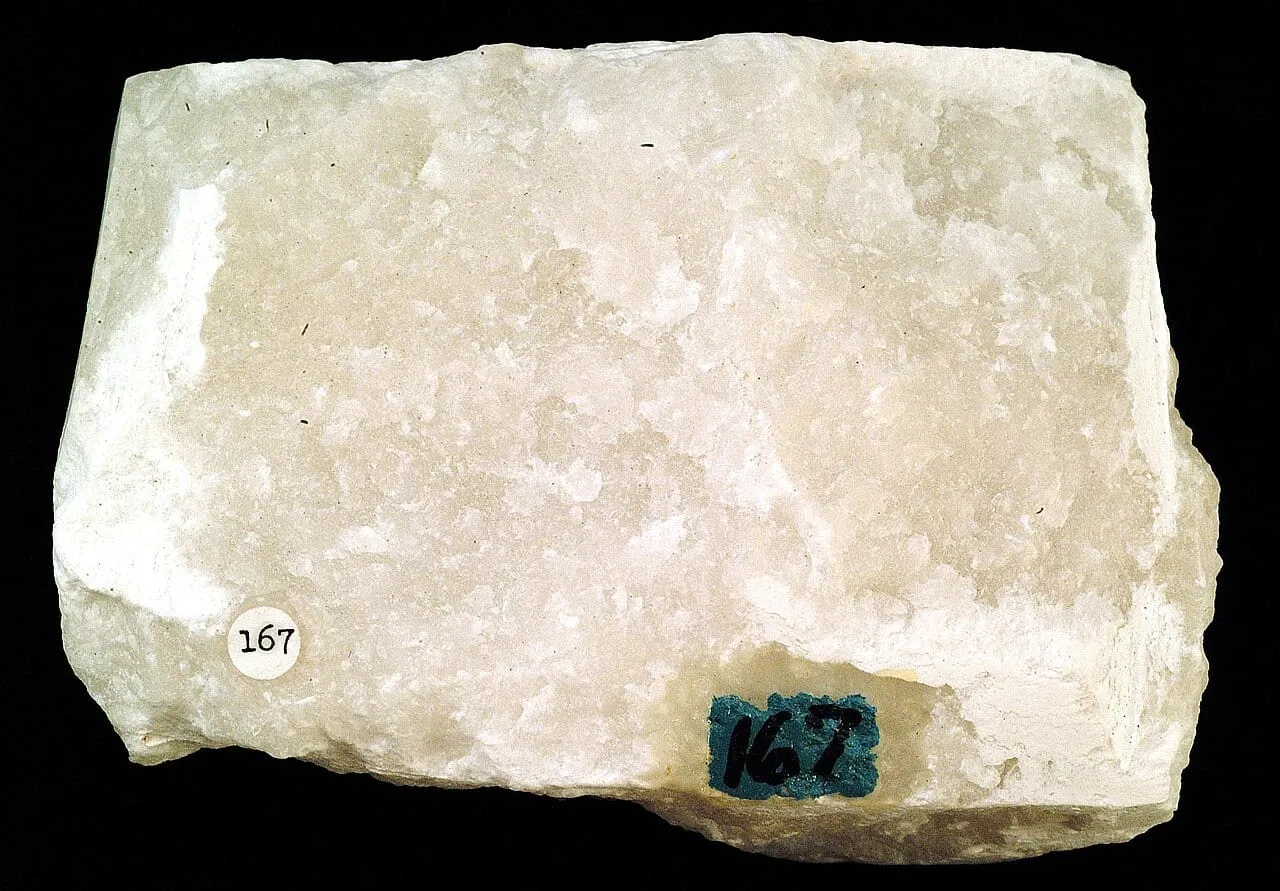
Alabaster
The fine-grained, translucent form of gypsum: a white stone soft enough to scratch with a fingernail, carved into statues, vessels and lamps for thousands of years.
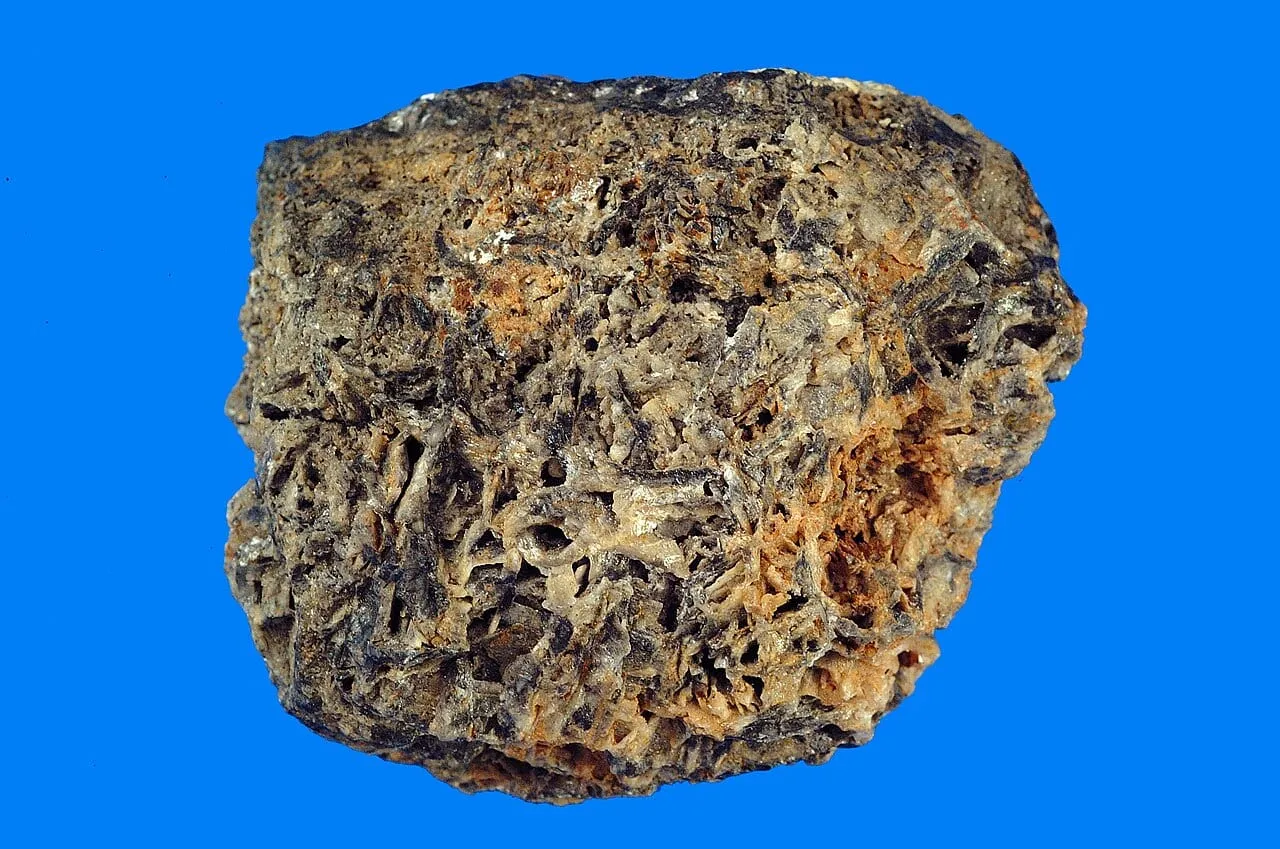
Anglesite
A heavy lead sulfate mineral with a diamond-like shine that grows as a crust around galena; it is named after the island of Anglesey in Wales.
Arsenopyrite
A widespread silvery-grey sulfide containing arsenic: it smells of garlic when struck and is poisonous.