Meteorite
Sarıçiçek meteorite
Sarıçiçek meteoriti
Meteorites that rained on village roofs in Bingöl in 2015: the first documented howardite fall, traced to Antonia crater on asteroid Vesta.
Also known as: Saricicek · Sariçiçek howardite
- Popularly: Meteorite

In short
The Sarıçiçek meteorite is a stony meteorite that fell on the night of 2 September 2015 on and around the village of Sarıçiçek in Bingöl, Türkiye. Small meteorites rained on the village's corrugated roofs; 343 stones were documented, totalling 24.78 kilograms. It is a eucrite-rich howardite, a rock from the crust of asteroid Vesta, and the first documented howardite fall. A 79-member international team found that it broke off Vesta's 16.7-kilometre Antonia crater about 22 million years ago.
How does it form?
Sarıçiçek comes from the crust of Vesta, the large asteroid between Mars and Jupiter. Vesta melted and separated into layers at the start of the Solar System; its crust is made of basalts called eucrites, and its deeper parts of pyroxenites called diogenites. Howardites are breccias formed when fragments of these two rocks mixed in the layer of dust and rubble on Vesta’s surface. Some minerals in Sarıçiçek crystallised about 4.55 billion years ago.
Cosmic-ray isotopes show that the material spent 12–14 million years in a layer near the asteroid’s surface. About 22 million years ago an impact on Vesta made Antonia crater and launched a boulder about 1 metre across into space. On 2 September 2015 it entered Earth’s atmosphere at about 17 kilometres per second.
What is it used for?
- Vesta’s history: Sarıçiçek underpins the first study linking the source of a large share of the HED meteorites from Vesta to Antonia crater.
- Impact hazard: It was used to assess the risk of Vesta-family asteroids hitting Earth.
- Science: Pieces whose ages, density and chemistry have been measured in detail help us understand the early Solar System.
In Türkiye
The meteorite fell at about 23:10 Turkish time on 2 September 2015 on and around the village of Sarıçiçek near the town of Bingöl. Istanbul University and Bingöl University ran a field expedition to the area on 29 September–4 October 2015. The results of the 79-member international team led by Assoc. Prof. Dr. Ozan Ünsalan of Ege University and Dr. Peter Jenniskens of the NASA-SETI Institute were published in 2019. Besides the documented stones, about 4.5 kilograms more were reported found, but these could not be verified.
What determines its value?
Sarıçiçek's value is above all scientific: being the first documented howardite fall, with its source crater on Vesta identified, makes it unique. After the fall, villagers sold the pieces they found to buyers from Türkiye and abroad, and the meteorite brought the village an income. A piece's value depends on its mass, the completeness of its fusion crust and its documented origin.
This information is educational, not buying, selling or investment advice. Value varies enormously with quality and treatment.
How to recognise it
- 1
The stones have a thin black fusion crust; inside they are light grey with light and dark fragments.
- 2
Being a stony meteorite, it contains very little iron–nickel metal.
- 3
Only documentation and laboratory analysis can show that a piece really comes from Sarıçiçek.
Myths and misconceptions
MythThere is no way to know where in space a meteorite came from.
FactIf a fireball is filmed by several cameras, its orbit can be calculated. For Sarıçiçek, video recordings, spectral measurements and isotope ages were combined to trace the meteorite to Antonia crater on asteroid Vesta.
Did you know?
“Sarıçiçek”, which the paper explains is Turkish for “Yellow-Flower”, is the meteorite's official name as accepted by the Meteoritical Society.
The footage of video cameras that caught the fireball was calibrated on site, with help from the villagers, and showed that the meteoroid came in from the northwest at about 17 kilometres per second.
The meteoroid broke up at 37, 33, 31 and 27 kilometres altitude; more than 95% of its mass dispersed before reaching the ground.
Where is it found?
Loading map…
- Sarıçiçek village and surroundings, Bingöl · Type localityOn the night of 2 September 2015, small meteorites fell on the village's corrugated roofs. 343 stones were documented, totalling 24.78 kg; the largest weighs 1.47 kg. The point marks the town of Bingöl.
Locations are approximate to protect sites. Red dots mark places in Türkiye. Open in the big map →
Frequently asked questions
What is sarıçiçek meteorite?
The Sarıçiçek meteorite is a stony meteorite that fell on the night of 2 September 2015 on and around the village of Sarıçiçek in Bingöl, Türkiye. Small meteorites rained on the village's corrugated roofs; 343 stones were documented, totalling 24.78 kilograms. It is a eucrite-rich howardite, a rock from the crust of asteroid Vesta, and the first documented howardite fall. A 79-member international team found that it broke off Vesta's 16.7-kilometre Antonia crater about 22 million years ago.
How was the Sarıçiçek meteorite shown to come from Vesta?
Video recordings of the fireball allowed the meteoroid's orbit before reaching Earth to be calculated, giving the first dynamical link to the inner asteroid belt. The meteorite's spectrum resembles that of Vesta-family asteroids. Cosmic-ray isotopes showed that it was launched by an impact 22 ± 2 million years ago, and the 16.7-kilometre Antonia crater in Vesta's south was found to have formed about that long ago, on terrain of the same age.
What is sarıçiçek meteorite used for?
Vesta's history: Sarıçiçek underpins the first study linking the source of a large share of the HED meteorites from Vesta to Antonia crater. Impact hazard: It was used to assess the risk of Vesta-family asteroids hitting Earth. Science: Pieces whose ages, density and chemistry have been measured in detail help us understand the early Solar System.
How hard is sarıçiçek meteorite?
It has a hardness of 5–6.5 on the Mohs scale. It can scratch glass; a steel knife scratches it only with difficulty. Its specific gravity is 2.89–2.93 g/cm³.
Where is sarıçiçek meteorite found?
Its best-known localities: Sarıçiçek village and surroundings, Bingöl.
Where is sarıçiçek meteorite found in Türkiye?
Known localities in Türkiye: Sarıçiçek village and surroundings, Bingöl.
How can you tell if sarıçiçek meteorite is real?
The stones have a thin black fusion crust; inside they are light grey with light and dark fragments. Being a stony meteorite, it contains very little iron–nickel metal. Only documentation and laboratory analysis can show that a piece really comes from Sarıçiçek.
Is sarıçiçek meteorite valuable?
On the “street to diamond” value ladder it sits on step 6 of nine: Fine ornamental and collector stone. Sarıçiçek's value is above all scientific: being the first documented howardite fall, with its source crater on Vesta identified, makes it unique. After the fall, villagers sold the pieces they found to buyers from Türkiye and abroad, and the meteorite brought the village an income. A piece's value depends on its mass, the completeness of its fusion crust and its documented origin.
Sources
- The Sariçiçek howardite fall in Turkey: Source crater of HED meteorites on Vesta and impact risk of Vestoids (O. Unsalan et al.), Meteoritics & Planetary Science 54 · The Meteoritical Society, 2019
- Sarıçiçek gök taşı Vesta'dan gelmiş · İstiklal, 2019
- Bingöl'e düşen göktaşı köylülere ekonomik gelir oldu · Yeni Akit
- Handbook of Mineralogy: Enstatite · Mineralogical Society of America
- Bingöl · Wikipedia
Draft: awaiting expert reviewReport an error
On the same step
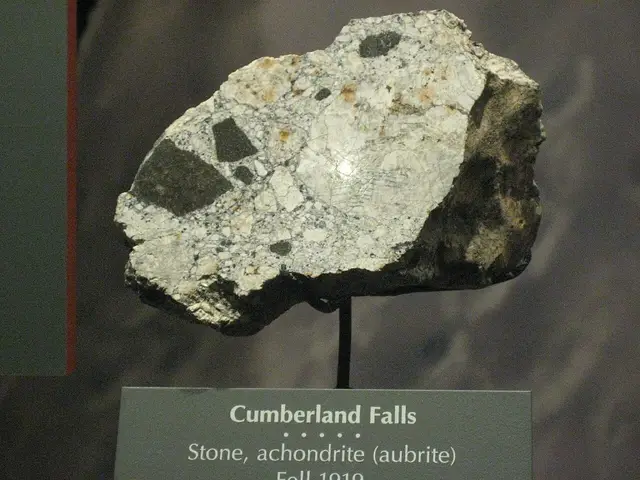
Achondrite
Stony meteorites with no chondrules: rock from melted asteroids, the Moon and Mars, and hard to recognise because they look like Earth rocks.
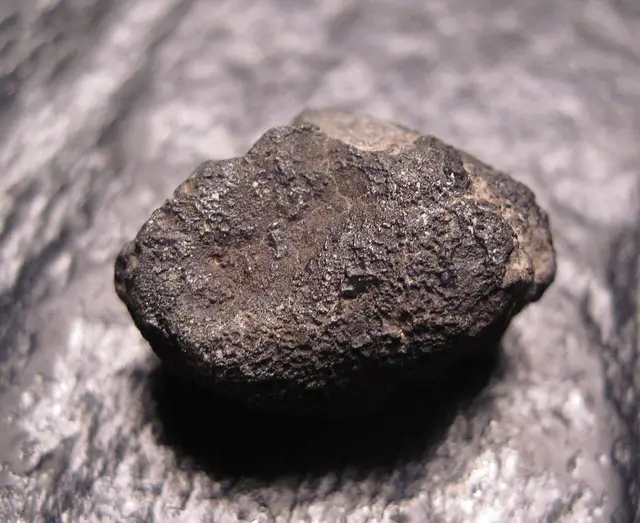
Allende meteorite
The most studied meteorite in history: the largest carbonaceous chondrite, which fell in Mexico in 1969 carrying the first solids of the Solar System.
Amber
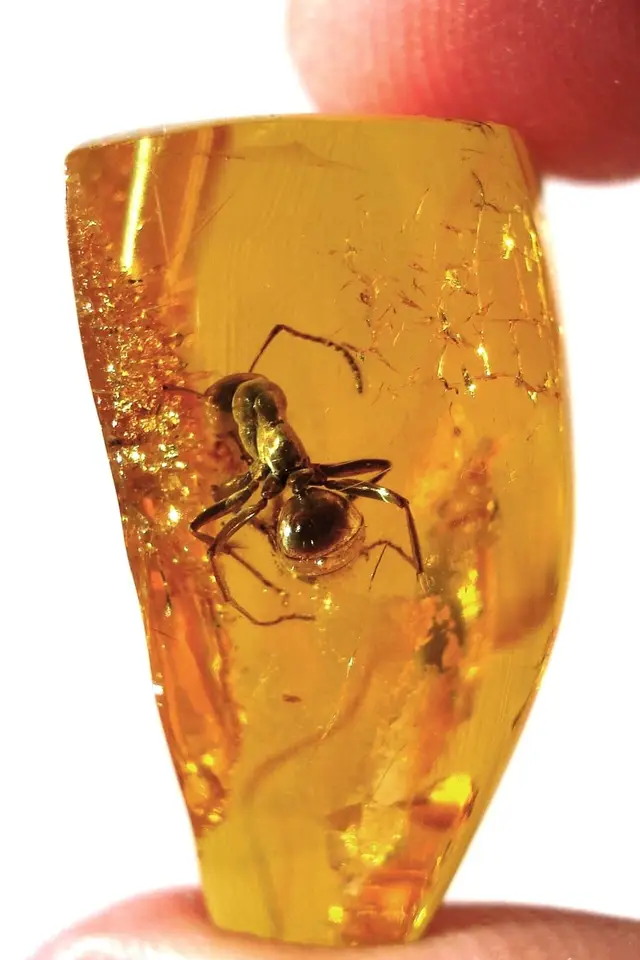
Tree resin fossilised over millions of years: a light, warm organic gem that sometimes holds prehistoric insects.