Rock
Purbeck Marble
Purbeck mermeri
A “marble” built of snail shells: the Dorset stone that gave England's medieval cathedrals their slender dark columns.
Also known as: Purbeck marble
- Popularly: Natural stone (building and decor)

In short
Purbeck Marble is a limestone packed with the shells of freshwater snails, quarried on the Isle of Purbeck in Dorset, southern England. It is called “marble” because it takes a fine polish, but it is not a true marble transformed by heat and pressure. It has been used since Roman times, and won its fame in the 12th and 13th centuries in the slender shafts, tomb effigies and fonts of great churches such as Salisbury, Canterbury and Westminster.
Photos

How does it form?
Purbeck Marble was laid down about 143–137 million years ago, at the start of the Early Cretaceous (in the Berriasian stage). At that time the area of today’s Dorset held waters teeming with freshwater snails called Viviparus. The shells of dead snails sank with fine lime mud and built up into dense shell beds. Over time the mud hardened, the spaces between the shells filled with crystalline calcite cement, and the stone became compact enough to take a polish.
These beds lie towards the top of the Durlston Formation in the rock sequence geologists call the Purbeck Group, and none is more than 1.2 metres thick. Iron oxides (hematite, limonite) in some beds give the stone red or brown colours, while glauconite in others makes it green, or occasionally blue. Because the stone never went through metamorphism, the snail shells are still clearly visible.
What is it used for?
- Roman times: In Roman Britain the stone was used for inscriptions, architectural mouldings, veneers, and mortars and pestles.
- Medieval cathedrals: It was used most between 1170 and 1540, above all in the 13th century for tall, slender, clustered shafts. It can be seen as columns, panels and flooring in virtually all the cathedrals of southern England, among them Salisbury, Canterbury, Exeter, Ely, Norwich, Chichester, Lincoln, Southwark, Llandaff and Westminster Abbey. The arches of the Temple Church in London also rest on Purbeck Marble shafts.
- Tomb effigies and fonts: From the mid-13th century, makers of tombs and effigies specialised in this stone; at Canterbury it was used for the tomb of the Black Prince and those of several archbishops. Many village churches have fonts made of it.
- Later times: Its use declined in the 14th and 15th centuries. Kingston church (1874–1880) is a remarkable Victorian example, and the sculptor Emily Young works with the stone today.
The stone’s weak point is damp: the small amount of iron in its cement rusts in wet conditions and the snail shells fall apart. That is why it lasts best indoors.
Where is it found?
The Purbeck Marble beds run right across the Isle of Purbeck in south-east Dorset, from Worbarrow Tout in the west to Peveril Point at Swanage in the east. Pits dating from Roman times, counted among England’s earliest stone quarries, stretch along the valley side north of Langton Matravers; in the Middle Ages they were extended westwards for the cathedrals. The village of Corfe Castle was the centre of medieval marble carving, and the stone was quarried close to the coast and shipped to distant towns. Other limestone beds of Purbeck are still quarried today.
What determines its value?
As a building and ornamental stone, its value depends on the thickness and soundness of the bed, the evenness of the colour (blue, green or red), a dense and even spread of snail shells and how well it polishes. Because it decays in damp conditions, sound, crack-free pieces for indoor use are the most sought after. Its real value comes from its place in medieval cathedrals and the need for the same stone when those buildings are repaired.
This information is educational, not buying, selling or investment advice. Value varies enormously with quality and treatment.
How to recognise it
- 1
On a polished surface, pale ring- and crescent-shaped cross-sections of small snail shells are packed closely in a dark matrix.
- 2
It is usually bluish grey or greenish; reddish and brown kinds also occur.
- 3
Pieces left outdoors or in damp places for a long time roughen, the snail shells begin to fall apart and rust stains may appear.
- 4
Being a limestone, it fizzes in dilute acid and can be scratched by a steel knife.
Fakes and imitations
What shops usually don’t tell you:
- Sussex Marble, from south-east England, is also a limestone full of Viviparus snail shells and is confused with Purbeck Marble. The shells in Sussex Marble are larger; those in Purbeck Marble are usually smaller than 8 × 4 mm.
- Not every limestone from the Isle of Purbeck is Purbeck Marble: the name is given only to beds containing a large proportion of Viviparus shells.
Myths and misconceptions
MythPurbeck Marble is a true marble.
FactIt is called marble because it takes a fine polish, but it is not a rock transformed by heat and pressure. It is a fossil-rich limestone formed when freshwater snail shells piled up in fine lime mud.
MythThe red Purbeck Marble slabs in old buildings came out of the quarry red.
FactAccording to studies at Canterbury Cathedral, many of the red-looking slabs actually come from the green bed. The iron-rich mineral glauconite that makes the stone green oxidises to red after the stone has been laid.
Did you know?
A Bronze Age stone burial chest (cist) made of Purbeck Marble was found at Langton Matravers.
An iron bell with two seats inside was found in old quarries near Langton Matravers; it is thought to have been used to lower quarrymen into the workings.
The 13th-century King's Table, once used at English coronations, is also made of Purbeck Marble.
Every Shrove Tuesday the Purbeck marblers gather at Corfe Castle to admit new apprentices to their company; then they play football in the street and kick the ball towards the old Ower Quay, where the stone was loaded onto boats in the Middle Ages.
Where is it found?
Loading map…
- Langton Matravers, Isle of Purbeck, Dorset, England · Type localityEngland's earliest stone quarries, dating from Roman times, run along the valley side north of the village and were extended westwards to build the medieval cathedrals. The village museum tells the story of the quarrying.
- Corfe Castle, Dorset, England · Historic sourceIn the Middle Ages the village had a large marble-carving and stone-cutting industry; the stone was sent across the country from Ower Quay in Poole Harbour.
- Peveril Point, Swanage, Dorset, England · Known localityThe eastern end of the strip in which the Purbeck Marble beds cross the peninsula.
- Worbarrow Tout, Dorset, England · Known localityThe western end of the strip in which the Purbeck Marble beds cross the peninsula.
Locations are approximate to protect sites. Red dots mark places in Türkiye. Open in the big map →
Frequently asked questions
What is purbeck Marble?
Purbeck Marble is a limestone packed with the shells of freshwater snails, quarried on the Isle of Purbeck in Dorset, southern England. It is called “marble” because it takes a fine polish, but it is not a true marble transformed by heat and pressure. It has been used since Roman times, and won its fame in the 12th and 13th centuries in the slender shafts, tomb effigies and fonts of great churches such as Salisbury, Canterbury and Westminster.
What is purbeck Marble used for?
Roman times: In Roman Britain the stone was used for inscriptions, architectural mouldings, veneers, and mortars and pestles. Medieval cathedrals: It was used most between 1170 and 1540, above all in the 13th century for tall, slender, clustered shafts. It can be seen as columns, panels and flooring in virtually all the cathedrals of southern England, among them Salisbury, Canterbury, Exeter, Ely, Norwich, Chichester, Lincoln, Southwark, Llandaff and Westminster Abbey. The arches of the Temple Church in London also rest on Purbeck Marble shafts.
How hard is purbeck Marble?
It has a hardness of 3 on the Mohs scale. A fingernail cannot scratch it, but a steel knife can. Its specific gravity is 2.7–2.8 g/cm³.
Where is purbeck Marble found?
Its best-known localities: Langton Matravers, Isle of Purbeck, Dorset, England; Corfe Castle, Dorset, England; Peveril Point, Swanage, Dorset, England; Worbarrow Tout, Dorset, England.
How can you tell if purbeck Marble is real?
On a polished surface, pale ring- and crescent-shaped cross-sections of small snail shells are packed closely in a dark matrix. It is usually bluish grey or greenish; reddish and brown kinds also occur. Pieces left outdoors or in damp places for a long time roughen, the snail shells begin to fall apart and rust stains may appear. Sussex Marble, from south-east England, is also a limestone full of Viviparus snail shells and is confused with Purbeck Marble. The shells in Sussex Marble are larger; those in Purbeck Marble are usually smaller than 8 × 4 mm.
Is purbeck Marble valuable?
On the “street to diamond” value ladder it sits on step 4 of nine: Fine dimension stone and ore. As a building and ornamental stone, its value depends on the thickness and soundness of the bed, the evenness of the colour (blue, green or red), a dense and even spread of snail shells and how well it polishes. Because it decays in damp conditions, sound, crack-free pieces for indoor use are the most sought after. Its real value comes from its place in medieval cathedrals and the need for the same stone when those buildings are repaired.
Sources
- Purbeck Marble · Wikipedia
- Purbeck Marble (building stones of Canterbury Cathedral) · Canterbury Archaeological Trust
- Sussex Marble · Dorset Building Stone
- Medieval marble quarries, Talbots Wood, Langton Matravers (MDO30751) · Dorset Historic Environment Record
- Langton Matravers · Dorset Life
- Langton Matravers · Wikipedia
- Corfe Castle (village) · Wikipedia
- Shrove Tuesday Football Ceremony of the Purbeck Marblers · Wikipedia
- Peveril Point · Wikipedia
- Worbarrow Bay · Wikipedia
- Berriasian · Wikipedia
- Density of Solids · The Engineering ToolBox
- Limestone · Geology.com
External links
Draft: awaiting expert reviewReport an error
On the same step
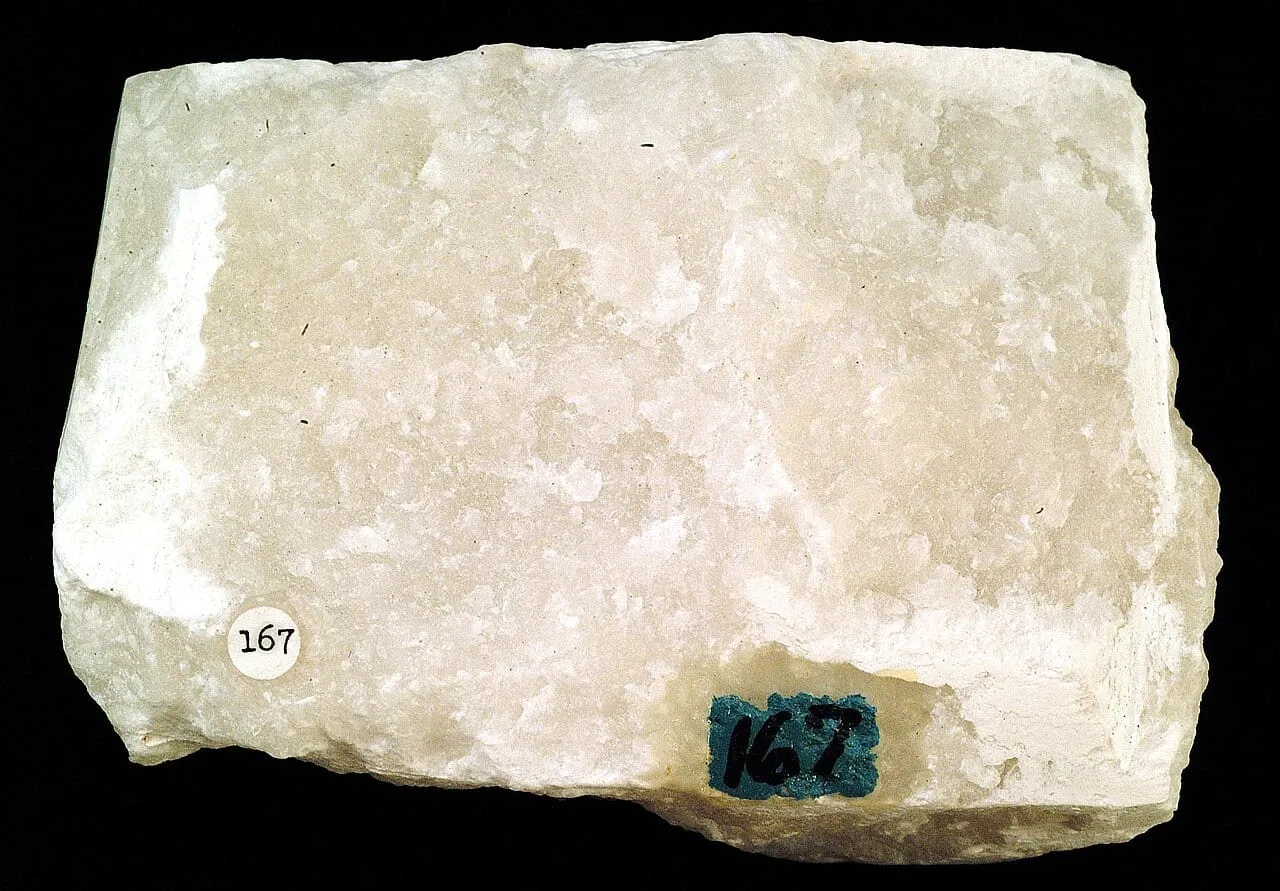
Alabaster
The fine-grained, translucent form of gypsum: a white stone soft enough to scratch with a fingernail, carved into statues, vessels and lamps for thousands of years.
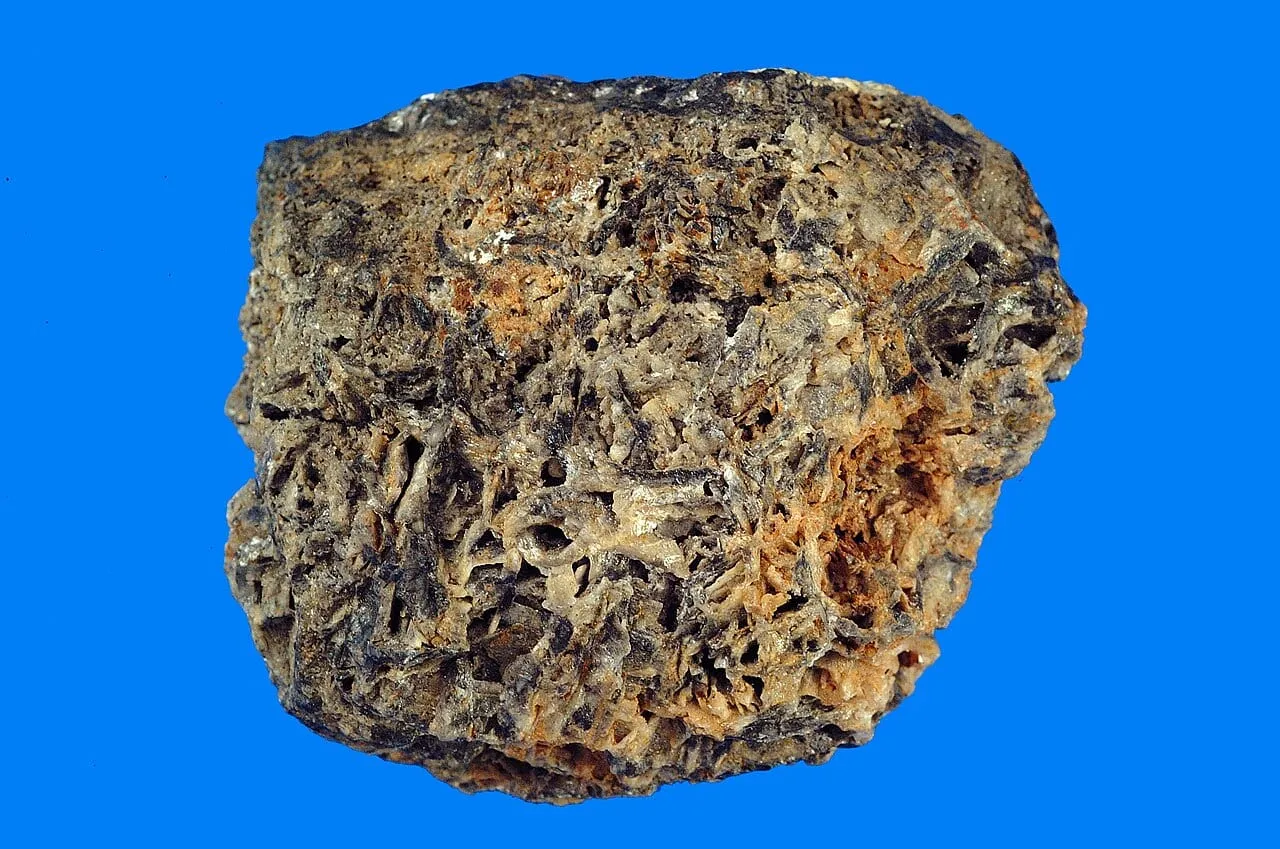
Anglesite
A heavy lead sulfate mineral with a diamond-like shine that grows as a crust around galena; it is named after the island of Anglesey in Wales.
Arsenopyrite
A widespread silvery-grey sulfide containing arsenic: it smells of garlic when struck and is poisonous.