Rock
Phyllite
Fillit
Between slate and schist: a silky-sheened rock whose mica flakes are too small to see, yet make its surface gleam silver in the light.
- Popularly: Natural stone (building and decor)
- Building stone

In short
Phyllite is a fine-grained metamorphic rock that forms when clay-rich sedimentary rocks (shale, mudstone) or slate are put through a little more heat and pressure deep in the crust. Its mica flakes have grown larger than in slate and line up in one direction, giving the surface a silky, silvery sheen; but they are not as big as in schist, so they cannot be picked out by eye. The name comes from the Greek phyllon, “leaf”.
Photos

How does it form?
Phyllite is a low-grade metamorphic rock. It usually forms from clay-rich sedimentary rocks such as shale or mudstone, or from slate, their first stage of change. When mountain building buries these rocks deeper in the crust, temperature and pressure rise: clay minerals turn into fine-grained mica (sericite) and chlorite, and the flakes grow and line up in one direction. As the alignment improves, the rock gains a tendency to split into sheets.
As heat and pressure increase, the sequence runs shale → slate → phyllite → schist → gneiss. Phyllite sits right in the middle of this ladder: coarser than slate, finer than schist.
What is it used for?
- Roofing and wall cladding: Phyllites that split into even sheets and resist water can be used for roofing and facades, much like slate.
- Paving and garden stone: Trimmed phyllite slabs are used for paths, garden walks and walling, and the offcuts as decorative gravel and aggregate.
- Memorials and writing slates: It is sometimes used for gravestones, commemorative tablets and writing slates.
- Science: The presence of phyllite is a clue to how much heat and pressure the rocks of a region have been through.
In Türkiye
In Türkiye, phyllites crop out in the Menderes Massif of western Anatolia. Among the upper-plate rocks of the massif, phyllites occur alongside schists and slates. The higher-grade rocks in the core of the massif are gneisses and schists.
What determines its value?
Phyllite is an abundant, inexpensive rock, used in many places as local building and cladding stone. Its value depends on whether it splits into thin, even and sound sheets, on the sheen and colour of its surface, on its resistance to water and frost, and on how close the quarry is to where it is used. It is not sought after as a collector's or ornamental stone.
This information is educational, not buying, selling or investment advice. Value varies enormously with quality and treatment.
How to recognise it
- 1
The surface has a silky, silvery or slightly golden sheen; this “phyllitic lustre” is the best clue for telling it from slate, whose fresh broken surfaces are dull.
- 2
It often has a crinkled or wavy surface, and it splits into sheets.
- 3
The mica grains can hardly be seen with the naked eye; if you can pick out individual flakes, the rock is probably schist.
- 4
It is grey, blackish or greenish grey, and weathered surfaces turn brownish.
- 5
A steel knife scratches it but it cannot scratch glass; it does not fizz in vinegar or dilute acid.
Fakes and imitations
What shops usually don’t tell you:
- In the trade phyllite is often sold as “slate”; since it does the same job as roofing and cladding sheets, the name is common in everyday speech, but geologically it is a different rock.
- It can be confused with fine-grained mica schist; in schist the mica flakes can be seen by eye, in phyllite they cannot.
Safety
Phyllite is harmless to handle. Cutting and grinding produce fine dust that contains quartz; wet cutting and a proper mask keep it from being breathed in.
Myths and misconceptions
MythPhyllite and slate are the same stone.
FactThey belong to the same family but are not the same: phyllite has been through one step more heat and pressure than slate. Its mica grains are larger and its surface gleams silky, where slate's is dull.
Did you know?
The name phyllite comes from the Greek phyllon, “leaf”: the rock splits into thin, leaf-like sheets.
Mount Patscherkofel (2,246 m), just south of Innsbruck, is made mainly of quartz phyllite; in Tyrol this body of rock is known as the Innsbruck Quartz Phyllite.
Where is it found?
Loading map…
- Patscherkofel, south of Innsbruck, Tyrol, Austria · Known localityThe Innsbruck Quartz Phyllite is a Palaeozoic rock body southeast of Innsbruck; quartz phyllite is the main bedrock of Mount Patscherkofel.
- Isle of Arran, Scotland · Known localityPhyllite is common among the Dalradian metasediments of north-western Arran.
- North Cornwall, England · Known localityThe Tredorn and Woolgarden phyllites of north Cornwall are known examples from this region.
- Great Smoky Mountains, Tennessee and North Carolina, USA · Known localityThe Ocoee Supergroup, which makes up most of the mountains, consists of slightly metamorphosed sandstones, phyllites, schists and slate.
- Crete, Greece · Known localityThe Phyllite–Quartzite Unit of Crete and the Peloponnese consists of rocks metamorphosed at high pressure and low temperature.
- Menderes Massif, western Anatolia, Türkiye · Known localityPhyllites occur among the upper-plate rocks of the massif, together with schists and slates.
Locations are approximate to protect sites. Red dots mark places in Türkiye. Open in the big map →
Frequently asked questions
What is phyllite?
Phyllite is a fine-grained metamorphic rock that forms when clay-rich sedimentary rocks (shale, mudstone) or slate are put through a little more heat and pressure deep in the crust. Its mica flakes have grown larger than in slate and line up in one direction, giving the surface a silky, silvery sheen; but they are not as big as in schist, so they cannot be picked out by eye. The name comes from the Greek phyllon, “leaf”.
What is phyllite used for?
Roofing and wall cladding: Phyllites that split into even sheets and resist water can be used for roofing and facades, much like slate. Paving and garden stone: Trimmed phyllite slabs are used for paths, garden walks and walling, and the offcuts as decorative gravel and aggregate. Memorials and writing slates: It is sometimes used for gravestones, commemorative tablets and writing slates. Science: The presence of phyllite is a clue to how much heat and pressure the rocks of a region have been through.
How hard is phyllite?
It has a hardness of 3–5.5 on the Mohs scale. A fingernail cannot scratch it, but a steel knife can. Its specific gravity is 2.7–2.8 g/cm³.
Where is phyllite found?
Its best-known localities: Patscherkofel, south of Innsbruck, Tyrol, Austria; Isle of Arran, Scotland; North Cornwall, England; Great Smoky Mountains, Tennessee and North Carolina, USA; Crete, Greece.
Where is phyllite found in Türkiye?
Known localities in Türkiye: Menderes Massif, western Anatolia, Türkiye.
How can you tell if phyllite is real?
The surface has a silky, silvery or slightly golden sheen; this “phyllitic lustre” is the best clue for telling it from slate, whose fresh broken surfaces are dull. It often has a crinkled or wavy surface, and it splits into sheets. The mica grains can hardly be seen with the naked eye; if you can pick out individual flakes, the rock is probably schist. In the trade phyllite is often sold as “slate”; since it does the same job as roofing and cladding sheets, the name is common in everyday speech, but geologically it is a different rock.
Is phyllite valuable?
On the “street to diamond” value ladder it sits on step 2 of nine: Raw material by the tonne. Phyllite is an abundant, inexpensive rock, used in many places as local building and cladding stone. Its value depends on whether it splits into thin, even and sound sheets, on the sheen and colour of its surface, on its resistance to water and frost, and on how close the quarry is to where it is used. It is not sought after as a collector's or ornamental stone.
Is phyllite dangerous?
Phyllite is harmless to handle. Cutting and grinding produce fine dust that contains quartz; wet cutting and a proper mask keep it from being breathed in.
Sources
- Phyllite · Wikipedia
- Phyllite · Encyclopaedia Britannica
- Phyllite: Identification, Properties & Lookalikes · Rockhounding.org
- Phyllite · Geology.com
- Phyllite vs. slate: differences and characteristics · Cupa Pizarras
- Slate · Wikipedia
- Innsbruck Quartz Phyllite (Innsbrucker Quarzphyllit) · Austria-Forum, Austrian Lexicon (AEIOU)
- Patscherkofel · Wikipedia
- Isle of Arran · Wikipedia
- Great Smoky Mountains · Wikipedia
- Crete · Wikipedia
- Carpholite, sudoite and chloritoid in low grade high pressure metapelites from Crete and the Peloponnese, Greece · European Journal of Mineralogy
- Menderes Masifi'nin Geç Senozoyik'te Asimetrik ve Simetrik Çekirdek Kompleksi Olarak Yüzeyleme ve Parçalanma Tarihçesi (Işık & Seyitoğlu) · Menderes Masifi Kolokyumu, Genişletilmiş Bildiri Özleri Kitabı
External links
Draft: awaiting expert reviewReport an error ↗
On the same step
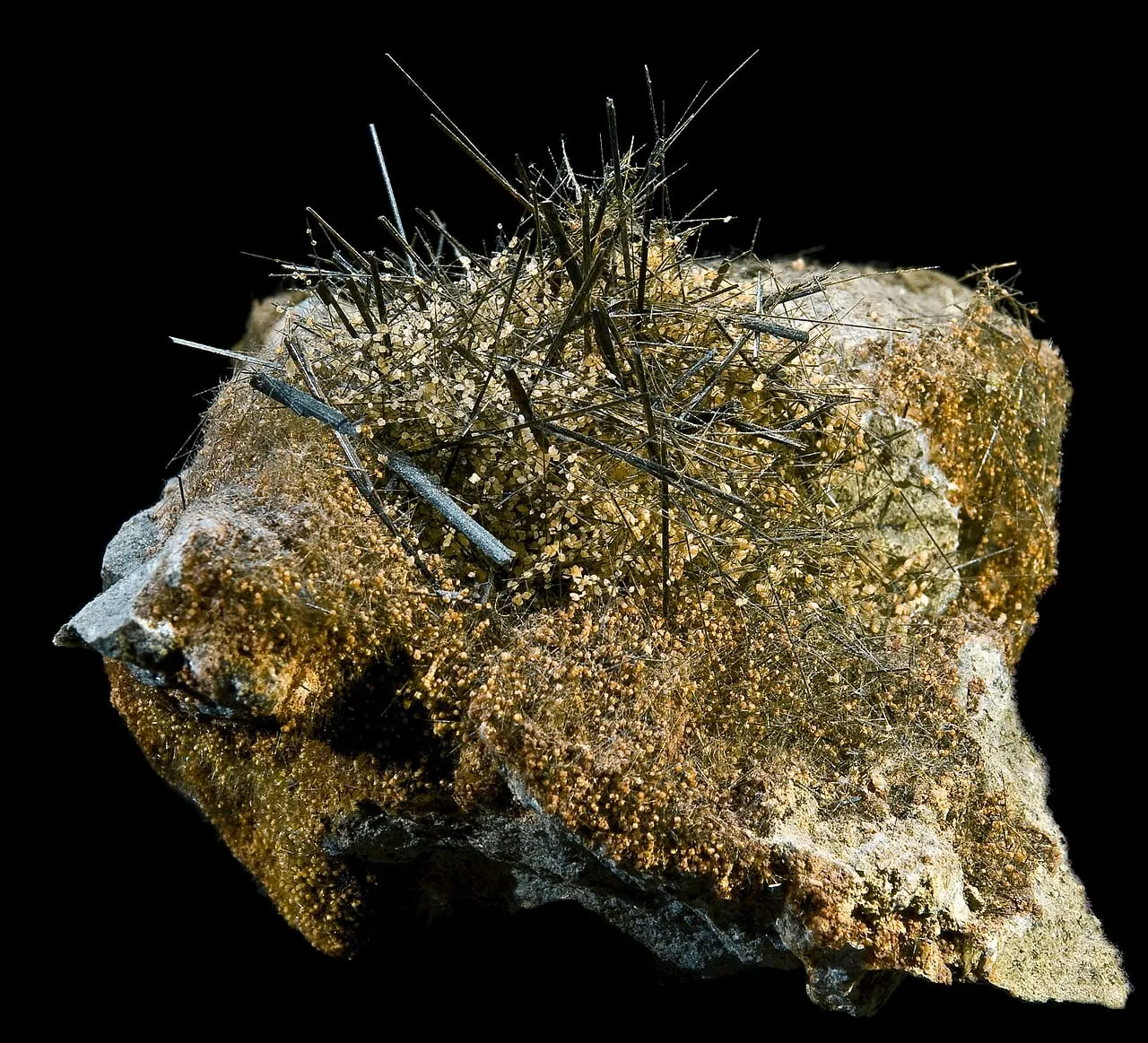
Actinolite
A green amphibole that grows like rays: a raw material of nephrite jade and cat's-eye stones; its fibrous form is asbestos.
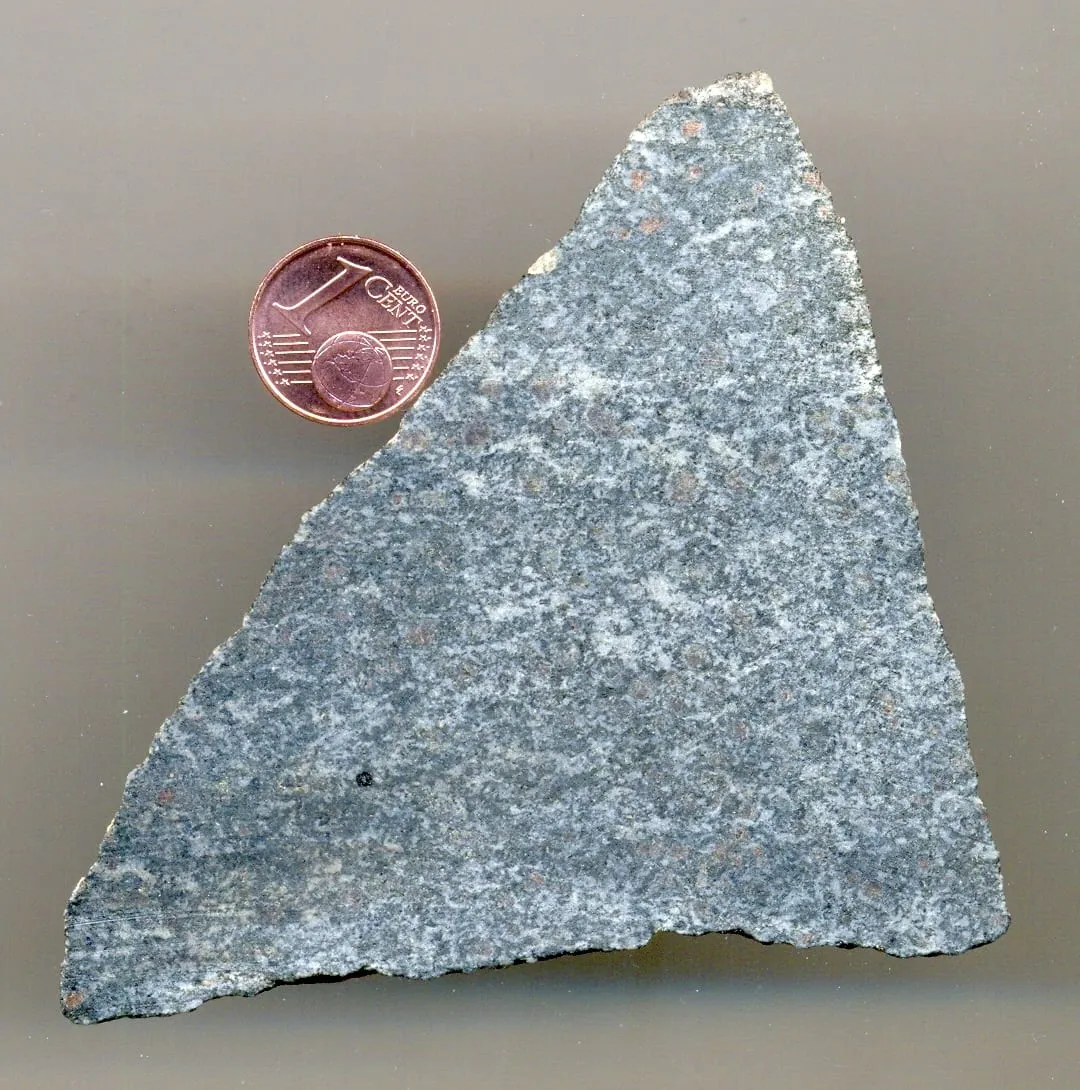
Amphibolite
A dark, heavy, salt-and-pepper metamorphic rock: basalt or gabbro transformed at depth; the stone of Neolithic axes.
Andesite
The rock of volcanic arcs, named after the Andes — and the pink-grey stone of Ankara Castle.