Rock
Petit Granit
Petit granit
Called “little granite” but not granite at all: Belgium's blue limestone, packed with sea-lily fossils, that polishes to a shiny black.
Also known as: Belgian blue stone · Pierre bleue de Belgique · Belgian Blue Limestone · Arduin · Nero Belga · Belgian Granite
- Popularly: Natural stone (building and decor)

In short
Petit Granit is a dense, bluish-grey limestone quarried in Wallonia, Belgium, in the Soignies-Écaussinnes basin and the Condroz. It formed about 350 million years ago, in the Carboniferous, from the remains of sea lilies (crinoids) that lived in a shallow sea. Despite its name it has nothing to do with granite. It turns shiny black when polished and has been used in Belgium's buildings, sculpture and gravestones since the Middle Ages.
Photos

How does it form?
Petit Granit formed early in the Carboniferous, late in the Tournaisian stage (about 350 million years ago). At that time southern Belgium lay beneath a warm, shallow sea. On the seabed, sea lilies (crinoids), animals with stalks and arms that look like flowers, spread like meadows. When they died, their limy skeletons fell apart into small discs. These piled up in thick beds together with brachiopod shells, bryozoans and pieces of coral.
The spaces between the fragments filled with lime mud carrying finely divided carbon, and as the mud hardened, the debris was bound tightly into a dense limestone. It is this carbon that gives the stone its blue-black colour. Each crinoid fragment behaves like a single calcite crystal, so when the stone is broken their cleavage faces glint in the light.
What is it used for?
- Architecture: Since the Middle Ages it has been used in many Belgian buildings, especially in Brussels. Seneffe Castle, the church of Sainte-Waudru in Mons and the Church of St. Joseph in Brussels are among them. Abroad, it went into the Panthéon and Notre-Dame Cathedral in Paris, St. Michael’s Church in Aachen and Funchal Cathedral on Madeira. Modern buildings such as Liège-Guillemins station use it too.
- Façades and floors: It is used for facing slabs, door and window sills, columns, stairs, indoor and outdoor paving, kitchen worktops and fireplaces.
- Gardens and streets: It is chosen for paving setts, kerbs, wall coping, fountains and benches.
- Sculpture and monuments: Because it is easy to work and polishes to a black shine, sculptors and monumental masons use it widely. Käthe Kollwitz’s “The Grieving Parents” and the 1592 coat of arms of Liège are carved from it.
Where is it found?
Petit Granit is quarried only in Belgium, in Wallonia. The oldest and best-known basin is around Soignies and Écaussinnes in the province of Hainaut. Quarry records at Soignies go back to about 1400, and the Gauthier-Wincqz quarry there has been worked without interruption since the 17th century. In the province of Liège, quarries in the Ourthe valley and the Condroz, around Sprimont, Anthisnes and Ouffet, produce stone of the same age. Sprimont’s old power station of 1904 is now a museum of stone. About 15 quarries are working in the region today.
What determines its value?
As a building stone, its value depends on the depth and evenness of its colour, its high compressive strength, its low porosity and frost resistance, and whether large, crack-free blocks can be quarried. Its ability to take very different finishes, polished, flamed, chiselled or bush-hammered, widens its uses. The appellation of origin and technically approved quarries guarantee where the stone comes from.
This information is educational, not buying, selling or investment advice. Value varies enormously with quality and treatment.
How to recognise it
- 1
It is grey, bluish grey or blue-black; polished it turns shiny black, and outdoors it slowly fades to light grey.
- 2
Pale remains of sea lilies, looking like tiny rings and stem pieces, stand out in the dark matrix.
- 3
On a fresh break, the cleavage faces of the fossils sparkle in the light.
- 4
Being a limestone, it fizzes in dilute acid and can be scratched with a steel knife; true granite does neither.
Myths and misconceptions
MythPetit Granit is a kind of granite.
FactAlthough its name means “little granite”, Petit Granit is a limestone: a sedimentary rock made of sea-lily fossils that fizzes in acid. Granite is an igneous rock of quartz and feldspar formed when magma cools deep underground.
Did you know?
In 2017 the International Union of Geological Sciences (IUGS) designated Petit Granit a Global Heritage Stone Resource.
The stone's dark colour comes from finely divided carbon in its matrix. As rain washes the carbon from the surface, the stone lightens and takes on a pale grey patina.
In Belgium, use of the name “Petit Granit” is protected by a local appellation of origin (Appellation d'Origine Locale).
Since the 18th century the stone has been exported, mostly to the Netherlands but also to France and Germany, and later around the world; it was even used in the original installations of the Suez Canal.
Where is it found?
Loading map…
- Soignies (including Neufvilles), Hainaut, Belgium · Type localityThe first quarries in the archives date from about 1400, and the Gauthier-Wincqz quarry has been worked without interruption since the 17th century. The Clypot quarry at Neufvilles lies in the same basin.
- Écaussinnes, Hainaut, Belgium · Major depositThe Tellier des Prés quarry, on the boundaries of Soignies, Braine-le-Comte and Écaussinnes, opened in 2008 and is gradually taking over from the nearly exhausted Soignies quarry.
- Sprimont (Chanxhe, Coreux and Rondia quarries), Liège, Belgium · Major depositThe quarries were revived around 1880; the old power station of 1904 is now a museum of stone.
- Anthisnes, Condroz, Liège, Belgium · Known locality
- Ouffet (Troydo quarry), Condroz, Liège, Belgium · Known localityWorked for blocks since the 1930s; the workable seamless beds are about 30 metres thick.
Locations are approximate to protect sites. Red dots mark places in Türkiye. Open in the big map →
Frequently asked questions
What is petit Granit?
Petit Granit is a dense, bluish-grey limestone quarried in Wallonia, Belgium, in the Soignies-Écaussinnes basin and the Condroz. It formed about 350 million years ago, in the Carboniferous, from the remains of sea lilies (crinoids) that lived in a shallow sea. Despite its name it has nothing to do with granite. It turns shiny black when polished and has been used in Belgium's buildings, sculpture and gravestones since the Middle Ages.
What is petit Granit used for?
Architecture: Since the Middle Ages it has been used in many Belgian buildings, especially in Brussels. Seneffe Castle, the church of Sainte-Waudru in Mons and the Church of St. Joseph in Brussels are among them. Abroad, it went into the Panthéon and Notre-Dame Cathedral in Paris, St. Michael's Church in Aachen and Funchal Cathedral on Madeira. Modern buildings such as Liège-Guillemins station use it too. Façades and floors: It is used for facing slabs, door and window sills, columns, stairs, indoor and outdoor paving, kitchen worktops and fireplaces.
How hard is petit Granit?
It has a hardness of 3 on the Mohs scale. A fingernail cannot scratch it, but a steel knife can. Its specific gravity is 2.67–2.7 g/cm³.
Where is petit Granit found?
Its best-known localities: Soignies (including Neufvilles), Hainaut, Belgium; Écaussinnes, Hainaut, Belgium; Sprimont (Chanxhe, Coreux and Rondia quarries), Liège, Belgium; Anthisnes, Condroz, Liège, Belgium; Ouffet (Troydo quarry), Condroz, Liège, Belgium.
How can you tell if petit Granit is real?
It is grey, bluish grey or blue-black; polished it turns shiny black, and outdoors it slowly fades to light grey. Pale remains of sea lilies, looking like tiny rings and stem pieces, stand out in the dark matrix. On a fresh break, the cleavage faces of the fossils sparkle in the light.
Is petit Granit valuable?
On the “street to diamond” value ladder it sits on step 4 of nine: Fine dimension stone and ore. As a building stone, its value depends on the depth and evenness of its colour, its high compressive strength, its low porosity and frost resistance, and whether large, crack-free blocks can be quarried. Its ability to take very different finishes, polished, flamed, chiselled or bush-hammered, widens its uses. The appellation of origin and technically approved quarries guarantee where the stone comes from.
Sources
- Petit Granit · Wikipedia
- Petit granit (pierre bleue) · Wikipédia (fr)
- Petit Granit – Pierre bleue de Belgique (Global Heritage Stone Resource) · IUGS Subcommission on Heritage Stones
- NIT 228 Pierres naturelles — fiche Petit Granit · CSTC / Buildwise
- Les carrières de la Pierre Bleue Belge S.A. — Petit granit, Belgian blue limestone (technical sheet) · Pierres et Marbres de Wallonie, 2018
- The Sprimont Quarries — Petit granit, Belgian blue limestone (technical sheet) · Pierres et Marbres de Wallonie, 2018
- Pierre Bleue de Wallonie — Petit granit, Belgian blue limestone (technical sheet) · Pierres et Marbres de Wallonie, 2018
- Soignies · Wikipedia
- Écaussinnes · Wikipedia
- Sprimont · Wikipedia
- Anthisnes · Wikipedia
- Ouffet · Wikipedia
- Limestone · Geology.com
External links
Draft: awaiting expert reviewReport an error
On the same step
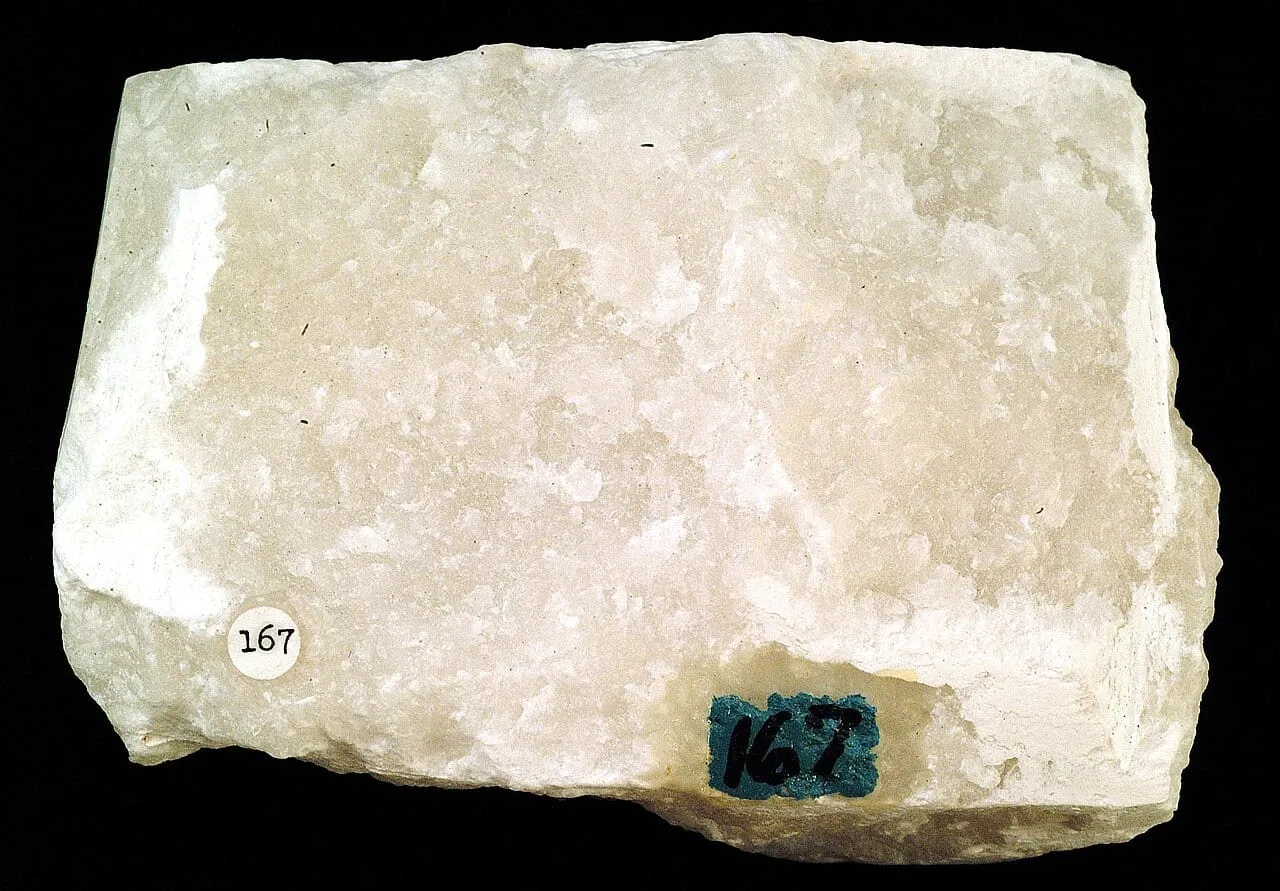
Alabaster
The fine-grained, translucent form of gypsum: a white stone soft enough to scratch with a fingernail, carved into statues, vessels and lamps for thousands of years.
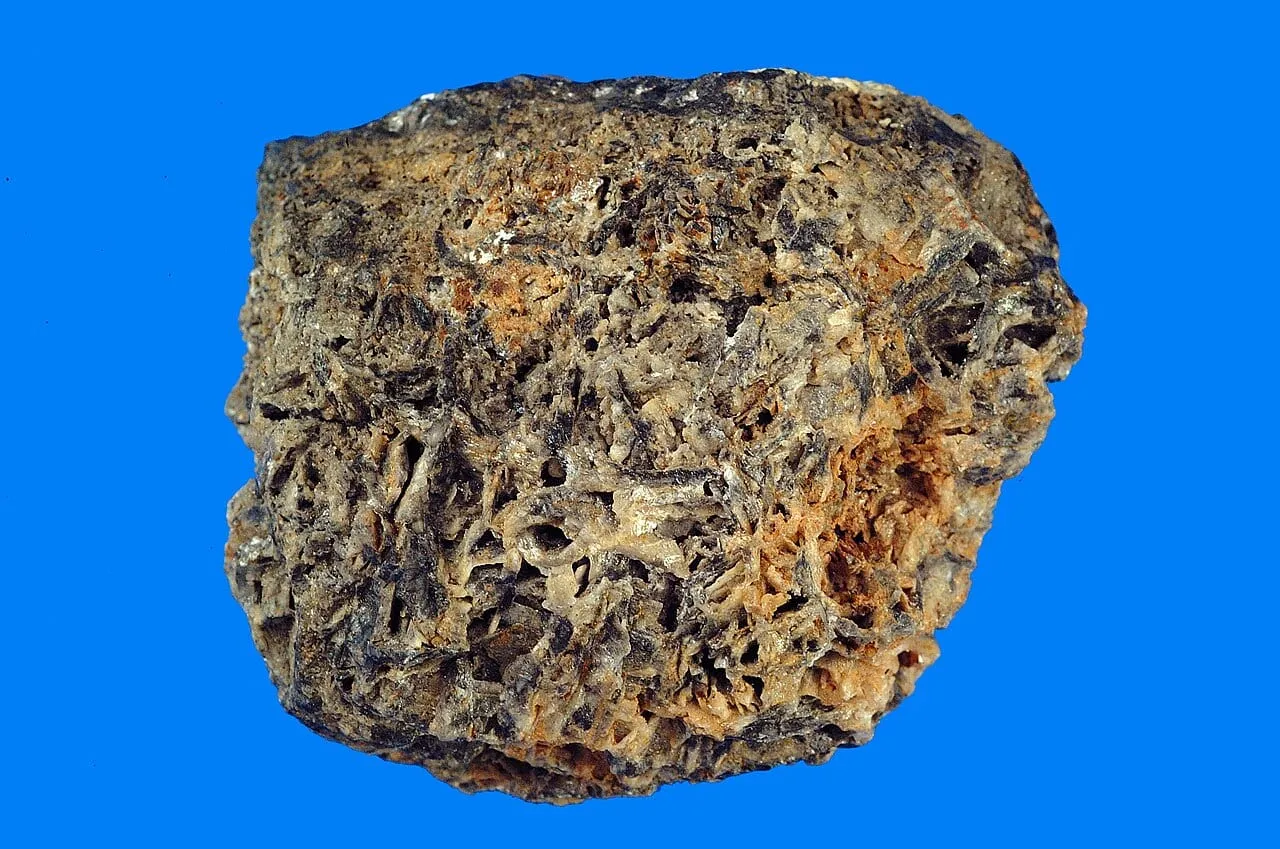
Anglesite
A heavy lead sulfate mineral with a diamond-like shine that grows as a crust around galena; it is named after the island of Anglesey in Wales.
Arsenopyrite
A widespread silvery-grey sulfide containing arsenic: it smells of garlic when struck and is poisonous.