Meteorite
Ordinary chondrite
Sıradan kondrit
Most of the stones that fall from the sky: the stony meteorites full of tiny round grains that make up 87% of all meteorite finds.
Also known as: O chondrite · OC
- Popularly: Meteorite

In short
Ordinary chondrites are by far the most numerous class of stony meteorites, making up 87% of all finds, which is why they are called “ordinary”. They contain millimetre-sized round grains called chondrules. By their total iron and metal content they fall into three groups, H, L and LL, thought to come from three different parent asteroids. Famous falls such as Chelyabinsk, Ensisheim, Sylacauga and L'Aigle are all ordinary chondrites.
Photos

How does it form?
Ordinary chondrites come from asteroids that formed from dust and chondrules at the start of the Solar System but never fully melted. Chondrules are ancient droplets formed in the nebula around the young Sun. Because heating varied inside the parent asteroids, chondrites are sorted into “petrologic types” from 3 to 6: type 3 is the least heated, type 6 the most.
The three groups (H, L, LL) hold different amounts of iron and metal and are expected to come from three separate parent asteroids. Fragments broken off these asteroids are pushed onto Earth-crossing paths from regions of the asteroid belt where Jupiter’s gravity is influential.
What is it used for?
- The start of the Solar System: Chondrules and chondrites help us understand the Solar System’s first solids and the materials the planets were built from.
- Links to asteroids: Spectral comparisons tie ordinary chondrites to S-type asteroids.
- History of science: The 1803 L’Aigle fall led to the acceptance that meteorites come from space.
Famous ordinary chondrites
L’Aigle (L6, 1803), Ensisheim (LL6, 1492), Chelyabinsk (LL5, 2013), Sylacauga (H4, 1954), Peekskill (H6, 1992) and Gao-Guenie (H5, 1960) are the best-known examples. Peekskill was documented by 16 separate video recordings and struck a parked car; Gao-Guenie is one of the largest meteorite showers observed in Africa.
What determines its value?
Being the commonest meteorites, ordinary chondrites are the most readily found among meteorites. A piece's value depends on its mass, the freshness of its fusion crust, how weathered (rusted) it is, the beauty of its interior and above all whether it comes from an observed fall; pieces of famous falls are worth much more.
This information is educational, not buying, selling or investment advice. Value varies enormously with quality and treatment.
How to recognise it
- 1
Fresh pieces have a thin black or dark brown fusion crust; inside they are light to dark grey.
- 2
A broken or cut face shows millimetre-sized round chondrules and small, shiny metal grains.
- 3
Because they contain metal, most attract a magnet and are a little heavier than an ordinary stone of the same size.
Myths and misconceptions
MythStones falling from the sky are an old folk tale.
FactUntil the late 18th century many scientists thought so. Jean-Baptiste Biot, who studied the thousands of stones that fell on L'Aigle in 1803, showed with both physical evidence and the testimony of many witnesses that they came from space.
MythAll meteorites are rare and very valuable.
Fact87% of meteorite finds are ordinary chondrites, the commonest meteorites of all. What really raises value is coming from a famous observed fall or belonging to a scientifically rare type.
Did you know?
When more than 3,000 stones rained on the French town of L'Aigle in 1803, the French Academy of Sciences sent Jean-Baptiste Biot to investigate. His report proved the stones came from space and is seen as the birth of meteorite science.
H chondrites make up about 46% of ordinary chondrites; their probable parent body is the asteroid 6 Hebe.
The Galileo spacecraft showed that freshly exposed surfaces on the asteroid 243 Ida have spectra like those of ordinary chondrites.
Where is it found?
Loading map…
- L'Aigle, Normandy, France · Historic sourceOn 26 April 1803 a shower of more than 3,000 fragments of an L6 chondrite fell. Jean-Baptiste Biot's investigation proved the stones came from space and effectively gave birth to meteorite science.
- Ensisheim, Alsace, France · Historic sourceAn LL6 chondrite that fell in 1492; the oldest European stony fall with material still preserved.
- Lake Chebarkul, Chelyabinsk Oblast, Russia · Known localityLL5 chondrite pieces of the asteroid that exploded over the Urals in 2013; the 654 kg main mass was raised from the lake.
- Peekskill, New York, USA · Known localityAn H6 chondrite documented by 16 separate video recordings in 1992; it struck a parked car.
- Oak Grove, near Sylacauga, Alabama, USA · Known localityThe H4 chondrite that came through a roof in 1954 and struck Ann Hodges.
- Gao and Guenie, Burkina Faso · Known localityAn H5 chondrite that fell on 5 March 1960; one of the largest observed meteorite showers in Africa.
Locations are approximate to protect sites. Red dots mark places in Türkiye. Open in the big map →
Frequently asked questions
What is ordinary chondrite?
Ordinary chondrites are by far the most numerous class of stony meteorites, making up 87% of all finds, which is why they are called “ordinary”. They contain millimetre-sized round grains called chondrules. By their total iron and metal content they fall into three groups, H, L and LL, thought to come from three different parent asteroids. Famous falls such as Chelyabinsk, Ensisheim, Sylacauga and L'Aigle are all ordinary chondrites.
Why are ordinary chondrites so common?
They are thought to come from a few asteroids placed favourably in the asteroid belt to send fragments onto Earth-crossing paths. So ordinary chondrites may represent not all asteroids but a few that happened to be “in the right place at the right time”.
What is ordinary chondrite used for?
The start of the Solar System: Chondrules and chondrites help us understand the Solar System's first solids and the materials the planets were built from. Links to asteroids: Spectral comparisons tie ordinary chondrites to S-type asteroids. History of science: The 1803 L'Aigle fall led to the acceptance that meteorites come from space.
How hard is ordinary chondrite?
It has a hardness of 5–7 on the Mohs scale. It can scratch glass; a steel knife scratches it only with difficulty. Its specific gravity is 2.99–3.58 g/cm³.
Where is ordinary chondrite found?
Its best-known localities: L'Aigle, Normandy, France; Ensisheim, Alsace, France; Lake Chebarkul, Chelyabinsk Oblast, Russia; Peekskill, New York, USA; Oak Grove, near Sylacauga, Alabama, USA.
How can you tell if ordinary chondrite is real?
Fresh pieces have a thin black or dark brown fusion crust; inside they are light to dark grey. A broken or cut face shows millimetre-sized round chondrules and small, shiny metal grains. Because they contain metal, most attract a magnet and are a little heavier than an ordinary stone of the same size.
Is ordinary chondrite valuable?
On the “street to diamond” value ladder it sits on step 5 of nine: Ornamental stone. Being the commonest meteorites, ordinary chondrites are the most readily found among meteorites. A piece's value depends on its mass, the freshness of its fusion crust, how weathered (rusted) it is, the beauty of its interior and above all whether it comes from an observed fall; pieces of famous falls are worth much more.
Sources
- Ordinary chondrite · Wikipedia
- L'Aigle (meteorite) · Wikipedia
- Peekskill meteorite · Wikipedia
- Gao–Guenie meteorite · Wikipedia
- Ensisheim meteorite · Wikipedia
- Chelyabinsk meteor · Wikipedia
- Sylacauga (meteorite) · Wikipedia
- Meteorite porosities and densities: a review of trends in the data (D. T. Britt & G. J. Consolmagno), Lunar and Planetary Science XXXV, abstract 2108 · Lunar and Planetary Institute, 2004
- Handbook of Mineralogy: Forsterite · Mineralogical Society of America
External links
Draft: awaiting expert reviewReport an error
On the same step
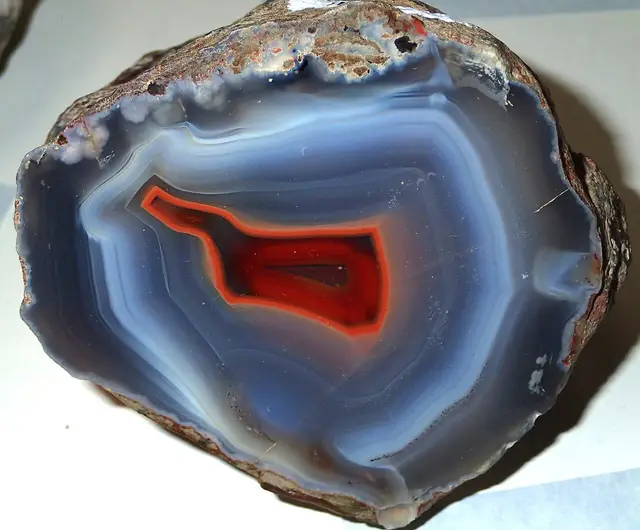
Agate
The banded variety of chalcedony: it grows layer by layer in hollows in volcanic rock and shows a new pattern every time it is cut.
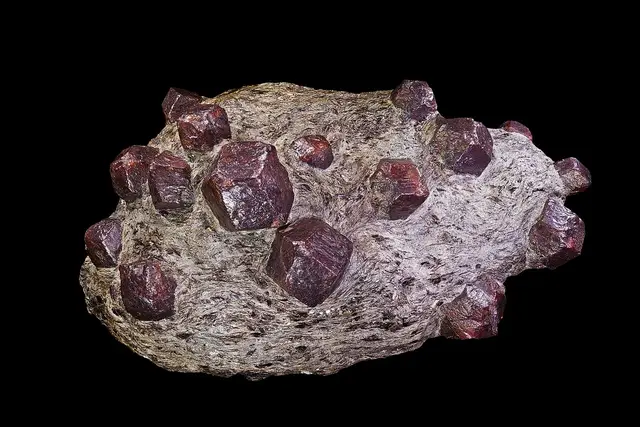
Almandine
The commonest garnet: a deep red, iron-rich stone named after the ancient city of Alabanda in Anatolia, used in jewellery and in sandpaper alike.
Amazonite
A turquoise-like green-blue feldspar: a variety of microcline worn as jewellery for more than three thousand years, but it can release lead.