Rock
Nubian Sandstone
Nubya kumtaşı
The stone of Petra and the rock of the world's largest fossil-water reserve: a red sandstone stretching from the eastern Sahara to Arabia.
Also known as: Sandstein von Nubien
- Popularly: Natural stone (building and decor)

In short
The Nubian Sandstone is a thick body of sandstone lying on the ancient basement rocks of the eastern Sahara, northeast Africa and the Arabian Peninsula. It built up over a very long span, from the Cambrian to the Late Cretaceous, mostly on land and at times in shallow seas. It is most often brown or reddish. The temples and tombs of ancient Petra in Jordan are carved into it, and the groundwater it holds makes up the world's largest known fossil-water system.
Photos

How does it form?
The Nubian Sandstone built up over hundreds of millions of years, from the Cambrian to the Late Cretaceous, in a tropical to subtropical climate. Palaeomagnetic data show it was laid down in or near the ancient equatorial belt. The settings varied: wind-blown desert sands, rivers and, from time to time, shallow seas. Marine beds from the Carboniferous to the Early Cretaceous, and the coal and lignite seams between layers, show that shallow seas covered the area at times.
The sandstone complex ranges from under 500 metres to over 3,000 metres thick and rests on the oldest (Precambrian) basement rocks. Faults and folds running northeast complicate its structure.
What is it used for?
- Water source: The Nubian Sandstone holds the Nubian Sandstone Aquifer System, the world’s largest known fossil-water system. Spreading under Sudan, Chad, Libya and Egypt, it supplies Libya’s Great Man-Made River project.
- Rock-cut monuments: The ancient temples and tombs of Petra in Jordan are carved into this sandstone.
- Soil: The weathering sandstone gives red, sandy soils; in moister areas these are better developed, while in arid zones they are shallow and salty.
Where is it found?
The Nubian Sandstone stretches from Sudan, Egypt, Libya and Chad to the Sinai Peninsula, Jordan, Lebanon and the Arabian Peninsula. It reaches its greatest development in Egypt, in the Ain Dalla basin southwest of the Bahariya Oasis. Southeast of the Dead Sea it is about 600 metres thick, and at Petra it rests on crystalline rocks. It was named in 1837 by the geologist Joseph Rüssegger, who traced these sandstones from Sudan to Arabia.
What determines its value?
As a building stone its value is local; how friable or compact it is in a given place decides how workable it is. Its real importance is the groundwater stored in it, a vital water source for desert countries. Rock-cut monuments such as Petra give it historical and cultural value too.
This information is educational, not buying, selling or investment advice. Value varies enormously with quality and treatment.
How to recognise it
- 1
Most often brown or reddish, but in places multicoloured, with pink, yellow and whitish bands.
- 2
In some places it is friable enough to crumble in the hand; elsewhere it is compact and hard.
- 3
Its sand grains can be seen by eye or with a hand lens; thin clay and shale beds and here and there coal seams lie between the layers.
Myths and misconceptions
MythThe water in the Nubian Sandstone is constantly topped up by rain.
FactMost of this water is fossil water that accumulated during the wet periods of the Quaternary. Libya's Great Man-Made River draws cubic kilometres of it every year, which is why the four countries work with the International Atomic Energy Agency on fair and sustainable management of the water.
Did you know?
The groundwater system in the Nubian Sandstone spreads under Sudan, Chad, Libya and Egypt across more than two million square kilometres and holds an estimated 150,000 cubic kilometres of water.
Much of the sand of the Arabian deserts came from the Nubian Sandstone, carried by the prevailing westerly winds.
Where the rock is capped by a sheet of volcanic lava, the sandstone beneath has been protected from erosion.
Where is it found?
Loading map…
- Nubia (Sudan and southern Egypt) · Type localityThe geologist Joseph Rüssegger named these sandstones “Sandstein von Nubien” in 1837 and traced them through Sudan, Egypt, Libya and northwestern Arabia.
- Ain Dalla basin, near the Bahariya Oasis, Egypt · Major depositA downthrown block southwest of the Bahariya Oasis where the Nubian Sandstone reaches its greatest development (overall thickness ranges from under 500 m to over 3,000 m). The point marks the oasis.
- Petra, Jordan · Known localityThe temples and tombs of ancient Petra were carved straight into Nubian Sandstone. Here the sandstone rests unconformably on crystalline rocks.
- Sinai Peninsula, Egypt · Known localityIn western Sinai the Nubian Sandstone rests on Carboniferous limestone; the peninsula may hold a second groundwater system.
- Southeast of the Dead Sea · Known localityBy the Dead Sea the sandstone rests on Cambrian limestone and reaches about 600 m (2,000 ft) thick in the southeast. The point marks the Dead Sea.
- Mount Hermon and the Anti-Lebanon Mountains · Known localityIn Lebanon, the Anti-Lebanon and Hermon the Nubian Sandstone rests on Jurassic limestone, and its age is relatively easy to work out.
Locations are approximate to protect sites. Red dots mark places in Türkiye. Open in the big map →
Frequently asked questions
What is nubian Sandstone?
The Nubian Sandstone is a thick body of sandstone lying on the ancient basement rocks of the eastern Sahara, northeast Africa and the Arabian Peninsula. It built up over a very long span, from the Cambrian to the Late Cretaceous, mostly on land and at times in shallow seas. It is most often brown or reddish. The temples and tombs of ancient Petra in Jordan are carved into it, and the groundwater it holds makes up the world's largest known fossil-water system.
Where did the water in the Nubian Sandstone come from?
This water built up mainly during the wet periods of the Quaternary and is barely renewed today, which is why it is called “fossil water”. Studies have identified two recharge periods: one about 38,000 years ago from the Mediterranean, the other about 361,000 years ago from the tropical Atlantic.
What is nubian Sandstone used for?
Water source: The Nubian Sandstone holds the Nubian Sandstone Aquifer System, the world's largest known fossil-water system. Spreading under Sudan, Chad, Libya and Egypt, it supplies Libya's Great Man-Made River project. Rock-cut monuments: The ancient temples and tombs of Petra in Jordan are carved into this sandstone. Soil: The weathering sandstone gives red, sandy soils; in moister areas these are better developed, while in arid zones they are shallow and salty.
How hard is nubian Sandstone?
It has a hardness of 6–7 on the Mohs scale. It can scratch glass; a steel knife scratches it only with difficulty. Its specific gravity is 2.2–2.8 g/cm³.
Where is nubian Sandstone found?
Its best-known localities: Nubia (Sudan and southern Egypt); Ain Dalla basin, near the Bahariya Oasis, Egypt; Petra, Jordan; Sinai Peninsula, Egypt; Southeast of the Dead Sea.
How can you tell if nubian Sandstone is real?
Most often brown or reddish, but in places multicoloured, with pink, yellow and whitish bands. In some places it is friable enough to crumble in the hand; elsewhere it is compact and hard. Its sand grains can be seen by eye or with a hand lens; thin clay and shale beds and here and there coal seams lie between the layers.
Is nubian Sandstone valuable?
On the “street to diamond” value ladder it sits on step 3 of nine: Building and industrial stone. As a building stone its value is local; how friable or compact it is in a given place decides how workable it is. Its real importance is the groundwater stored in it, a vital water source for desert countries. Rock-cut monuments such as Petra give it historical and cultural value too.
Sources
- Nubian Sandstone · Wikipedia
- Nubian Sandstone Aquifer System · Wikipedia
- Sandstone · Encyclopaedia Britannica
- Common rock densities · chemeurope.com (from Wikipedia, GFDL)
- Petra · Wikipedia
- Bahariya Oasis · Wikipedia
- Nubia · Wikipedia
- Sinai Peninsula · Wikipedia
- Dead Sea · Wikipedia
- Mount Hermon · Wikipedia
External links
Draft: awaiting expert reviewReport an error
On the same step
Acanthite
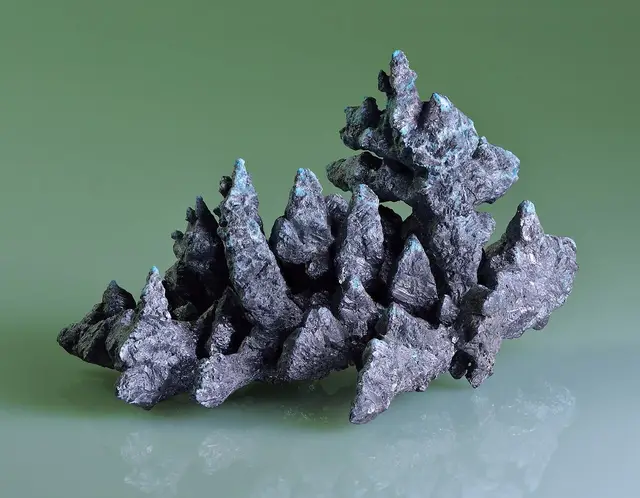
Silver's black sulfide: one of the world's main silver ores and the mineral that coats tarnished native silver.
Adamite
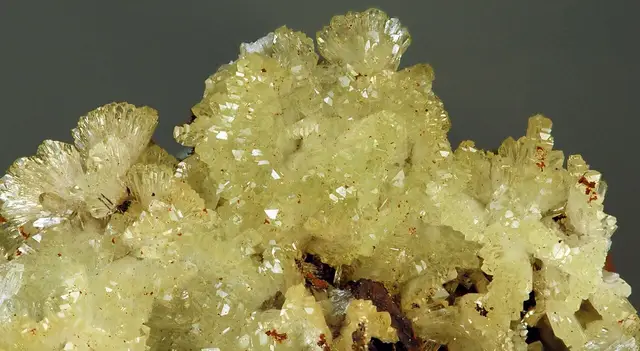
Zinc arsenate in fan-shaped crystals from honey yellow to green: some specimens glow under ultraviolet light.

Albite
The white, sodium end of the feldspars: with its deposits at Çine–Milas, a glass and ceramics raw material that makes Türkiye one of the world’s main feldspar producers.