Rock
Monzonite
Monzonit
A granite-like plutonic rock between syenite and diorite, named after the Monzoni mountains in the Dolomites.
- Popularly: Natural stone (building and decor)
- Building stone
- Important in Türkiye

In short
Monzonite is a medium- to coarse-grained rock formed when magma cools slowly deep in the crust. It holds pinkish-white alkali feldspar and milky plagioclase in about equal amounts, with almost no quartz. Grey and speckled, it looks like granite and is often sold as “granite”. Norway's larvikite, with its silver-blue sheen, is also a monzonite. In Türkiye it occurs around Kırşehir.
Photos

How does it form?
Monzonite is a plutonic rock, formed when magma of intermediate silica content and rich in sodium and potassium cools slowly and solidifies deep in the crust. A similar rock richer in alkali feldspar is syenite, and one richer in plagioclase is monzodiorite. When the quartz content rises to between 5 and 20%, the rock is called quartz monzonite, which is told from granite (more than 20% quartz).
The same magma reaching the surface and cooling quickly forms fine-grained latite. The name monzonite comes from the Monzoni mountains in Italy, where the rock is abundant.
What is it used for?
- Building stone: Durable, it is used as cladding, kerbs and building stone. Kinds with a silver-blue sheen, such as larvikite, are sought as polished cladding slabs.
- Crushed stone: Crushed, it is used as road and concrete aggregate.
- Copper ore: Quartz monzonite porphyry intrusions are often associated with porphyry copper deposits; Bingham Canyon in the USA is the best-known example. The copper was carried into the rock later by hot fluids; the rock itself is not ore.
- Science: Monzonite intrusions are studied to understand how magma differentiates; the Predazzo-Monzoni plutons in Italy played a leading role in the birth of petrography.
Where is it found?
The type locality of monzonite is the area of Predazzo and Monte Monzoni in the Dolomites, Italy. The area around Larvik in Norway is the main place where the monzonite variety called larvikite is quarried. In the USA, the quartz monzonites of Little Cottonwood Canyon in Utah went into the Salt Lake Temple, and the Stone Mountain dome in Georgia is known as a natural landmark.
Monzonite in Türkiye
In the Kırşehir Massif, around Kaman, the Baranadağ quartz monzonite lies within the Central Anatolian granitoids. The igneous rocks of the region formed in two plutonic phases; the Baranadağ quartz monzonite, together with the Hamit and Çamsarı quartz syenites, is among the units of the first phase.
What determines its value?
Monzonite is a plentiful plutonic rock; sold by the tonne as crushed stone it is worth little. As block and cladding stone, its value depends on whether large, crack-free blocks can be quarried, on an even and attractive colour and pattern, on how well it polishes, on its strength and on the distance of the quarry. Kinds with a silver-blue sheen, such as larvikite, are more sought-after cladding stones than ordinary grey monzonite. The value of monzonite intrusions that host porphyry copper deposits comes not from the rock but from the copper ore in it.
This information is educational, not buying, selling or investment advice. Value varies enormously with quality and treatment.
How to recognise it
- 1
It is a grey, speckled rock in which visible pinkish-white alkali feldspar and milky white plagioclase occur in about equal amounts.
- 2
Dark minerals such as biotite (black, shiny flakes), hornblende or pyroxene are scattered through it; glassy grey quartz grains are absent or very few.
- 3
In the kind called larvikite, a polished surface shows a silver-blue sheen from the feldspar crystals.
- 4
To tell monzonite from syenite, diorite and granodiorite you have to count feldspar proportions; a firm identification by eye is hard.
Fakes and imitations
What shops usually don’t tell you:
- In the stone trade most hard silicate rocks that take a polish are sold as “granite”. The stone called “Blue Pearl granite” is not granite but larvikite, a variety of monzonite.
Myths and misconceptions
Myth“Blue Pearl granite” is real granite.
FactThe Norwegian stone sold as “Blue Pearl granite” is larvikite, a quartz-poor variety of monzonite. It differs from granite in having almost no quartz.
MythEvery grey, speckled, coarse-grained plutonic rock is granite.
FactMonzonite, syenite, diorite and granodiorite look like granite too. Monzonite has at most 5% quartz, whereas granite has more than 20%.
Did you know?
Fragments of monzonite have been found on the surface of the Moon.
The blocks of the Salt Lake Temple were quarried in Little Cottonwood Canyon, Utah, from an intrusion made of quartz monzonite, granite and granodiorite.
Larvikite has been recognised by the International Union of Geological Sciences (IUGS) as a Global Heritage Stone Resource.
Where is it found?
Loading map…
- Predazzo and Monte Monzoni, Trentino, Italy · Type localityThe Dolomites, home of the Monzoni mountains that gave the rock its name. The Predazzo and Monzoni plutons, emplaced in the Triassic about 238 million years ago, are the type locality of monzonite and played a leading role in the birth of petrography.
- Larvik, Vestfold, Norway · Major depositLarvikite (sold as “Blue Pearl granite”) is mainly quarried here. It is a 298-292 million-year-old monzonite variety of the Larvik Batholith in the Oslo Rift and shows a silver-blue schiller when polished.
- Bingham Canyon Mine, Utah, USA · Major depositA porphyry copper deposit formed by a quartz monzonite porphyry intruded into sedimentary rocks. The pit, 4 km wide and more than 1,200 metres deep, has been in production since 1906.
- Little Cottonwood Canyon, Utah, USA · Historic sourceThe Salt Lake Temple was built with blocks of quartz monzonite, granite and granodiorite quarried from the Little Cottonwood stock near the mouth of the canyon; the stock is about 30 million years old.
- Stone Mountain, Georgia, USA · Known localityA quartz monzonite dome about 300-350 million years old; a mass of rock rising 251 metres above its surroundings with a base more than 8 km around.
- Kaman area, Baranadağ, Kırşehir, Türkiye · Known localityThe Baranadağ quartz monzonite, one of the Central Anatolian granitoids of the Kırşehir Massif, is a unit of the first plutonic phase of the region.
Locations are approximate to protect sites. Red dots mark places in Türkiye. Open in the big map →
Frequently asked questions
What is monzonite?
Monzonite is a medium- to coarse-grained rock formed when magma cools slowly deep in the crust. It holds pinkish-white alkali feldspar and milky plagioclase in about equal amounts, with almost no quartz. Grey and speckled, it looks like granite and is often sold as “granite”. Norway's larvikite, with its silver-blue sheen, is also a monzonite. In Türkiye it occurs around Kırşehir.
What is monzonite used for?
Building stone: Durable, it is used as cladding, kerbs and building stone. Kinds with a silver-blue sheen, such as larvikite, are sought as polished cladding slabs. Crushed stone: Crushed, it is used as road and concrete aggregate. Copper ore: Quartz monzonite porphyry intrusions are often associated with porphyry copper deposits; Bingham Canyon in the USA is the best-known example. The copper was carried into the rock later by hot fluids; the rock itself is not ore.
How hard is monzonite?
It has a hardness of 5.5–6.5 on the Mohs scale. It can scratch glass; a steel knife scratches it only with difficulty. Its specific gravity is 2.7–2.9 g/cm³.
Where is monzonite found?
Its best-known localities: Predazzo and Monte Monzoni, Trentino, Italy; Larvik, Vestfold, Norway; Bingham Canyon Mine, Utah, USA; Little Cottonwood Canyon, Utah, USA; Stone Mountain, Georgia, USA.
Where is monzonite found in Türkiye?
Known localities in Türkiye: Kaman area, Baranadağ, Kırşehir, Türkiye.
How can you tell if monzonite is real?
It is a grey, speckled rock in which visible pinkish-white alkali feldspar and milky white plagioclase occur in about equal amounts. Dark minerals such as biotite (black, shiny flakes), hornblende or pyroxene are scattered through it; glassy grey quartz grains are absent or very few. In the kind called larvikite, a polished surface shows a silver-blue sheen from the feldspar crystals. In the stone trade most hard silicate rocks that take a polish are sold as “granite”. The stone called “Blue Pearl granite” is not granite but larvikite, a variety of monzonite.
Is monzonite valuable?
On the “street to diamond” value ladder it sits on step 3 of nine: Building and industrial stone. Monzonite is a plentiful plutonic rock; sold by the tonne as crushed stone it is worth little. As block and cladding stone, its value depends on whether large, crack-free blocks can be quarried, on an even and attractive colour and pattern, on how well it polishes, on its strength and on the distance of the quarry. Kinds with a silver-blue sheen, such as larvikite, are more sought-after cladding stones than ordinary grey monzonite. The value of monzonite intrusions that host porphyry copper deposits comes not from the rock but from the copper ore in it.
Sources
- Monzonite · Wikipedia
- Quartz monzonite · Wikipedia
- Larvikite · Wikipedia
- Larvik · Wikipedia
- Thermobarometry, geochronology and petrological evolution of the Middle-Late Triassic magmatic products in the Dolomitic Area, Southern Alps (Casetta), Plinius 45 · Società Italiana di Mineralogia e Petrologia, 2019
- Predazzo · Wikipedia
- Bingham Canyon Mine · Wikipedia
- Little Cottonwood Canyon · Wikipedia
- Stone Mountain · Wikipedia
- Kaman (Kırşehir-Türkiye) floritlerinin mineralojik ve gemolojik özellikleri (Kaydu Akbudak, Ketenci & Gürbüz), Gümüşhane Üniversitesi Fen Bilimleri Dergisi 12(4): 1012–1023 · Gümüşhane Üniversitesi, 2022
External links
Draft: awaiting expert reviewReport an error ↗
On the same step
Albite
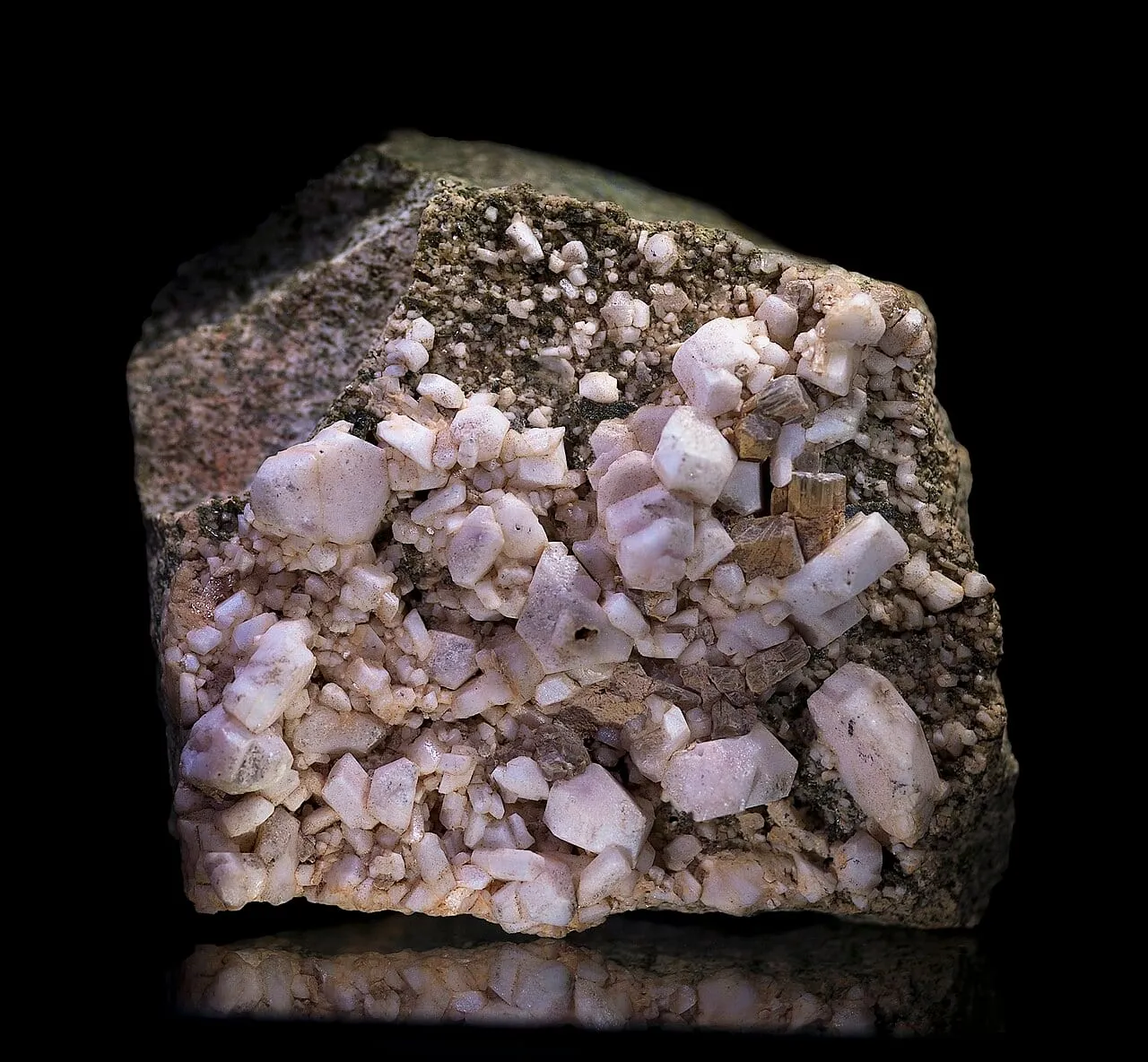
The white, sodium end of the feldspars: with its deposits at Çine–Milas, a glass and ceramics raw material that makes Türkiye one of the world’s main feldspar producers.
Alunite
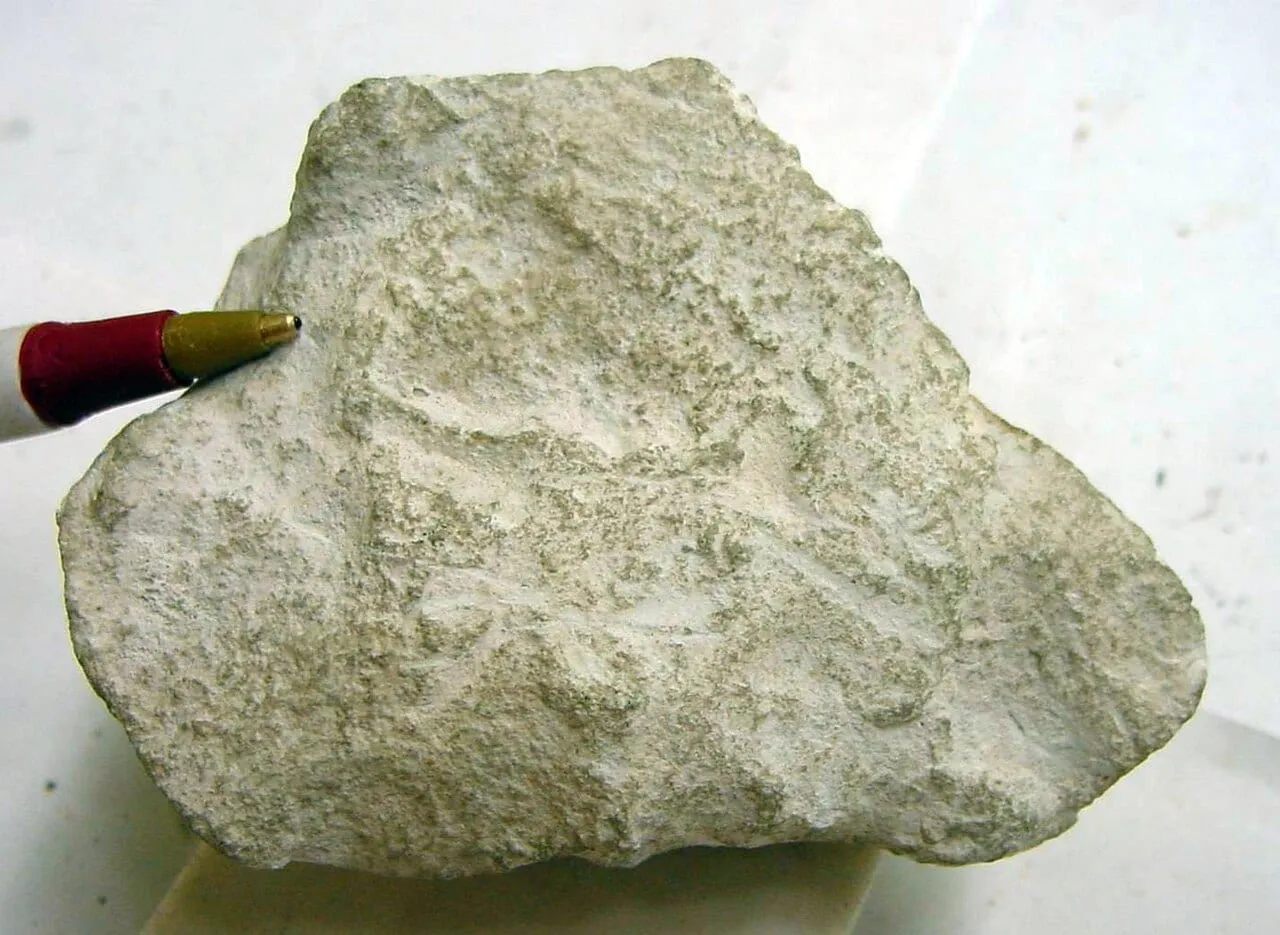
The “alum stone” from which alum was made for centuries. Foça, Şaphane in Kütahya and Şebinkarahisar are Türkiye's old alum homelands.
Anhydrite
Gypsum without its water: a calcium sulfate mineral, whose blue-grey Peruvian form is sold as “angelite”.