Mineral
Mimetite
Pb₅(AsO₄)₃ClMimetit
It imitates pyromorphite so well that its name means “imitator”: a heavy yellow-orange mineral of lead and arsenic.
Also known as: Campylite (name for its barrel-shaped crystals)
- Popularly: Common stone

In short
Mimetite is a mineral made of lead, arsenic, oxygen and chlorine (Pb₅(AsO₄)₃Cl). It forms pale to bright yellow, yellow-orange and brownish crystals shaped as hexagonal prisms, needles or barrels. It is common in the parts of arsenic-bearing lead deposits exposed to air. Its name comes from the Greek mimetes, “imitator”, because it closely resembles pyromorphite. It belongs to the same (apatite) group as pyromorphite and vanadinite.
Photos
.jpg)
How does it form?
Mimetite is a common secondary mineral that forms in the oxidised zone of arsenic-bearing lead deposits, the part near the surface exposed to air and water. That is why it occurs with cerussite, anglesite, smithsonite, willemite, pyromorphite and wulfenite. It has the same structure as pyromorphite and vanadinite: all three share lead and chlorine, with arsenic in mimetite, phosphorus in pyromorphite and vanadium in vanadinite.
According to the Handbook of Mineralogy, well-crystallised mimetite comes from Johanngeorgenstadt in Germany, Příbram in Czechia, Cornwall and Caldbeck Fells in Cumbria in England, Leadhills in Scotland, and Santa Eulalia and the Ojuela mine in Mexico; Tsumeb in Namibia has produced extraordinary crystals.
What is it used for?
- Collecting: Its bright yellow-orange crystals and barrel-shaped campylite groups are sought by collectors.
- Science: As a member of the apatite group, it shows how different elements can take each other’s place within the same crystal structure.
What determines its value?
Mimetite is valued as a collector's mineral. Collectors look for vivid yellow or orange, lustrous, large crystals, barrel-shaped campylite groups and specimens with wulfenite. The extraordinary crystals of Tsumeb in Namibia and Mexican specimens are the best known.
This information is educational, not buying, selling or investment advice. Value varies enormously with quality and treatment.
How to recognise it
- 1
Pale to bright yellow, yellow-orange or yellowish brown; sometimes white or colourless.
- 2
Its crystals are hexagonal prisms or needles; sometimes it forms rounded, barrel-shaped crystals (campylite).
- 3
Very heavy (specific gravity about 7.2): about three times as heavy as a piece of quartz the same size.
- 4
Resinous to adamantine lustre; hardness 3.5–4.
- 5
Some specimens can glow reddish yellow under ultraviolet light.
Fakes and imitations
What shops usually don’t tell you:
- Pyromorphite looks almost identical to mimetite; the difference is that mimetite contains arsenic and pyromorphite phosphorus. A certain distinction takes chemical analysis.
- Vanadinite is in the same group and forms similar hexagonal prisms, but it is usually bright red or orange-red.
Safety
Mimetite contains both lead and arsenic. Lead builds up in the body and can permanently harm the brain and nervous system, especially in children; according to the World Health Organization, there is no level of lead exposure known to be without harmful effects. Inorganic arsenic also causes cancer in humans. Do not put mimetite in your mouth, grind or heat it, breathe its dust or put it in drinking water. Wash your hands after handling it and keep specimens out of reach of children.
Myths and misconceptions
MythYellow mimetite crystals are yellow because they contain sulfur or gold.
FactMimetite is made of lead, arsenic, oxygen and chlorine; it contains no gold or sulfur. Its yellow colour comes from this composition.
Did you know?
It is named for its likeness to pyromorphite: mimetes is Greek for “imitator”.
The kind whose barrel-shaped crystals form hemispherical clusters is called campylite; the same name is used for pyromorphite of this shape.
Its crystals can grow up to 12 cm; mimetite is piezoelectric, meaning an electric charge builds up on its surface when it is squeezed.
Where is it found?
Loading map…
- Tsumeb, Oshikoto, Namibia · Major depositYields extraordinary crystals, according to the Handbook of Mineralogy
- Ojuela mine, Mapimí, Durango, Mexico · Known localityOne of the notable occurrences of mimetite
- Johanngeorgenstadt, Saxony, Germany · Historic sourceAn old mining town cited by the Handbook of Mineralogy for well-crystallised mimetite
- Leadhills, Lanarkshire, Scotland · Historic sourceScotland's old lead-mining district
- Broken Hill, New South Wales, Australia · Known localityOne of the world's great lead–zinc–silver deposits
Locations are approximate to protect sites. Red dots mark places in Türkiye. Open in the big map →
Frequently asked questions
What is mimetite?
Mimetite is a mineral made of lead, arsenic, oxygen and chlorine (Pb₅(AsO₄)₃Cl). It forms pale to bright yellow, yellow-orange and brownish crystals shaped as hexagonal prisms, needles or barrels. It is common in the parts of arsenic-bearing lead deposits exposed to air. Its name comes from the Greek mimetes, “imitator”, because it closely resembles pyromorphite. It belongs to the same (apatite) group as pyromorphite and vanadinite.
How can mimetite be told apart from pyromorphite?
Often it cannot be done by eye: both are heavy lead minerals of the same group that crystallise in the same shapes. The difference lies in their composition; mimetite contains arsenic, pyromorphite phosphorus. A certain identification takes chemical analysis. Mimetite's name, meaning “imitator”, comes from this likeness.
What is mimetite used for?
Collecting: Its bright yellow-orange crystals and barrel-shaped campylite groups are sought by collectors. Science: As a member of the apatite group, it shows how different elements can take each other's place within the same crystal structure.
How hard is mimetite?
It has a hardness of 3.5–4 on the Mohs scale. A fingernail cannot scratch it, but a steel knife can. Its specific gravity is 7.24–7.26 g/cm³.
Where is mimetite found?
Its best-known localities: Tsumeb, Oshikoto, Namibia; Johanngeorgenstadt, Saxony, Germany; Leadhills, Lanarkshire, Scotland; Ojuela mine, Mapimí, Durango, Mexico; Broken Hill, New South Wales, Australia.
How can you tell if mimetite is real?
Pale to bright yellow, yellow-orange or yellowish brown; sometimes white or colourless. Its crystals are hexagonal prisms or needles; sometimes it forms rounded, barrel-shaped crystals (campylite). Very heavy (specific gravity about 7.2): about three times as heavy as a piece of quartz the same size. Pyromorphite looks almost identical to mimetite; the difference is that mimetite contains arsenic and pyromorphite phosphorus. A certain distinction takes chemical analysis.
Is mimetite valuable?
On the “street to diamond” value ladder it sits on step 3 of nine: Building and industrial stone. Mimetite is valued as a collector's mineral. Collectors look for vivid yellow or orange, lustrous, large crystals, barrel-shaped campylite groups and specimens with wulfenite. The extraordinary crystals of Tsumeb in Namibia and Mexican specimens are the best known.
Is mimetite dangerous?
Mimetite contains both lead and arsenic. Lead builds up in the body and can permanently harm the brain and nervous system, especially in children; according to the World Health Organization, there is no level of lead exposure known to be without harmful effects. Inorganic arsenic also causes cancer in humans. Do not put mimetite in your mouth, grind or heat it, breathe its dust or put it in drinking water. Wash your hands after handling it and keep specimens out of reach of children.
Sources
- Mimetite · Wikipedia
- Handbook of Mineralogy: Mimetite · Mineralogical Society of America
- Lead poisoning (fact sheet) · World Health Organization
- Arsenic (fact sheet) · World Health Organization
External links
ReviewedLast checked: 4 October 2026
On the same step
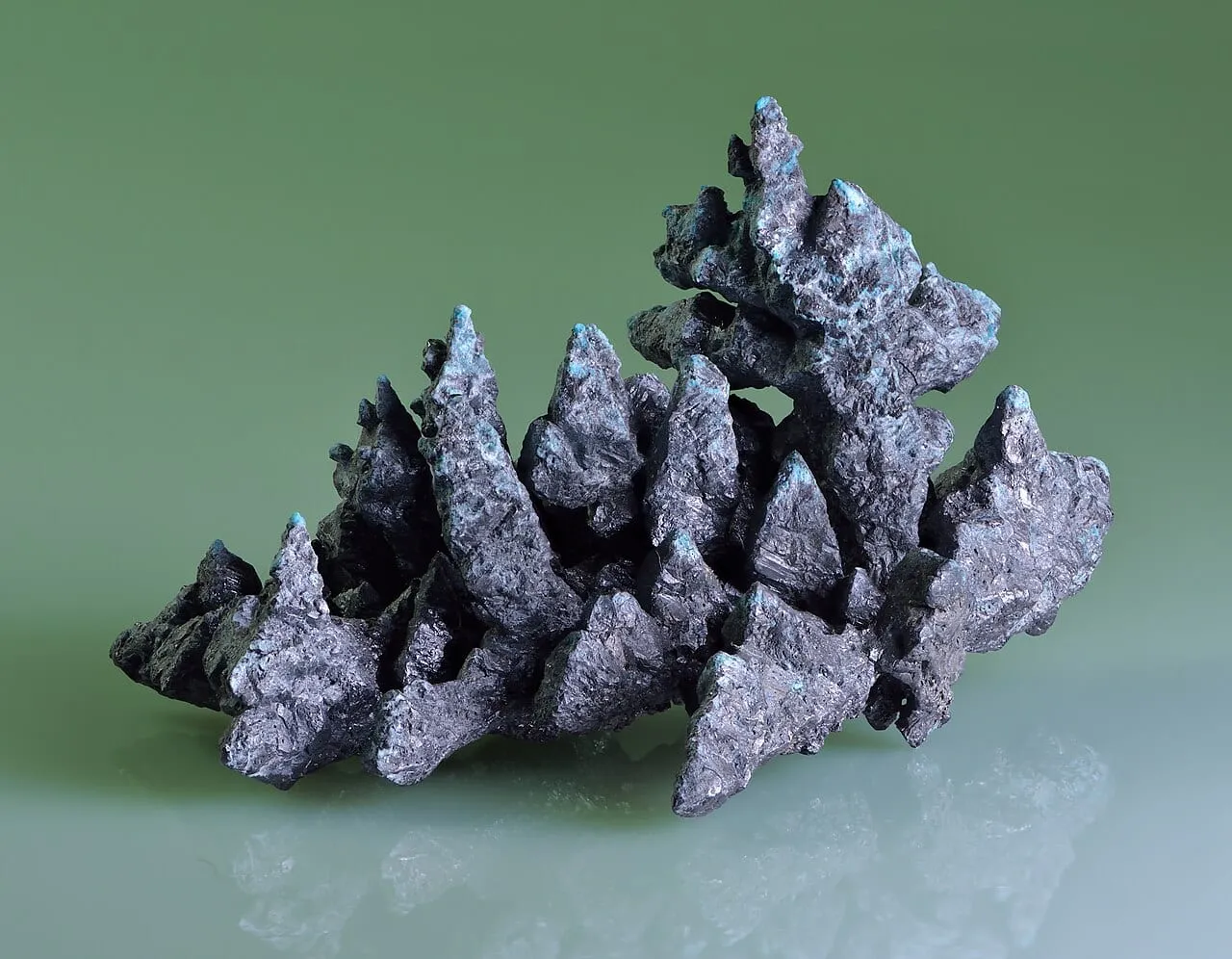
Acanthite
Silver's black sulfide: one of the world's main silver ores and the mineral that coats tarnished native silver.
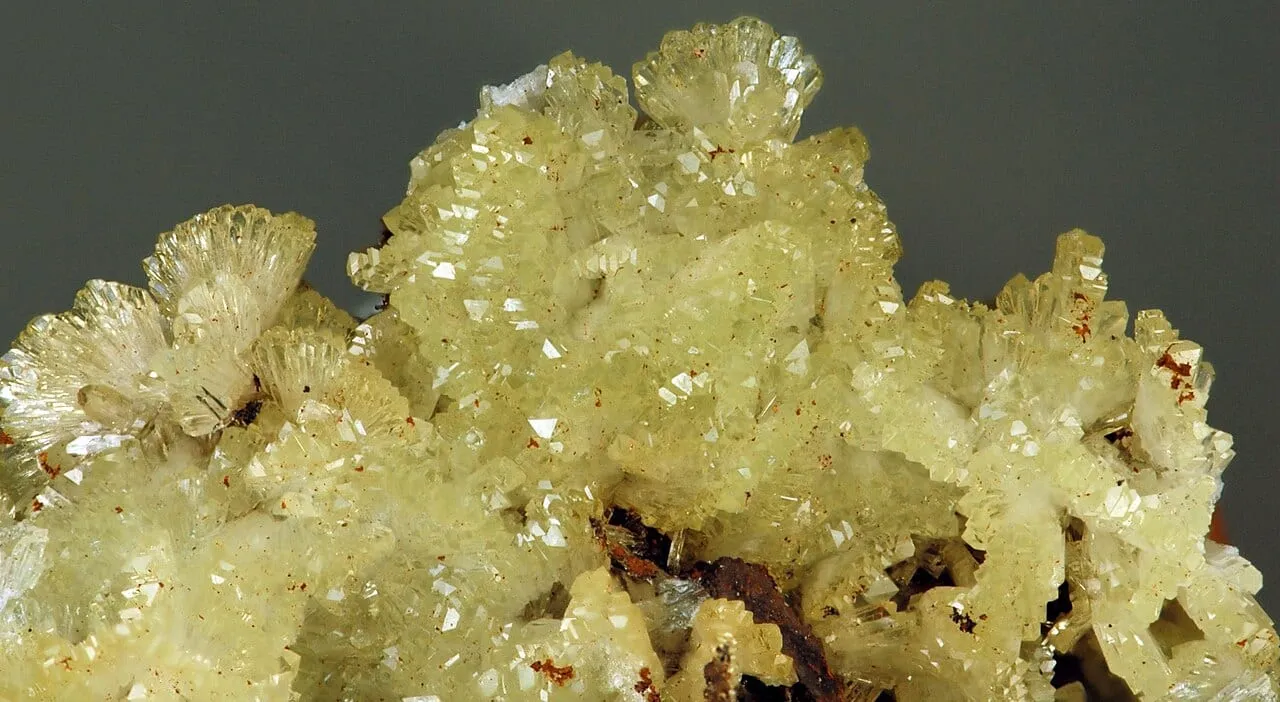
Adamite
Zinc arsenate in fan-shaped crystals from honey yellow to green: some specimens glow under ultraviolet light.
Albite
The white, sodium end of the feldspars: with its deposits at Çine–Milas, a glass and ceramics raw material that makes Türkiye one of the world’s main feldspar producers.