Mineral
Microcline
KAlSi₃O₈Mikroklin
The common potassium feldspar of granite and pegmatite: its green variety is amazonite, and some of the largest crystals ever found are microcline.
Also known as: Potassium feldspar (one of the K-feldspars) · Amazonite (green variety)
- Popularly: Ore and raw material
- Everyday
- Industrial
In short
Microcline is a feldspar made of potassium, aluminium, silicon and oxygen (KAlSi₃O₈). It is the sibling of orthoclase, which has the same composition; the difference lies in the crystal structure: microcline has three inclined axes (triclinic), so its two cleavage planes meet not at exactly a right angle but at an angle very close to it. It is very common in granite and pegmatite, and its green variety, amazonite, is cut as an ornamental stone.
How does it form?
Microcline crystallises in slowly cooling silica-rich magmas, that is, in plutonic rocks such as granite, granite pegmatite and syenite. It forms when orthoclase cools slowly; the variety stable at still higher temperature is sanidine. It also occurs in metamorphic rocks (at greenschist and amphibolite grade) and in hydrothermal veins, and in sedimentary rocks as worn fragments. In pegmatites it can form very large crystals.
What is it used for?
- Glass and ceramics: Feldspar is used in glassmaking and pottery as a flux, lowering the melting temperature of the mix. According to the US Geological Survey (USGS), 53% of the feldspar used in the United States goes into ceramics, pottery and similar uses and 47% into glassmaking.
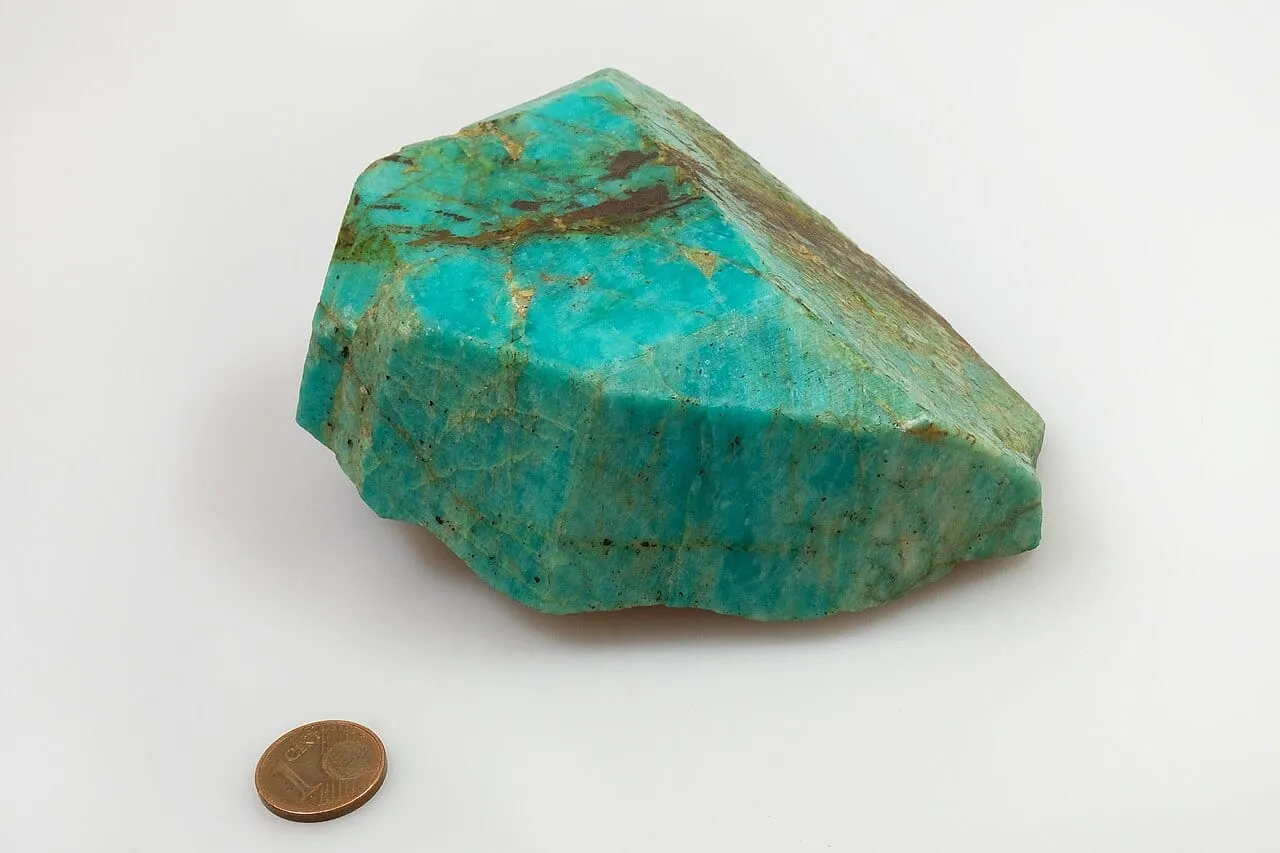
- Ornamental stone: Its green variety, amazonite, is cut into cabochons, beads and small carvings (see its own page).
- Collecting: Large, well-formed crystals and twins are sought by museums and collectors.
Relationship to orthoclase
Microcline and orthoclase have the same composition and belong to the potassium feldspar (K-feldspar) family. Which one forms depends on the rate of cooling: slow cooling gives microcline, faster cooling gives orthoclase, and cooling at still higher temperature gives sanidine. In granite and pegmatite, microcline often grows intergrown with albite; when the albite separates into thin streaks, the pattern called perthite results. For orthoclase’s role on the Mohs scale, see the orthoclase page.
What determines its value?
Feldspar for industry is sold by the ton; its value depends on the potassium-to-sodium ratio, on how little iron and other colour-spoiling impurities it contains for glass and ceramics, on grain size and on the size of the deposit, and beneficiation and transport costs also matter. The green variety, amazonite, is sought separately as an ornamental stone (see its own page). Among collectors, large, well-formed crystals and well-developed twins are valued.
This information is educational, not buying, selling or investment advice. Value varies enormously with quality and treatment.
How to recognise it
- 1
It scratches glass, and a steel knife scratches it only with great difficulty or not at all (hardness 6–6.5).
- 2
It has perfect cleavage in two directions that meet at about a right angle; when the specimen is turned in the light these flat faces flash like mirrors.
- 3
Its colour is white, cream, flesh-pink or reddish; green and bluish-green specimens are amazonite.
- 4
Telling microcline from orthoclase takes a microscope or X-rays. Under a polarising microscope microcline shows a very fine, grid-like twinning pattern that is unmistakable.
- 5
Some specimens show fine white and pink streaks: microcline or orthoclase in which albite has separated out as thin layers is called perthite.
Myths and misconceptions
MythAmazonite comes from the Amazon Basin.
FactAmazonite is the green variety of microcline and is not found in the Amazon Basin. The Spanish explorers who named it are thought to have confused it with another green stone from that region; whether those stones were really amazonite is uncertain.
MythMicrocline and orthoclase are chemically different minerals.
FactThey have the same composition (KAlSi₃O₈); the difference is in the crystal structure. Orthoclase has one inclined axis (monoclinic), microcline three (triclinic). Microcline forms when orthoclase cools slowly; telling them apart takes a microscope or X-ray examination.
Did you know?
Its name comes from the Greek words for “small” and “inclined”: it describes the small deviation of the two cleavage planes from a right angle.
The largest documented single crystal was found at the Devil's Hole beryl mine in Colorado, USA, and measured about 50 × 36 × 14 metres. It may be one of the largest crystals of any material found so far.
Microcline is an exceptionally active ice-nucleating agent in the atmosphere; wind-blown microcline dust helps ice crystals form in clouds.
Where is it found?
Loading map…
- Devil's Hole beryl mine, Fremont County, Colorado, USA · Known localitySource of the largest documented single crystals, about 50 × 36 × 14 m, among the largest crystals of any material found
- Larvik and Stavern (Fredriksvärn) area, Vestfold, Norway · Known localityNorwegian localities cited by the Handbook of Mineralogy for microcline
- Ilmen Mountains, Chelyabinsk Oblast, Russia · Historic sourceThe Miass area, for a long time almost the only source of amazonite, the green variety of microcline
- St. Gotthard, Ticino, Switzerland · Known locality
- Pikes Peak area, El Paso County, Colorado, USA · Known localityA region where microcline and amazonite occur in granite and pegmatite
- Amelia, Amelia County, Virginia, USA · Known locality
- Klein Spitzkoppe, Erongo Region, Namibia · Known locality
- Broken Hill, New South Wales, Australia · Known locality
Locations are approximate to protect sites. Red dots mark places in Türkiye. Open in the big map →
Frequently asked questions
What is microcline?
Microcline is a feldspar made of potassium, aluminium, silicon and oxygen (KAlSi₃O₈). It is the sibling of orthoclase, which has the same composition; the difference lies in the crystal structure: microcline has three inclined axes (triclinic), so its two cleavage planes meet not at exactly a right angle but at an angle very close to it. It is very common in granite and pegmatite, and its green variety, amazonite, is cut as an ornamental stone.
What is microcline used for?
Glass and ceramics: Feldspar is used in glassmaking and pottery as a flux, lowering the melting temperature of the mix. According to the US Geological Survey (USGS), 53% of the feldspar used in the United States goes into ceramics, pottery and similar uses and 47% into glassmaking. Ornamental stone: Its green variety, amazonite, is cut into cabochons, beads and small carvings (see its own page). Collecting: Large, well-formed crystals and twins are sought by museums and collectors.
How hard is microcline?
It has a hardness of 6–6.5 on the Mohs scale. It can scratch glass; a steel knife scratches it only with difficulty. Its specific gravity is 2.54–2.57 g/cm³.
Where is microcline found?
Its best-known localities: Ilmen Mountains, Chelyabinsk Oblast, Russia; Devil's Hole beryl mine, Fremont County, Colorado, USA; Larvik and Stavern (Fredriksvärn) area, Vestfold, Norway; St. Gotthard, Ticino, Switzerland; Pikes Peak area, El Paso County, Colorado, USA.
How can you tell if microcline is real?
It scratches glass, and a steel knife scratches it only with great difficulty or not at all (hardness 6–6.5). It has perfect cleavage in two directions that meet at about a right angle; when the specimen is turned in the light these flat faces flash like mirrors. Its colour is white, cream, flesh-pink or reddish; green and bluish-green specimens are amazonite.
Is microcline valuable?
On the “street to diamond” value ladder it sits on step 3 of nine: Building and industrial stone. Feldspar for industry is sold by the ton; its value depends on the potassium-to-sodium ratio, on how little iron and other colour-spoiling impurities it contains for glass and ceramics, on grain size and on the size of the deposit, and beneficiation and transport costs also matter. The green variety, amazonite, is sought separately as an ornamental stone (see its own page). Among collectors, large, well-formed crystals and well-developed twins are valued.
Varieties

Sources
- Handbook of Mineralogy: Microcline · Mineralogical Society of America
- Microcline Mineral Data · Webmineral
- Microcline · Wikipedia
- Mineral Commodity Summaries 2026: Feldspar and Nepheline Syenite · U.S. Geological Survey, 2026
- Amazonite · Wikipedia
- Spitzkoppe · Wikipedia
External links
Draft: awaiting expert reviewReport an error ↗
On the same step
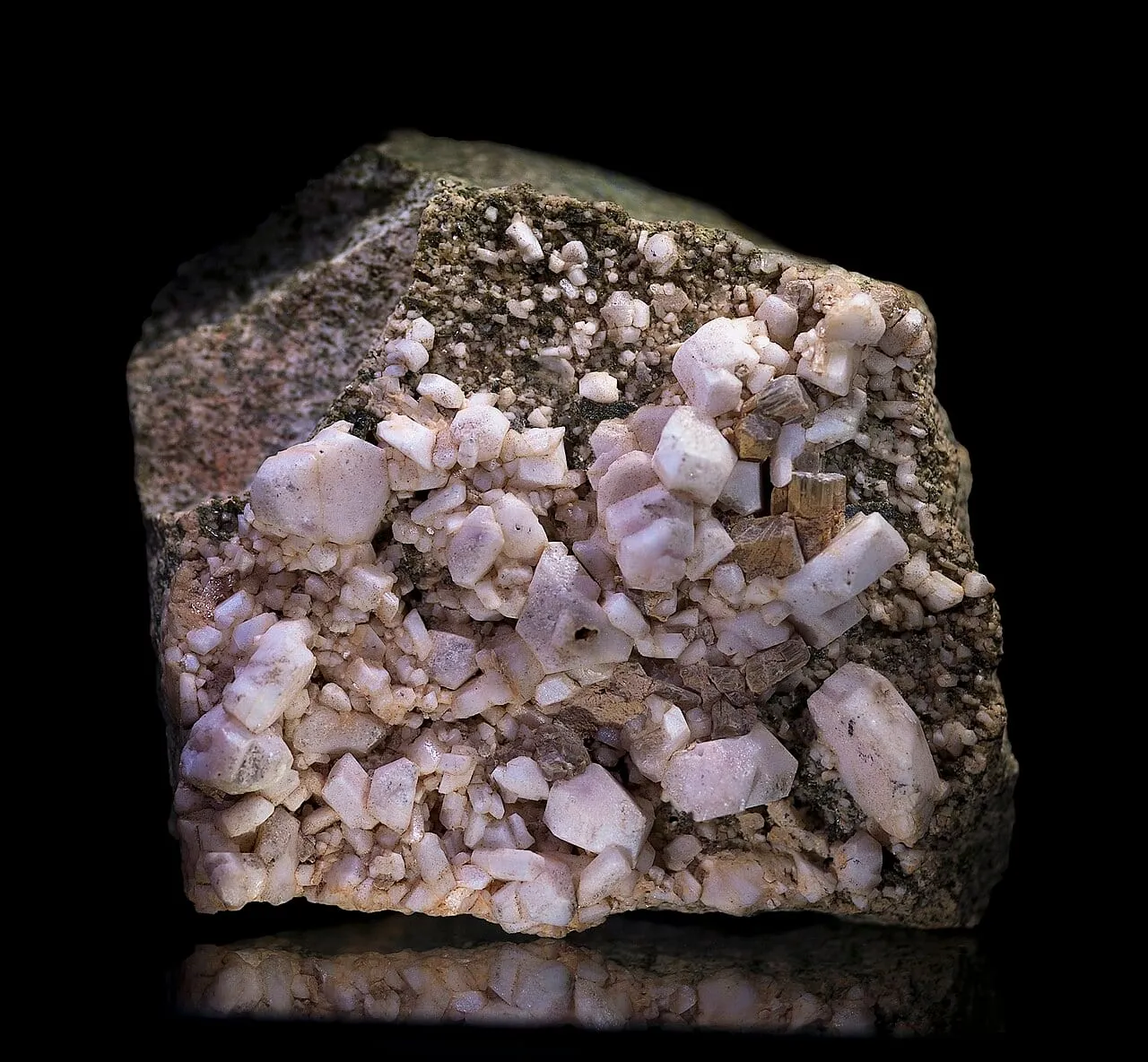
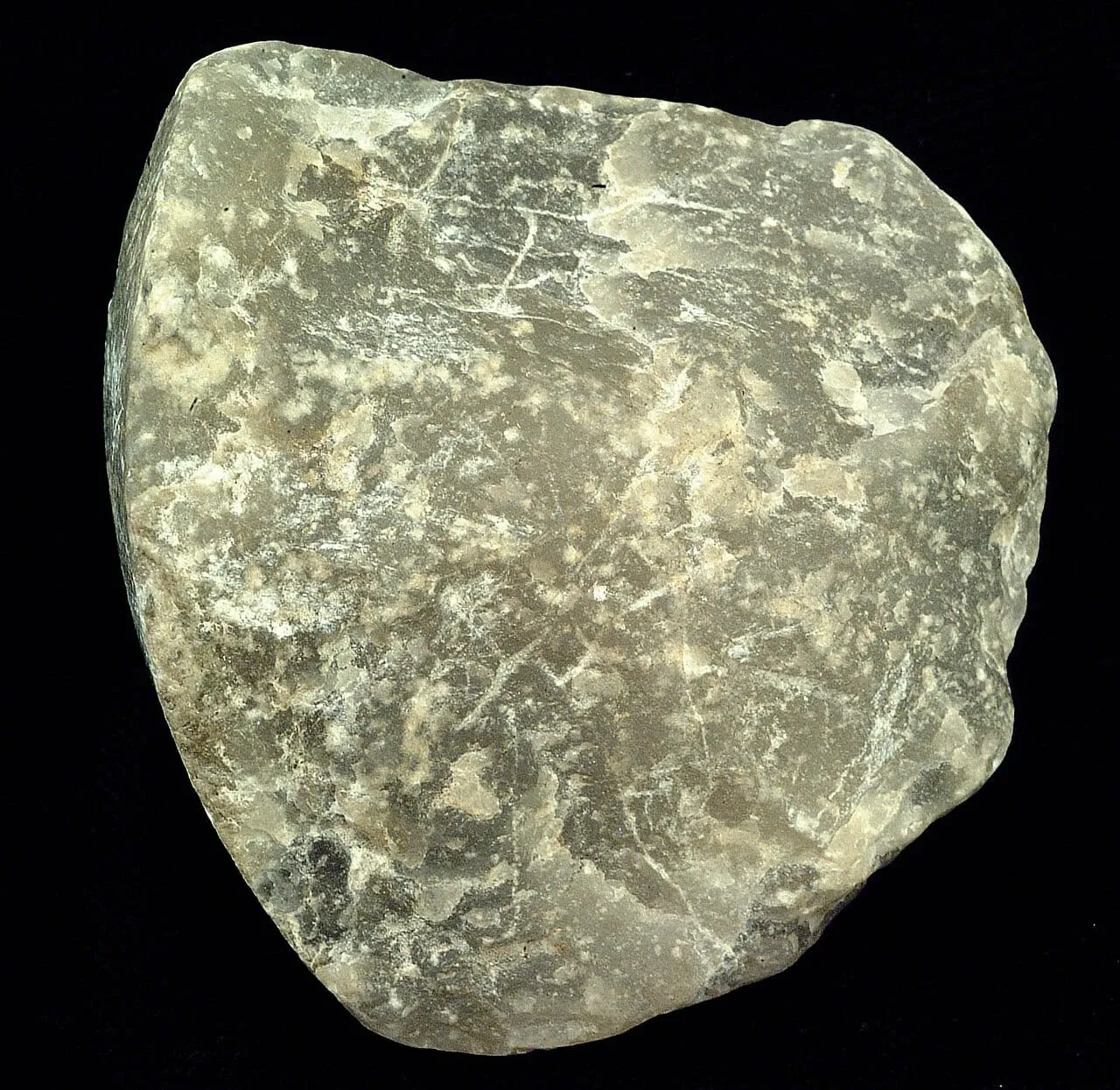
Albite
The white, sodium end of the feldspars: with its deposits at Çine–Milas, a glass and ceramics raw material that makes Türkiye one of the world’s main feldspar producers.
Anhydrite
Gypsum without its water: a calcium sulfate mineral, whose blue-grey Peruvian form is sold as “angelite”.
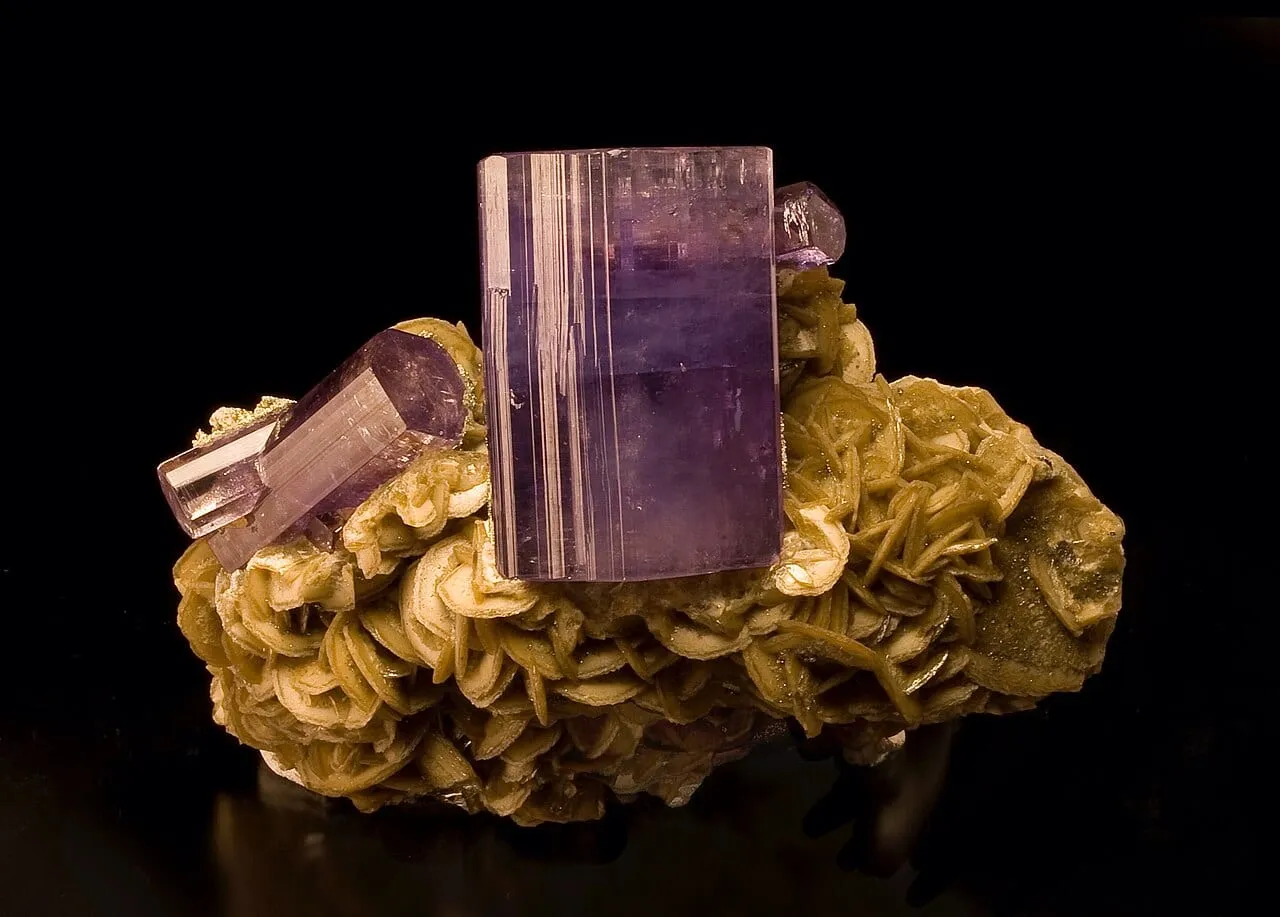
Apatite
A mineral cousin of our teeth and bones, the source of the phosphorus in fertilisers, and number 5 on the Mohs scale.