Meteorite
L chondrite
L kondrit
The second commonest meteorite group: low-iron ordinary chondrites, many heavily shocked, from an asteroid shattered 467 million years ago.
Also known as: Hypersthene chondrite (obsolete) · Olivine hypersthene chondrite (obsolete)
- Popularly: Meteorite

In short
L chondrites are the second most common meteorite group, making up about 35% of catalogued meteorites and 40% of ordinary chondrites. The “L” stands for “low”, as they hold less iron than H chondrites. Most show strong heating and heavy shock, suggesting their parent asteroid was broken up by a large collision. That break-up, about 468 million years ago, is thought to have temporarily raised the number of meteorites falling on Earth during the Ordovician.
Photos

How does it form?
L chondrites come from an asteroid that formed at the start of the Solar System from dust and chondrules but never fully melted. Over 60% are petrologic type 6, showing that the parent body was large enough, more than 100 kilometres across, to be strongly heated.
A much larger share of L chondrites than of other chondrites shows heavy shock, suggesting that the parent body was completely shattered by a large collision. Cosmic-ray data date this break-up to about 468 million years ago. Which asteroid was the parent is unknown; 433 Eros, 8 Flora or the Flora family, and the Massalia family have been suggested.
What is it used for?
- Earth history: L chondrites help study the Ordovician meteor event and its possible effects on life at the time.
- Asteroid collisions: Their shock features record the history of large collisions in the asteroid belt.
- Tracking meteorites: Camera-tracked falls such as Novato help calculate meteorites’ orbits before they reached Earth.
Famous L chondrites
L’Aigle (L6, 1803, France) is the fall that gave birth to meteorite science. Novato (L6, 2012, California) is a fall tracked by cameras and then recovered. The fossil L chondrites found in Ordovician limestone in Sweden are evidence of a meteor shower in Earth’s past.
What determines its value?
Being so common, L chondrites are relatively easy to find among meteorites. A piece's value depends on its mass, the freshness of its fusion crust, how rusted it is, interior features such as shock veins, and whether it belongs to a famous observed fall.
This information is educational, not buying, selling or investment advice. Value varies enormously with quality and treatment.
How to recognise it
- 1
A black fusion crust outside; inside light grey, often with dark shock veins.
- 2
With 4–10% free metal it attracts a magnet, but not as strongly as H chondrites.
- 3
Since most are type 6, the chondrules show only faintly on a cut face.
Myths and misconceptions
MythThe number of meteorites falling on Earth has always been the same.
FactIn the Ordovician, about 467 million years ago, the break-up of the L chondrite parent body clearly raised the number of L chondrites falling on Earth, for about 40 million years. The evidence is fossil meteorites in Sweden and chondritic chromite grains in sedimentary rocks of that age.
Did you know?
They used to be called “hypersthene chondrites” or “olivine hypersthene chondrites” after their dominant minerals.
Abundant fossil L chondrites have been found in about 467-million-year-old limestone in a quarry in Sweden.
Cameras worked out the track of the Novato meteorite, which fell in California in 2012; after reading a newspaper story, Lisa Webber went looking for the source of a sound she had heard on her roof that night and found the first piece.
Where is it found?
Loading map…
- L'Aigle, Normandy, France · Historic sourceA shower of more than 3,000 fragments of an L6 chondrite on 26 April 1803; Biot's investigation proved that meteorites come from space.
- Novato, California, USA · Known localityAn L6 breccia that fell on 17 October 2012; thanks to the camera-based trajectory, the first piece was found by Lisa Webber, who had heard a sound on her roof that night.
- Thorsberg quarry, Österplana, Kinnekulle, Sweden · Known localityA quarry known for fossil meteorites in Ordovician limestone. Abundant fossil L chondrites from a quarry in Sweden show that L chondrite falls rose sharply about 467 million years ago.
Locations are approximate to protect sites. Red dots mark places in Türkiye. Open in the big map →
Frequently asked questions
What is l chondrite?
L chondrites are the second most common meteorite group, making up about 35% of catalogued meteorites and 40% of ordinary chondrites. The “L” stands for “low”, as they hold less iron than H chondrites. Most show strong heating and heavy shock, suggesting their parent asteroid was broken up by a large collision. That break-up, about 468 million years ago, is thought to have temporarily raised the number of meteorites falling on Earth during the Ordovician.
What was the Ordovician meteor event?
In the Middle Ordovician, about 467.5 million years ago, the number of L chondrites falling on Earth rose sharply, and the increase lasted about 40 million years. It is thought to have been caused by the break-up of the roughly 150-kilometre L chondrite parent body in the asteroid belt, which scattered fragments onto Earth-crossing paths. Shock ages in many L chondrites falling today support this date.
What is l chondrite used for?
Earth history: L chondrites help study the Ordovician meteor event and its possible effects on life at the time. Asteroid collisions: Their shock features record the history of large collisions in the asteroid belt. Tracking meteorites: Camera-tracked falls such as Novato help calculate meteorites' orbits before they reached Earth.
How hard is l chondrite?
It has a hardness of 5–7 on the Mohs scale. It can scratch glass; a steel knife scratches it only with difficulty. Its specific gravity is 3.19–3.51 g/cm³.
Where is l chondrite found?
Its best-known localities: L'Aigle, Normandy, France; Novato, California, USA; Thorsberg quarry, Österplana, Kinnekulle, Sweden.
How can you tell if l chondrite is real?
A black fusion crust outside; inside light grey, often with dark shock veins. With 4–10% free metal it attracts a magnet, but not as strongly as H chondrites. Since most are type 6, the chondrules show only faintly on a cut face.
Is l chondrite valuable?
On the “street to diamond” value ladder it sits on step 5 of nine: Ornamental stone. Being so common, L chondrites are relatively easy to find among meteorites. A piece's value depends on its mass, the freshness of its fusion crust, how rusted it is, interior features such as shock veins, and whether it belongs to a famous observed fall.
Sources
- L chondrite · Wikipedia
- Ordovician meteor event · Wikipedia
- Österplana 065 · Wikipedia
- L'Aigle (meteorite) · Wikipedia
- Novato meteorite · Wikipedia
- Meteorite porosities and densities: a review of trends in the data (D. T. Britt & G. J. Consolmagno), Lunar and Planetary Science XXXV, abstract 2108 · Lunar and Planetary Institute, 2004
- Handbook of Mineralogy: Enstatite · Mineralogical Society of America
External links
Draft: awaiting expert reviewReport an error
On the same step
Agate
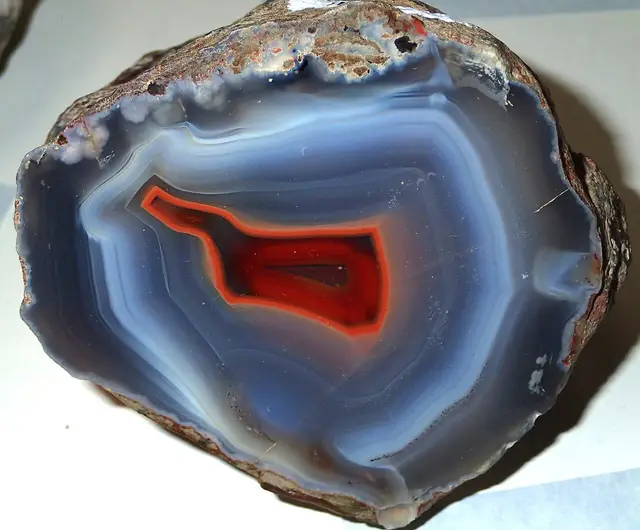
The banded variety of chalcedony: it grows layer by layer in hollows in volcanic rock and shows a new pattern every time it is cut.
Almandine
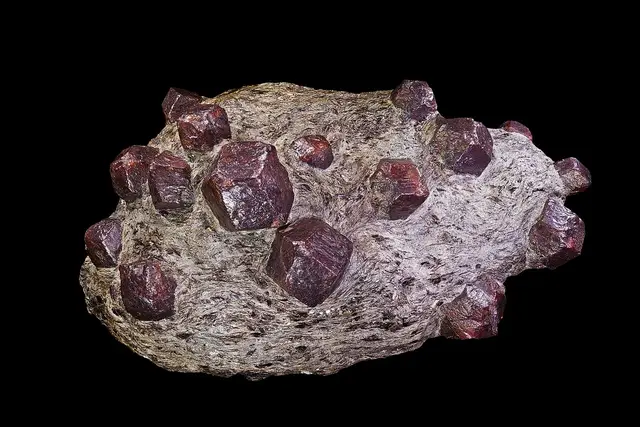
The commonest garnet: a deep red, iron-rich stone named after the ancient city of Alabanda in Anatolia, used in jewellery and in sandpaper alike.
Amazonite
A turquoise-like green-blue feldspar: a variety of microcline worn as jewellery for more than three thousand years, but it can release lead.