Meteorite
Fukang meteorite
Fukang meteoriti
A stained-glass window from space: a one-tonne pallasite from China with gem-quality peridot crystals set in silvery metal.
Also known as: Fukang pallasite
- Popularly: Meteorite

In short
The Fukang meteorite is a 1,003-kilogram pallasite found in 2000 in the mountains near Fukang, in China's Xinjiang region. Pallasites are stony-iron meteorites made of olivine crystals set in nickel–iron metal. Fukang's olivines are large and gem quality (peridot); when thin slices are lit from behind, the crystals glow golden and green. It is estimated to be about 4.5 billion years old.
Photos

How does it form?
Pallasites are thought to form at the boundary where an asteroid’s molten metal core meets its olivine-rich rocky mantle. There olivine crystals became embedded in molten nickel–iron, and when the metal cooled and solidified the crystals were trapped inside. Fukang is a “main-group” pallasite.
Fukang’s metal is mostly kamacite. It is estimated to be about 4.5 billion years old, close to the age of the Solar System. After the parent body was broken up by collisions, a piece reached Earth; its fall was not seen.
What is it used for?
Fukang was studied at the University of Arizona’s Southwest Meteorite Center by Dante Lauretta and his team, joined by Ian Franchi of the Open University. Pallasites are studied to understand the inner structure of asteroids, the boundary between metal core and mantle, and how these bodies cooled. The oxygen isotope ratios of the olivine help show which group of pallasites a meteorite belongs to. Thin slices cut from Fukang are among the most admired meteorite specimens in museums and collections.
Specimens
A 31-kilogram section is kept at the University of Arizona as the type specimen. The main mass has been displayed in the University of Arizona’s Michael J. Drake building.
What determines its value?
Pallasites are a very small share of meteorites, and the coloured olivine crystals revealed when they are cut make them among the most sought-after meteorites for collectors. A slice's value depends on the clarity, colour and soundness of its olivines, how thin and large the slice is, how well the metal resists rust, and its documented origin.
This information is educational, not buying, selling or investment advice. Value varies enormously with quality and treatment.
How to recognise it
- 1
Translucent crystals ranging from golden yellow to olive green, set in silvery grey metal.
- 2
The crystals range from rounded to angular and from under 5 millimetres to several centimetres, and many are fractured.
- 3
The metal makes it heavy; only documentation and laboratory analysis can show that a slice really comes from Fukang.
Myths and misconceptions
MythPeridot is a gemstone that forms only on Earth.
FactPeridot is gem-quality olivine, and it also occurs in pallasites such as Fukang. Fukang's large olivine crystals come from a piece of a 4.5-billion-year-old asteroid.
MythThe main mass of Fukang was sold at auction.
FactThe main mass was offered at a Bonhams auction in New York in April 2008, but it did not sell. Part of the mass and a research specimen are at the University of Arizona.
Did you know?
The Chinese dealer who obtained the mass removed about 20 kg from it; in 2005 it was brought to the Tucson Gem and Mineral Show, where the planetary scientist Dante Lauretta spotted it.
The main mass contains clusters of massive olivine up to 11 centimetres across, cut by thin metal veins.
A 48 × 91 centimetre “window” was cut and polished into the main mass to give a view into its gem-quality areas.
Where is it found?
Loading map…
- Mountains near Fukang, Xinjiang, China · Type localityThe area where the 1,003-kilogram mass was found in 2000; its fall was not observed.
Locations are approximate to protect sites. Red dots mark places in Türkiye. Open in the big map →
Frequently asked questions
What is fukang meteorite?
The Fukang meteorite is a 1,003-kilogram pallasite found in 2000 in the mountains near Fukang, in China's Xinjiang region. Pallasites are stony-iron meteorites made of olivine crystals set in nickel–iron metal. Fukang's olivines are large and gem quality (peridot); when thin slices are lit from behind, the crystals glow golden and green. It is estimated to be about 4.5 billion years old.
What are the green crystals in the Fukang meteorite?
They are olivine crystals; gem-quality olivine is called peridot. Fukang's olivine is rich in magnesium. The crystals formed where an asteroid's metal core met its rocky mantle, becoming embedded in molten metal.
What is fukang meteorite used for?
Fukang was studied at the University of Arizona's Southwest Meteorite Center by Dante Lauretta and his team, joined by Ian Franchi of the Open University. Pallasites are studied to understand the inner structure of asteroids, the boundary between metal core and mantle, and how these bodies cooled. The oxygen isotope ratios of the olivine help show which group of pallasites a meteorite belongs to. Thin slices cut from Fukang are among the most admired meteorite specimens in museums and collections.
How hard is fukang meteorite?
It has a hardness of 4–7 on the Mohs scale. It can scratch glass; a steel knife scratches it only with difficulty. Its specific gravity is 4.66–4.86 g/cm³.
Where is fukang meteorite found?
Its best-known localities: Mountains near Fukang, Xinjiang, China.
How can you tell if fukang meteorite is real?
Translucent crystals ranging from golden yellow to olive green, set in silvery grey metal. The crystals range from rounded to angular and from under 5 millimetres to several centimetres, and many are fractured. The metal makes it heavy; only documentation and laboratory analysis can show that a slice really comes from Fukang.
Is fukang meteorite valuable?
On the “street to diamond” value ladder it sits on step 7 of nine: Precious stone. Pallasites are a very small share of meteorites, and the coloured olivine crystals revealed when they are cut make them among the most sought-after meteorites for collectors. A slice's value depends on the clarity, colour and soundness of its olivines, how thin and large the slice is, how well the metal resists rust, and its documented origin.
Sources
- Fukang meteorite · Wikipedia
- Fukang meteoriti · Vikipedi
- Pallasite · Wikipedia
- Meteorite porosities and densities: a review of trends in the data (D. T. Britt & G. J. Consolmagno), Lunar and Planetary Science XXXV, abstract 2108 · Lunar and Planetary Institute, 2004
- Kamacite Mineral Data · Webmineral.com
- Handbook of Mineralogy: Forsterite · Mineralogical Society of America
External links
Draft: awaiting expert reviewReport an error
On the same step
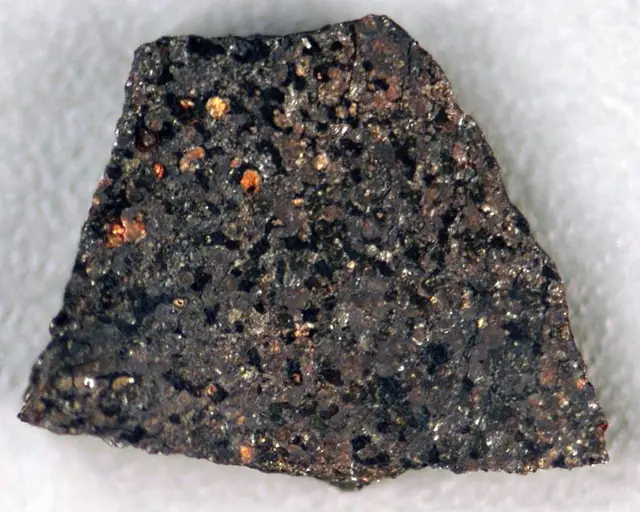
Acapulcoite
Stony meteorites that began to melt but never fully did: metal-veined primitive achondrites, named after a stone that fell near Acapulco in 1976.
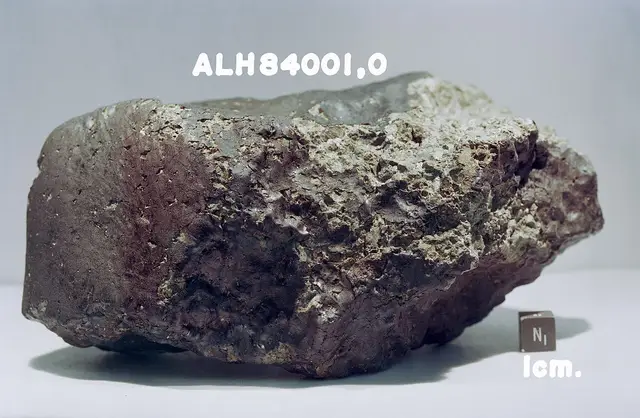
Allan Hills 84001
The stone that sparked the Mars-life debate: a 4-billion-year-old Martian meteorite from Antarctica whose tiny structures were likened to fossil bacteria in 1996.
Angrite
The oldest known igneous rocks: rare basaltic meteorites that crystallised about 4.56 billion years ago, in the very earliest days of the Solar System.