Mineral
Bismuth
BiBizmut
The rainbow-coloured stepped crystals in shops are grown in a lab; natural bismuth is a silver-white metal with a pinkish sheen.
Also known as: Native bismuth
- Popularly: Ore and raw material

In short
Bismuth is an element that sometimes occurs in nature as the pure metal, silver-white with a faint reddish hue. Native bismuth usually occurs in small amounts in veins carrying cobalt, nickel, silver and tin ores. Most bismuth produced today is a by-product of refining lead, copper, tin, molybdenum and tungsten. The eye-catching, colourful “stepped” crystals are grown in laboratories by melting pure bismuth and letting it cool.
Photos

How does it form?
Native bismuth forms mostly in hydrothermal veins, where hot water circulating through cracks in rock leaves minerals behind, together with ores of cobalt, nickel, silver and tin. It is also found in pegmatites and in topaz-bearing tin-tungsten quartz veins. It is known from many places, but usually in small amounts, as an accessory mineral. The main commercial ores of bismuth are the minerals bismuthinite (bismuth sulfide) and bismite (bismuth oxide).
In the laboratory, pure bismuth is melted at about 271 °C and cooled slowly. Because the edges of the crystal grow faster than its centre, hollow, stepped “hopper” crystals form; when the hot crystal meets the air, a thin oxide layer appears on its surface, and that is where the colours come from.
What is it used for?
- Medicine: Bismuth subsalicylate is a medicine used to treat diarrhoea.
- Replacing lead: It replaces lead in shotgun pellets, bullets and some ammunition.
- Low-melting alloys: Wood’s metal, an alloy of bismuth, lead, tin and cadmium, is used in automatic fire sprinkler systems.
- Cosmetics: Bismuth oxychloride is used in some cosmetics as a pigment that adds shimmer.
What determines its value?
Since bismuth is mostly a by-product of refining other metals, its value is largely set by the production of lead, copper, tin and tungsten; most of the world’s output comes from China. For native bismuth specimens, size, how distinct the crystal form is and the locality, such as the famous deposits of Bolivia, matter. Lab-grown coloured crystals are common decorative objects and do not carry the value of natural specimens.
This information is educational, not buying, selling or investment advice. Value varies enormously with quality and treatment.
How to recognise it
- 1
A fresh surface is silver-white with a reddish hue; tarnished in air, it can take on rainbow colours.
- 2
Soft (hardness 2–2.5): a knife can cut it, but it is brittle and shatters rather than flattening when hammered.
- 3
Heavy (specific gravity about 9.8); roughly four times heavier than an ordinary stone of the same size.
- 4
Native bismuth is usually grains, leaves or branching masses; distinct crystals are rare. Neatly stepped, brightly coloured crystals are lab-grown.
Fakes and imitations
What shops usually don’t tell you:
- Rainbow-coloured, stepped (“hopper”) bismuth crystals are made by melting pure bismuth and cooling it slowly; they are not a natural mineral. A seller should not offer them as “natural bismuth”.
- The iridescent tarnish of native bismuth can also appear on other metallic minerals; a firm identification needs a density measurement or a laboratory analysis.
Safety
Growing bismuth crystals at home means melting the metal at about 271 °C; the hot metal and its container can cause serious burns.
Myths and misconceptions
MythRainbow-coloured stepped bismuth crystals are found like that in nature.
FactThese crystals are grown by melting pure bismuth in a laboratory and letting it cool. Their colours come from a thin oxide layer that forms on the surface when the hot crystal meets the air: as the thickness of the layer changes, different wavelengths of light reinforce or cancel each other. Native bismuth is mostly a silvery metal with indistinct crystals or in grains.
MythBismuth is a poisonous heavy metal, just like lead.
FactBismuth is a heavy element next to lead in the periodic table, but some bismuth compounds are less toxic to humans when swallowed than other heavy metals. That is why a bismuth compound is used in a diarrhoea medicine and bismuth replaces lead in shotgun pellets. Medicines should still only be used as their leaflet directs.
Did you know?
Bismuth is actually radioactive, but extremely slowly: bismuth-209 has a half-life of about 2×10¹⁹ years, more than a billion times the age of the universe. This radioactivity was only demonstrated in 2003.
Like water, bismuth expands when it freezes: its volume grows by about 3.3% as it solidifies.
Its name comes from the German Wismut; the origin is uncertain, but it has been linked to an old word meaning “white”.
Where is it found?
Loading map…
- Llallagua and Uncia, Potosí, Bolivia · Major depositAccording to the Handbook of Mineralogy, the deposits of Uncia, Chorolque, Llallagua and Tazna in Potosí are economically important; an 11 kg nugget of native bismuth was found at Velaque, La Paz.
- Schneeberg, Saxony, Germany · Historic sourceThe Handbook of Mineralogy lists native bismuth from Altenberg, Schneeberg and Annaberg in Saxony, in veins carrying cobalt, nickel and silver ores.
- Jáchymov, Czech Republic · Known localityOne of the classic native bismuth localities listed by the Handbook of Mineralogy (formerly Joachimsthal).
- Dolcoath mine, Camborne, Cornwall, England · Known localityThe Handbook of Mineralogy lists native bismuth from Dolcoath and other mines in Cornwall.
- Cobalt, Ontario, Canada · Known localityOne of the native bismuth localities listed by the Handbook of Mineralogy.
Locations are approximate to protect sites. Red dots mark places in Türkiye. Open in the big map →
Frequently asked questions
What is bismuth?
Bismuth is an element that sometimes occurs in nature as the pure metal, silver-white with a faint reddish hue. Native bismuth usually occurs in small amounts in veins carrying cobalt, nickel, silver and tin ores. Most bismuth produced today is a by-product of refining lead, copper, tin, molybdenum and tungsten. The eye-catching, colourful “stepped” crystals are grown in laboratories by melting pure bismuth and letting it cool.
What is bismuth used for?
Medicine: Bismuth subsalicylate is a medicine used to treat diarrhoea. Replacing lead: It replaces lead in shotgun pellets, bullets and some ammunition. Low-melting alloys: Wood’s metal, an alloy of bismuth, lead, tin and cadmium, is used in automatic fire sprinkler systems. Cosmetics: Bismuth oxychloride is used in some cosmetics as a pigment that adds shimmer.
How hard is bismuth?
It has a hardness of 2–2.5 on the Mohs scale. It is soft enough to scratch with a fingernail. Its specific gravity is 9.7–9.83 g/cm³.
Where is bismuth found?
Its best-known localities: Llallagua and Uncia, Potosí, Bolivia; Schneeberg, Saxony, Germany; Jáchymov, Czech Republic; Dolcoath mine, Camborne, Cornwall, England; Cobalt, Ontario, Canada.
How can you tell if bismuth is real?
A fresh surface is silver-white with a reddish hue; tarnished in air, it can take on rainbow colours. Soft (hardness 2–2.5): a knife can cut it, but it is brittle and shatters rather than flattening when hammered. Heavy (specific gravity about 9.8); roughly four times heavier than an ordinary stone of the same size. Rainbow-coloured, stepped (“hopper”) bismuth crystals are made by melting pure bismuth and cooling it slowly; they are not a natural mineral. A seller should not offer them as “natural bismuth”.
Is bismuth valuable?
On the “street to diamond” value ladder it sits on step 4 of nine: Fine dimension stone and ore. Since bismuth is mostly a by-product of refining other metals, its value is largely set by the production of lead, copper, tin and tungsten; most of the world’s output comes from China. For native bismuth specimens, size, how distinct the crystal form is and the locality, such as the famous deposits of Bolivia, matter. Lab-grown coloured crystals are common decorative objects and do not carry the value of natural specimens.
Is bismuth dangerous?
Growing bismuth crystals at home means melting the metal at about 271 °C; the hot metal and its container can cause serious burns.
Sources
- Handbook of Mineralogy: Bismuth · Mineralogical Society of America
- Bismuth · Wikipedia
- Llallagua · Wikipedia
- Schneeberg, Saxony · Wikipedia
- Jáchymov · Wikipedia
- Dolcoath mine · Wikipedia
- Cobalt, Ontario · Wikipedia
External links
Draft: awaiting expert reviewReport an error ↗
On the same step
Anglesite
A heavy lead sulfate mineral with a diamond-like shine that grows as a crust around galena; it is named after the island of Anglesey in Wales.
Arsenopyrite
A widespread silvery-grey sulfide containing arsenic: it smells of garlic when struck and is poisonous.
Banded iron formation
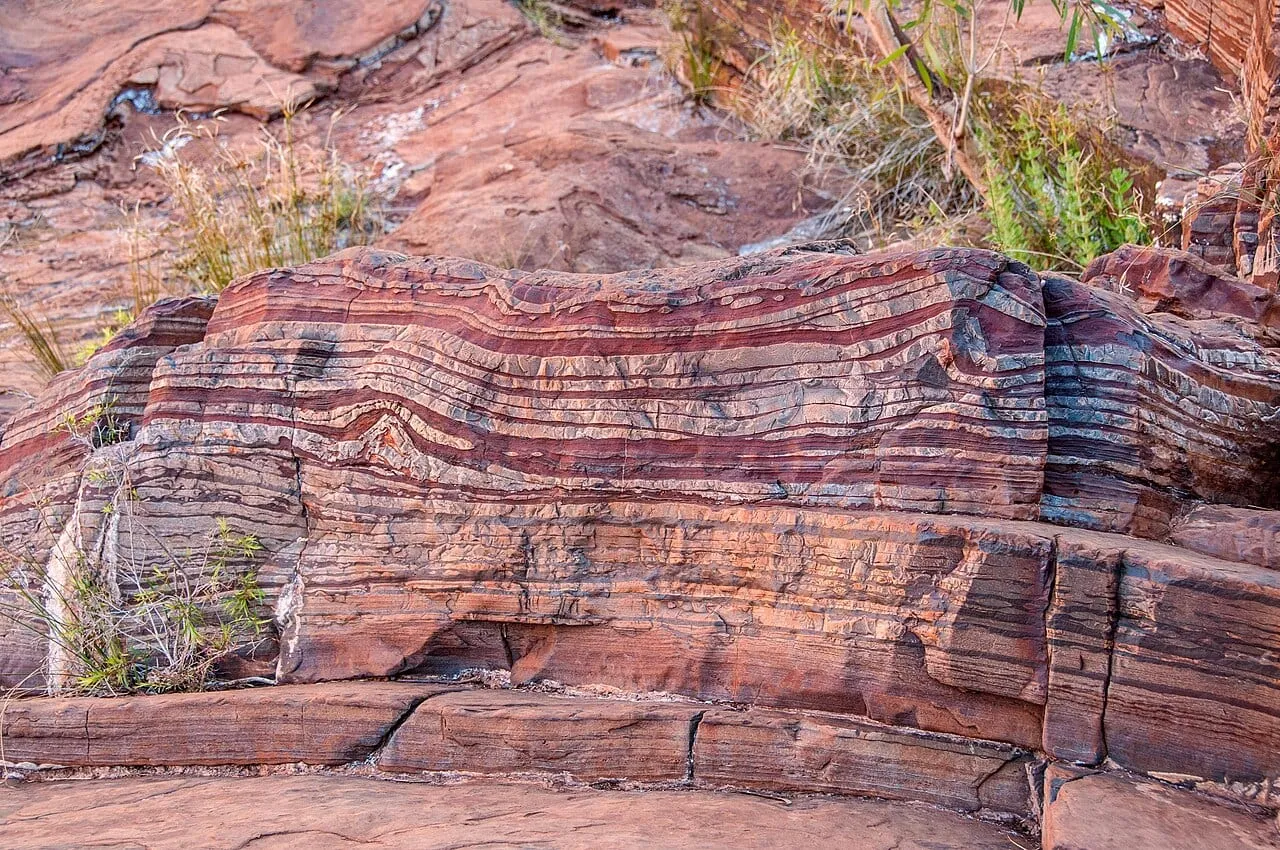
An ancient rock of alternating iron-oxide and chert bands: the record of oxygen beginning to build up on Earth, and the main source of iron ore.