VarietyA variety of Obsidian
Apache tears
Apaçi gözyaşı
Rounded black nodules of obsidian that weather out of grey perlite; they are translucent against the light and take their name from an Apache legend in Arizona.
Also known as: Marekanite · Obsidian nodules
- Popularly: Semi-precious stone
In short
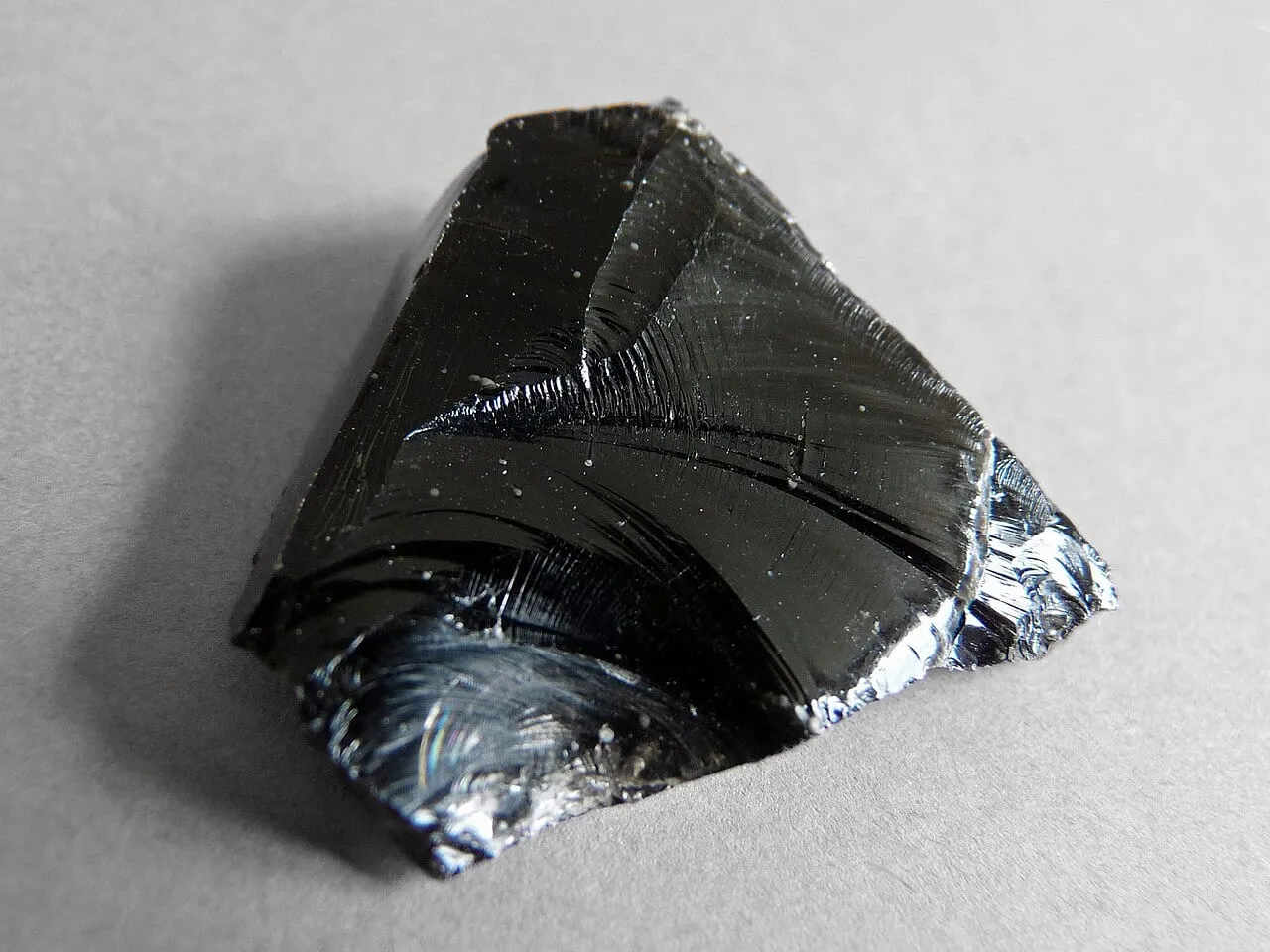
Apache tears is the popular name for rounded or teardrop-shaped pieces of black obsidian (volcanic glass), usually less than 5 cm across; geologists call them marekanite. They are the sound glass cores left behind when volcanic glass later took up water and turned into grey, crumbly perlite. In reflected light they look jet black, but held up to the light they show a smoky translucency. The name comes from a legend about Apache Leap, the mountain rising above the town of Superior in Arizona, USA.
Photos
How does it form?
Apache tears form in silica-rich (rhyolitic) lava flows, lava domes or ash-flow tuffs. When lava cools very quickly, it has no time to crystallise and sets as the volcanic glass called obsidian, which usually contains less than 1 percent water.
If this glass later reacts with water, it takes the water up (hydration) and turns into perlite, a grey, crumbly glass of the same composition but containing 2–5 percent water. The change is not complete everywhere: where water fails to reach, fresh obsidian cores survive as rounded nodules. A study in Nicaragua found that the core and the outer skin of such spheres differ in water content. As the perlite weathers and falls apart, the sound glass nodules are scattered over slopes and valleys, where Apache tears are collected.
What is it used for?
- Collecting and ornament: They are sought by rockhounds collecting in the field and are often polished by tumbling (in a rotating barrel).
- Lapidary work: They count as a semi-precious ornamental stone and are polished and worked by lapidaries.
- Alongside perlite: The perlite they come from is an industrial raw material that expands about twentyfold when heated; the extensive perlite beds around Superior have been mined for this purpose.
Where does the name come from?
According to the Wikipedia article on Superior, in 1872 a group of Apache raiders was ambushed by US Cavalry coming from nearby Picket Post Mountain; about 50 Apaches were killed and the rest retreated up the mountain. Local legend says that the remaining warriors leapt from the cliff rather than be captured, giving the mountain the name Apache Leap. Tellings of the legend differ somewhat: the Apache tears article speaks of about 75 warriors and of their families’ tears turning to stone, while a magazine article from 1961 describes the stones as tears born of the mountain’s grief.
In Türkiye
Rich obsidian deposits occur around Anatolia’s young volcanoes. According to a study by MTA and university researchers published in 1990, marekanite-type obsidian pieces no longer than 5–6 cm were observed together with tuffs and ignimbrites near Kulaklıkepez Hill, around Çat between Nevşehir and Gülşehir.
What determines its value?
Apache tears are a plentiful, inexpensive collector’s and ornamental stone. Their value depends on size, a neat round or teardrop shape, how clear they look when held up to the light, and the polish they take when tumbled. Specimens still sitting in their perlite and pieces from famous localities such as Superior draw more interest from collectors.
This information is educational, not buying, selling or investment advice. Value varies enormously with quality and treatment.
How to recognise it
- 1
They are black pebbles, usually under 5 cm, rounded, teardrop-shaped or irregular, with a dimpled surface.
- 2
Held up to a strong light, smoky grey or brownish light shows through the thinner parts.
- 3
They are usually found embedded in grey, crumbly perlite or scattered over slopes underlain by perlite.
- 4
Like obsidian, they have a hardness of 5–5.5; when broken they leave curved, shell-like surfaces with very sharp edges.
Safety
Although Apache tears are rounded, broken pieces have razor-sharp edges like any obsidian. Wear safety glasses and gloves when breaking or knapping them.
Myths and misconceptions
MythApache tears are a different stone from obsidian.
FactApache tears is a popular name for rounded pieces of obsidian; geologists call them marekanite. Chemically and structurally they are the same volcanic glass as obsidian.
MythApache tears are completely opaque, jet-black stones.
FactAlthough they look black in reflected light, they are translucent when held up to the light. As Rock & Gem magazine notes, contrary to common assumptions, light can pass through this glass.
Did you know?
Johnny Cash sang a song called “Apache Tears” on his 1964 album “Bitter Tears: Ballads of the American Indian”.
The name “marekanite” comes from Marekanka, near Okhotsk in Siberia. In 1886 the British geologist John W. Judd argued that these glass spheres, which collectors had filed as a mineral, were really a type of rock.
According to a 1961 article in Arizona Highways, some businesses near Superior at the time let visitors collect their own Apache tears for a small fee.
Where is it found?
Loading map…
- Superior and Apache Leap, Pinal County, Arizona, USA · Major depositWhere the legend behind the name is set; Apache tears weather out of extensive perlite beds
- South Pahroc Range, Lincoln County, Nevada, USA · Known localityMarekanite nodules, sought by collectors, abundant on slopes underlain by perlite
- Marekanka, near Okhotsk, Russia · Type localityThe source of the name “marekanite”; glassy spheres between pea and walnut size
- Cerro Tijerina, near Matagalpa, Nicaragua · Known localityDark obsidian spheres up to 3 cm across in brittle grey perlite
- Streda nad Bodrogom, Košice Region, Slovakia · Known localityMarekanite about 14–15 million years old, 0.5–5 cm in size
- Çat (Kulaklıkepez Hill), Nevşehir, Türkiye · Known localityMarekanite-type obsidian pieces no longer than 5–6 cm, together with tuffs and ignimbrites
Locations are approximate to protect sites. Red dots mark places in Türkiye. Open in the big map →
Frequently asked questions
What is apache tears?
Apache tears is the popular name for rounded or teardrop-shaped pieces of black obsidian (volcanic glass), usually less than 5 cm across; geologists call them marekanite. They are the sound glass cores left behind when volcanic glass later took up water and turned into grey, crumbly perlite. In reflected light they look jet black, but held up to the light they show a smoky translucency. The name comes from a legend about Apache Leap, the mountain rising above the town of Superior in Arizona, USA.
Where does the name Apache tears come from?
From a local legend. In the 1870s, it is said, Apache warriors fighting the US Cavalry on the mountain above Superior chose to leap from the cliff rather than surrender when defeat was certain. When their wives and families heard of their deaths, their tears turned to stone as they hit the ground. The mountain is called Apache Leap for the same reason.
What is apache tears used for?
Collecting and ornament: They are sought by rockhounds collecting in the field and are often polished by tumbling (in a rotating barrel). Lapidary work: They count as a semi-precious ornamental stone and are polished and worked by lapidaries. Alongside perlite: The perlite they come from is an industrial raw material that expands about twentyfold when heated; the extensive perlite beds around Superior have been mined for this purpose.
How hard is apache tears?
It has a hardness of 5–5.5 on the Mohs scale. A fingernail cannot scratch it, but a steel knife can. Its specific gravity is 2.35–2.6 g/cm³.
Where is apache tears found?
Its best-known localities: Marekanka, near Okhotsk, Russia; Superior and Apache Leap, Pinal County, Arizona, USA; South Pahroc Range, Lincoln County, Nevada, USA; Cerro Tijerina, near Matagalpa, Nicaragua; Streda nad Bodrogom, Košice Region, Slovakia.
Where is apache tears found in Türkiye?
Known localities in Türkiye: Çat (Kulaklıkepez Hill), Nevşehir, Türkiye.
How can you tell if apache tears is real?
They are black pebbles, usually under 5 cm, rounded, teardrop-shaped or irregular, with a dimpled surface. Held up to a strong light, smoky grey or brownish light shows through the thinner parts. They are usually found embedded in grey, crumbly perlite or scattered over slopes underlain by perlite.
Is apache tears valuable?
On the “street to diamond” value ladder it sits on step 5 of nine: Ornamental stone. Apache tears are a plentiful, inexpensive collector’s and ornamental stone. Their value depends on size, a neat round or teardrop shape, how clear they look when held up to the light, and the polish they take when tumbled. Specimens still sitting in their perlite and pieces from famous localities such as Superior draw more interest from collectors.
Is apache tears dangerous?
Although Apache tears are rounded, broken pieces have razor-sharp edges like any obsidian. Wear safety glasses and gloves when breaking or knapping them.
Family

.jpg)

Sources
- Apache tears · Wikipedia
- Superior, Arizona · Wikipedia
- Apache Tears (H. R. Moore), Arizona Highways, July 1961 · Arizona Highways, 1961
- On marekanite and its allies (J. W. Judd), Geological Magazine 3(6): 241–248 · Cambridge University Press, 1886
- Mineral resources of the South Pahroc Range Wilderness Study Area, Lincoln County, Nevada (USGS Bulletin 1729-A) · U.S. Geological Survey, 1988
- Obsidian balls (marekanite) from Cerro Tijerina, central Nicaragua: petrographic investigations (Mrázová & Gadas), Arabian Journal of Geosciences · Springer, 2011
- Use of obsidian in Slovak prehistory (Ľ. Kaminská), Študijné zvesti Archeologického ústavu SAV, Supplementum 2: 231–250 · Archeologický ústav SAV, 2021
- Kuzeybatı Anadolu obsidiyen buluntularının kaynak belirleme çalışmaları (Ercan, Yeğingil, Bigazzi, Oddone & Özdoğan), Jeoloji Mühendisliği 36: 19–32 · TMMOB Jeoloji Mühendisleri Odası, 1990
- Tumbling Talk: Tearless Apache Tears (L. Wallace) · Rock & Gem Magazine, 2021
- Obsidyen taşının 5 ilginç özelliği · Webtekno, 2023
External links
Draft: awaiting expert reviewReport an error
On the same step
Agate
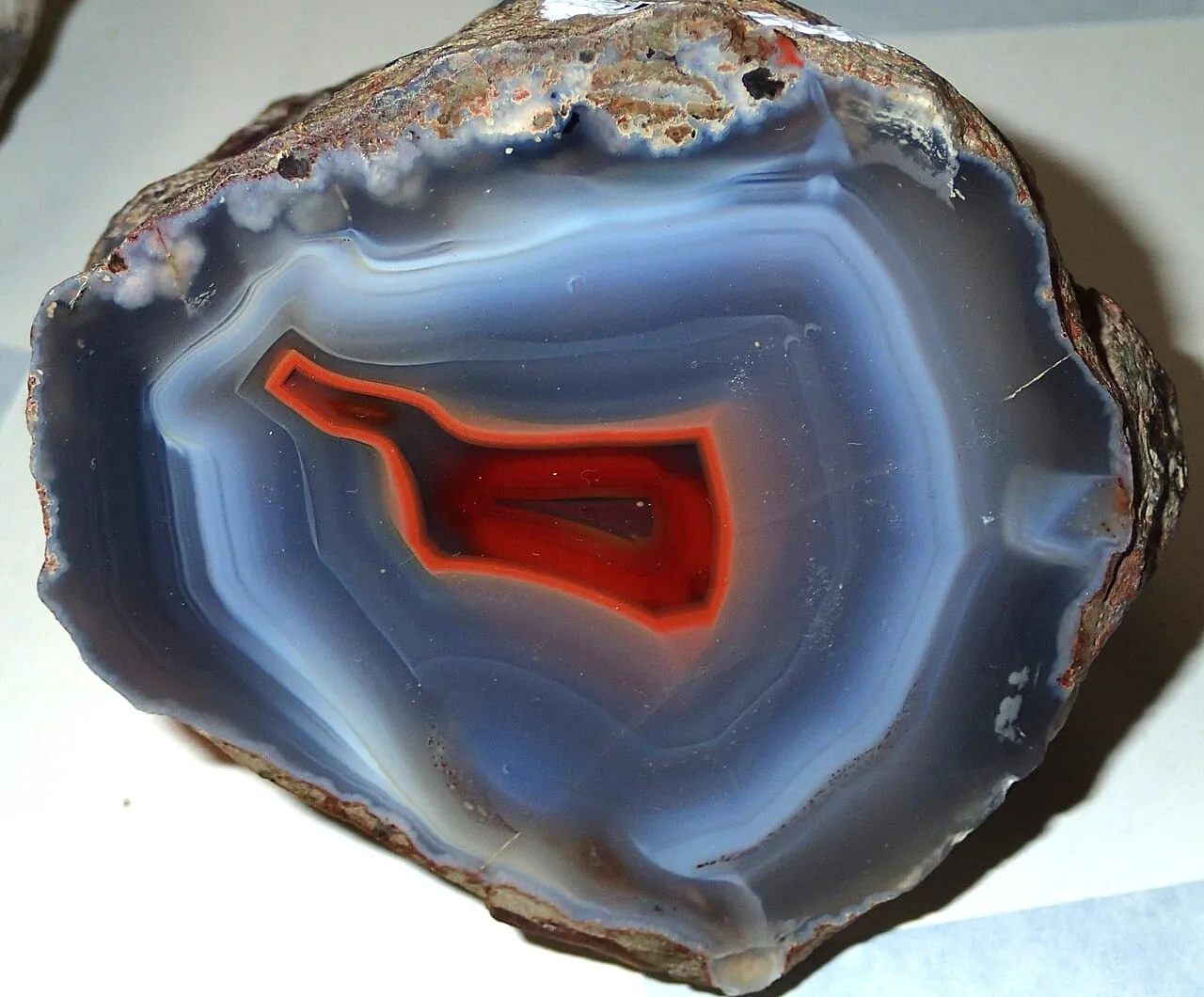
The banded variety of chalcedony: it grows layer by layer in hollows in volcanic rock and shows a new pattern every time it is cut.

Almandine
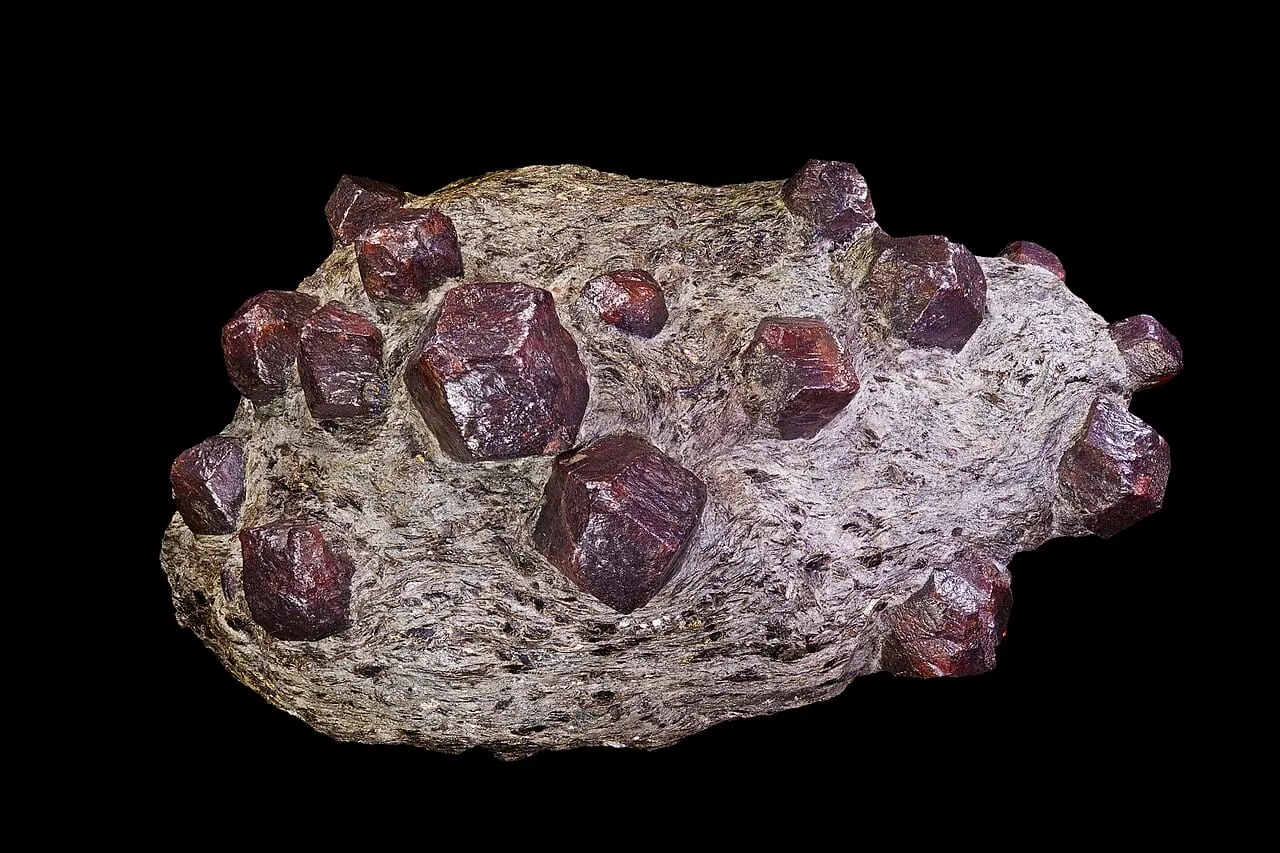
The commonest garnet: a deep red, iron-rich stone named after the ancient city of Alabanda in Anatolia, used in jewellery and in sandpaper alike.
Amazonite
A turquoise-like green-blue feldspar: a variety of microcline worn as jewellery for more than three thousand years, but it can release lead.