Mineral
Vanadinite
Pb₅(VO₄)₃ClVanadinit
The lead mineral with striking red-orange hexagonal crystals: a main ore of vanadium and a collector's favourite.
Also known as: Brown lead (del Río's name)
- Popularly: Ore and raw material
_1_(23733319832).jpg)
In short
Vanadinite is a mineral made of lead, vanadium and chlorine (Pb₅(VO₄)₃Cl). It usually forms bright red or orange-red crystals shaped like neat hexagonal prisms. It forms in the upper parts of lead deposits that are exposed to air. Along with carnotite and roscoelite, it is one of the main industrial ores of the element vanadium. It is named for its vanadium content. Its most famous specimens come from the Mibladen area of Morocco.
Photos

How does it form?
Vanadinite is a secondary mineral: it forms in the oxidised zone of lead deposits, the part near the surface that is exposed to air and groundwater. The lead comes from the primary lead minerals of the deposit; the vanadium is leached by water from the silicate minerals of the surrounding rock. That is why it occurs with minerals such as mimetite, pyromorphite, wulfenite, cerussite, anglesite, baryte and calcite. It belongs to the apatite group, which gives it its hexagonal prism-shaped crystals.
What is it used for?
- Vanadium ore: Along with carnotite and roscoelite, it is one of the main industrial ores of vanadium, which is extracted by roasting and smelting.
- Steel: About 85% of the vanadium produced is used to strengthen steel.
- Collecting: Its bright red crystals are much loved by collectors; the Mibladen specimens are probably the most popular of all.
In Türkiye
The Handbook of Mineralogy lists the Keban area of Elazığ among the known localities of vanadinite.
What determines its value?
As an ore, vanadinite is valued for its vanadium; about 85% of the vanadium produced is used as a steel additive. Collectors look for vivid red, sharp-edged, lustrous and undamaged crystals, and groups sitting on pale baryte or dolostone. Specimens from the Mibladen area of Morocco are among the best-known vanadinites in the world.
This information is educational, not buying, selling or investment advice. Value varies enormously with quality and treatment.
How to recognise it
- 1
Forms bright red, orange-red or brownish-red hexagonal prisms; the crystals are often hollow inside.
- 2
Very heavy (specific gravity about 6.9): more than two and a half times as heavy as a piece of quartz the same size.
- 3
Soft (Mohs 2.5–3) and very brittle; it breaks into small fragments with a conchoidal fracture.
- 4
Its lustre is between resinous and adamantine.
- 5
Usually found with baryte, cerussite, wulfenite, mimetite and pyromorphite.
Fakes and imitations
What shops usually don’t tell you:
- Pyromorphite and mimetite, from the same mineral group (the apatite group), also form similar hexagonal prisms and can sometimes be orangey. Telling them apart from vanadinite with certainty takes chemical analysis.
Safety
Vanadinite contains lead: according to an analysis in the Handbook of Mineralogy, about 78% of its weight is lead oxide. Lead is a toxic metal that builds up in the body and can permanently harm the brain and nervous system, especially in children; according to the World Health Organization, there is no level of lead exposure known to be without harmful effects. Wash your hands after handling specimens and keep them out of reach of children. Do not put vanadinite in your mouth, grind or heat it, or put it in drinking water.
Myths and misconceptions
MythVanadium was first discovered in Sweden in 1831.
FactThe first person to find vanadium was Andrés Manuel del Río, who studied vanadinite in Mexico in 1801. His discovery was forgotten after it was wrongly taken for chromium; Sefström rediscovered the element in 1831 and gave it its present name.
MythBecause vanadinite is a vanadium mineral, it carries no lead risk.
FactMost of vanadinite's weight is lead (about 78% lead oxide in analyses). It should therefore be handled with the same care as other lead minerals: never put it in your mouth or breathe its dust.
Did you know?
In 1801 the Spanish mineralogist Andrés Manuel del Río found a new element in this mineral in Mexico, which he called “brown lead”; he named the element first pancromium and later erythronium. When the French chemist Collet-Descotils declared it to be impure chromium, del Río came to doubt his own discovery.
The element was rediscovered in 1831 by the Swedish chemist Nils Gabriel Sefström, who named it vanadium after the Norse goddess Vanadís because of its many beautifully coloured compounds.
According to the Handbook of Mineralogy, the original specimens used to describe vanadinite (its type material) were lost at sea.
Its crystals can grow up to 14 cm long.
Where is it found?
Loading map…
- Mibladen, Midelt, Morocco · Major depositYields large crystals; the Mibladen vanadinites are likely the most popular specimens for collectors
- Touissit mine, near Oujda, Morocco · Known localityOne of the Moroccan deposits the Handbook of Mineralogy cites for large vanadinite crystals
- Zimapán, Hidalgo, Mexico · Historic sourceAndrés Manuel del Río discovered vanadium here in 1801; the mineral was rediscovered at Zimapán in 1838 and named vanadinite
- Broken Hill, New South Wales, Australia · Known localityOne of the world's great lead–zinc–silver deposits; listed by the Handbook of Mineralogy among vanadinite localities
- Keban, Elazığ, Türkiye · Known localityThe Handbook of Mineralogy lists Keban among vanadinite localities (coordinate is the district town)
Locations are approximate to protect sites. Red dots mark places in Türkiye. Open in the big map →
Frequently asked questions
What is vanadinite?
Vanadinite is a mineral made of lead, vanadium and chlorine (Pb₅(VO₄)₃Cl). It usually forms bright red or orange-red crystals shaped like neat hexagonal prisms. It forms in the upper parts of lead deposits that are exposed to air. Along with carnotite and roscoelite, it is one of the main industrial ores of the element vanadium. It is named for its vanadium content. Its most famous specimens come from the Mibladen area of Morocco.
What is vanadium used for?
About 85% of the vanadium produced is used as ferrovanadium or as a steel additive. Its first large-scale industrial use was in the steel alloy chassis of the Ford Model T. Today vanadium redox batteries are also used to store energy on the electricity grid.
What is vanadinite used for?
Vanadium ore: Along with carnotite and roscoelite, it is one of the main industrial ores of vanadium, which is extracted by roasting and smelting. Steel: About 85% of the vanadium produced is used to strengthen steel. Collecting: Its bright red crystals are much loved by collectors; the Mibladen specimens are probably the most popular of all.
How hard is vanadinite?
It has a hardness of 2.5–3 on the Mohs scale. A fingernail cannot scratch it, but a steel knife can. Its specific gravity is 6.88–6.95 g/cm³.
Where is vanadinite found?
Its best-known localities: Mibladen, Midelt, Morocco; Zimapán, Hidalgo, Mexico; Touissit mine, near Oujda, Morocco; Broken Hill, New South Wales, Australia; Keban, Elazığ, Türkiye.
Where is vanadinite found in Türkiye?
Known localities in Türkiye: Keban, Elazığ, Türkiye.
How can you tell if vanadinite is real?
Forms bright red, orange-red or brownish-red hexagonal prisms; the crystals are often hollow inside. Very heavy (specific gravity about 6.9): more than two and a half times as heavy as a piece of quartz the same size. Soft (Mohs 2.5–3) and very brittle; it breaks into small fragments with a conchoidal fracture. Pyromorphite and mimetite, from the same mineral group (the apatite group), also form similar hexagonal prisms and can sometimes be orangey. Telling them apart from vanadinite with certainty takes chemical analysis.
Is vanadinite valuable?
On the “street to diamond” value ladder it sits on step 3 of nine: Building and industrial stone. As an ore, vanadinite is valued for its vanadium; about 85% of the vanadium produced is used as a steel additive. Collectors look for vivid red, sharp-edged, lustrous and undamaged crystals, and groups sitting on pale baryte or dolostone. Specimens from the Mibladen area of Morocco are among the best-known vanadinites in the world.
Is vanadinite dangerous?
Vanadinite contains lead: according to an analysis in the Handbook of Mineralogy, about 78% of its weight is lead oxide. Lead is a toxic metal that builds up in the body and can permanently harm the brain and nervous system, especially in children; according to the World Health Organization, there is no level of lead exposure known to be without harmful effects. Wash your hands after handling specimens and keep them out of reach of children. Do not put vanadinite in your mouth, grind or heat it, or put it in drinking water.
Sources
- Vanadinite · Wikipedia
- Handbook of Mineralogy: Vanadinite · Mineralogical Society of America
- Vanadium · Wikipedia
- Zimapán · Wikipedia
- Lead poisoning (fact sheet) · World Health Organization
External links
ReviewedLast checked: 4 October 2026
On the same step
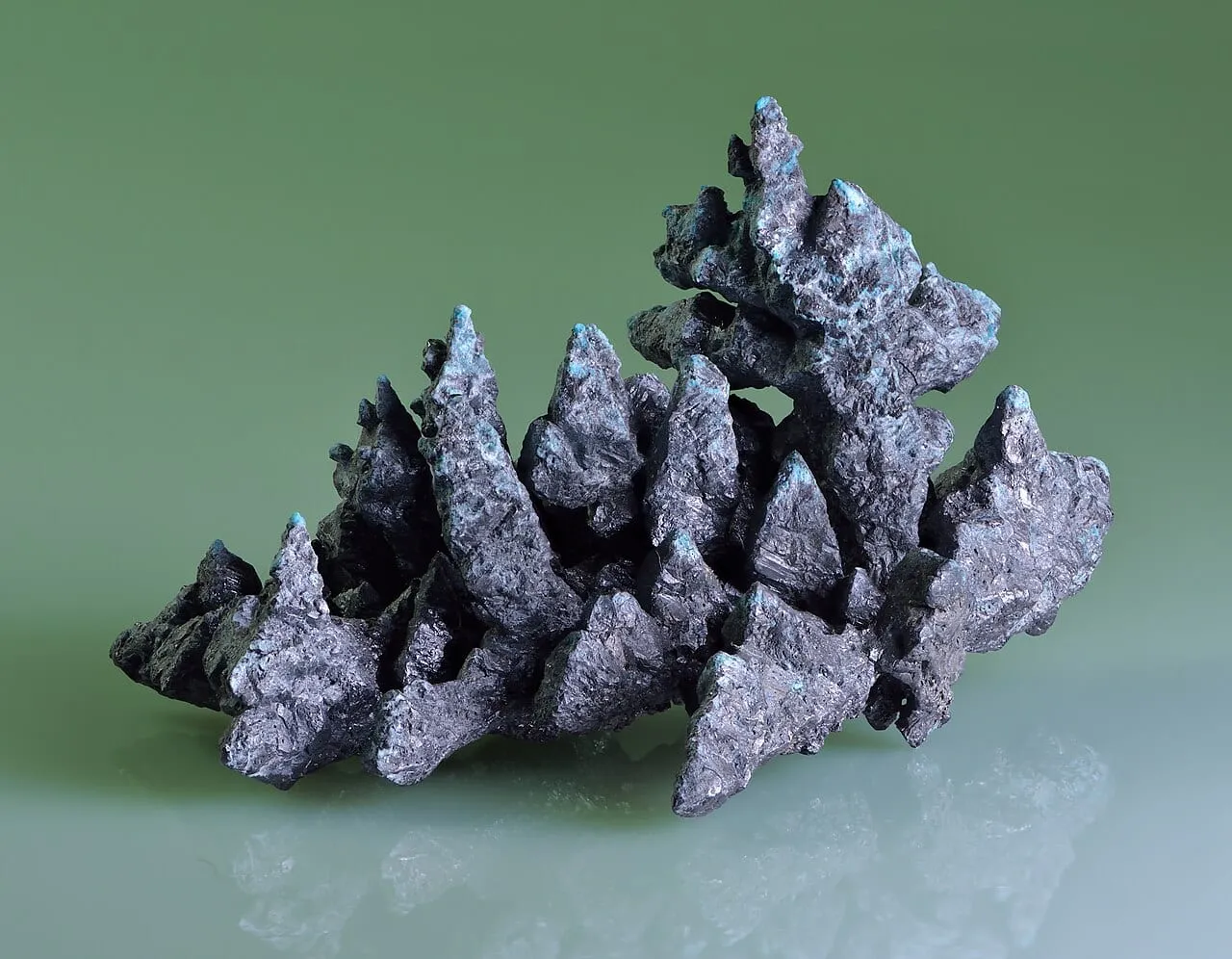
Acanthite
Silver's black sulfide: one of the world's main silver ores and the mineral that coats tarnished native silver.
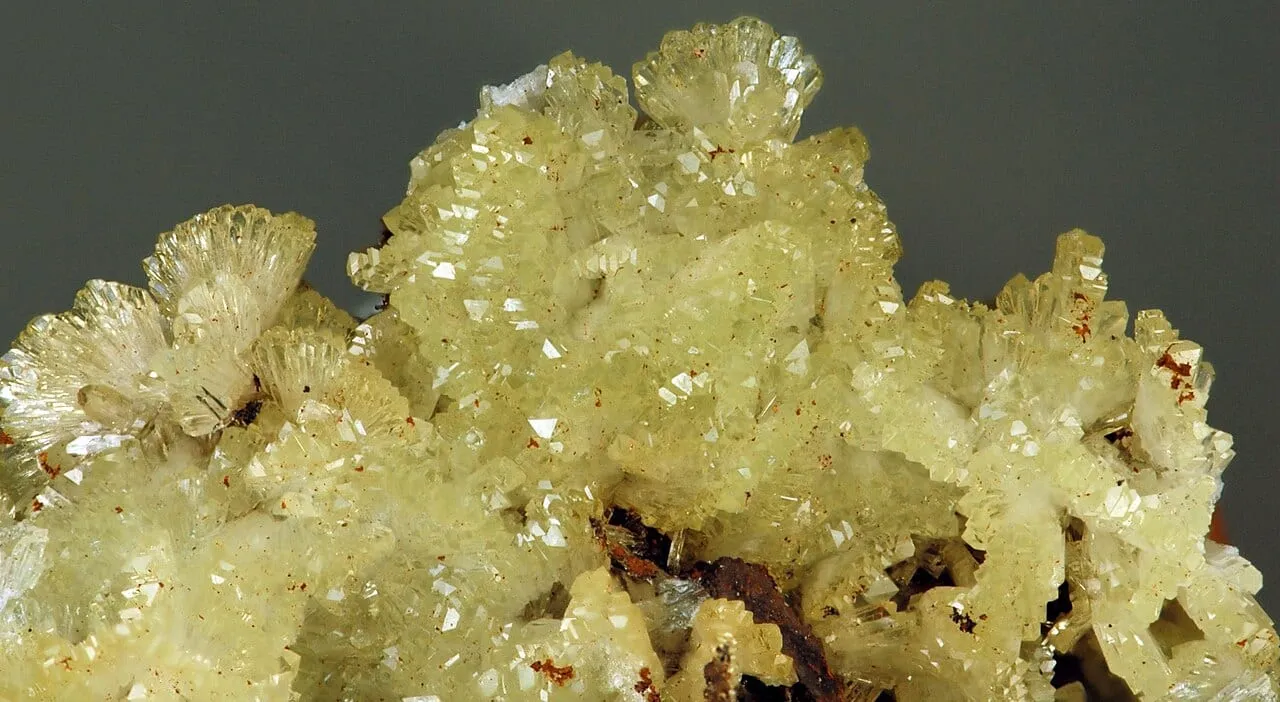
Adamite
Zinc arsenate in fan-shaped crystals from honey yellow to green: some specimens glow under ultraviolet light.
Albite
The white, sodium end of the feldspars: with its deposits at Çine–Milas, a glass and ceramics raw material that makes Türkiye one of the world’s main feldspar producers.