Rock
Trachyte
Trakit
Syenite's surface-cooled cousin: a light-coloured volcanic rock rich in alkali feldspar, and the stone of Afyon Castle.
- Popularly: Natural stone (building and decor)
- Building stone
- Important in Türkiye
_2.jpg)
In short
Trachyte is a light grey or cream, fine-grained rock formed when lava of intermediate silica content, rich in sodium and potassium, cools quickly at the surface. Its slowly cooled equivalent from depth is syenite. Its broken surface is rough, which is why it is named after the Greek trachys, “rough”. It has been used as building stone since Roman times; in Türkiye it covers wide areas around Afyon, and the rock of Afyonkarahisar Castle is trachyte.
Photos

How does it form?
Trachyte forms when lava of intermediate silica content and rich in sodium and potassium cools and solidifies quickly at or near the surface. It occurs in the late stages of volcanism on ocean islands, and in continental rift valleys above hot zones of rising mantle. The same magma cooling slowly at depth makes syenite, so trachyte is the volcanic equivalent of syenite.
Trachyte lava is sticky; it does not flow far, and builds lava domes and volcanic plugs (necks) where it emerges. The Puy de Dôme in France and the rock of Afyonkarahisar Castle are examples.
What is it used for?
- Building stone: It was widely used as dimension stone in the Roman Empire and the Republic of Venice. Cologne Cathedral was built with trachyte from the Drachenfels in Germany.
- Cladding and paving stone: Today it is used as slabs, kerbs and paving.
- Crushed stone: Crushed, it is used as road and construction aggregate.
- Science: Trachyte is studied to understand how volcanoes evolve and how alkaline magmas form; trachyte has also been found in Gale crater on Mars.
Trachyte in Türkiye
Around Afyonkarahisar, Middle-Upper Miocene volcanism produced trachyte, porphyroidal trachyte, trachyandesite, andesite and a little basalt over wide areas. According to Kibici and colleagues, Afyonkarahisar Castle in the middle of the city is a trachytic neck (volcanic plug), and sanidine crystals up to 5 cm long are typical of the trachytes. Building stone is quarried from trachyandesites covering about 30 km² south of Elvanpaşa village, some 45 km west of Afyon; its uniaxial compressive strength has been measured and it was found usable as building stone. The Gölcük volcanic area in Isparta also consists of series of trachyte, trachyandesite, andesite, tuff and pumice. For the syenite page, see syenite.
What determines its value?
Trachyte is not very plentiful but is a cheap building stone; sold by the tonne as crushed stone it is worth little. As block and cladding stone, its value depends on whether large, crack-free blocks can be quarried, on an even colour and pattern (for example the distribution of large sanidine crystals), on porosity and degree of weathering, on resistance to frost and wear, and on the distance of the quarry. Weathered, porous trachyte is weak, while unweathered trachyte is durable.
This information is educational, not buying, selling or investment advice. Value varies enormously with quality and treatment.
How to recognise it
- 1
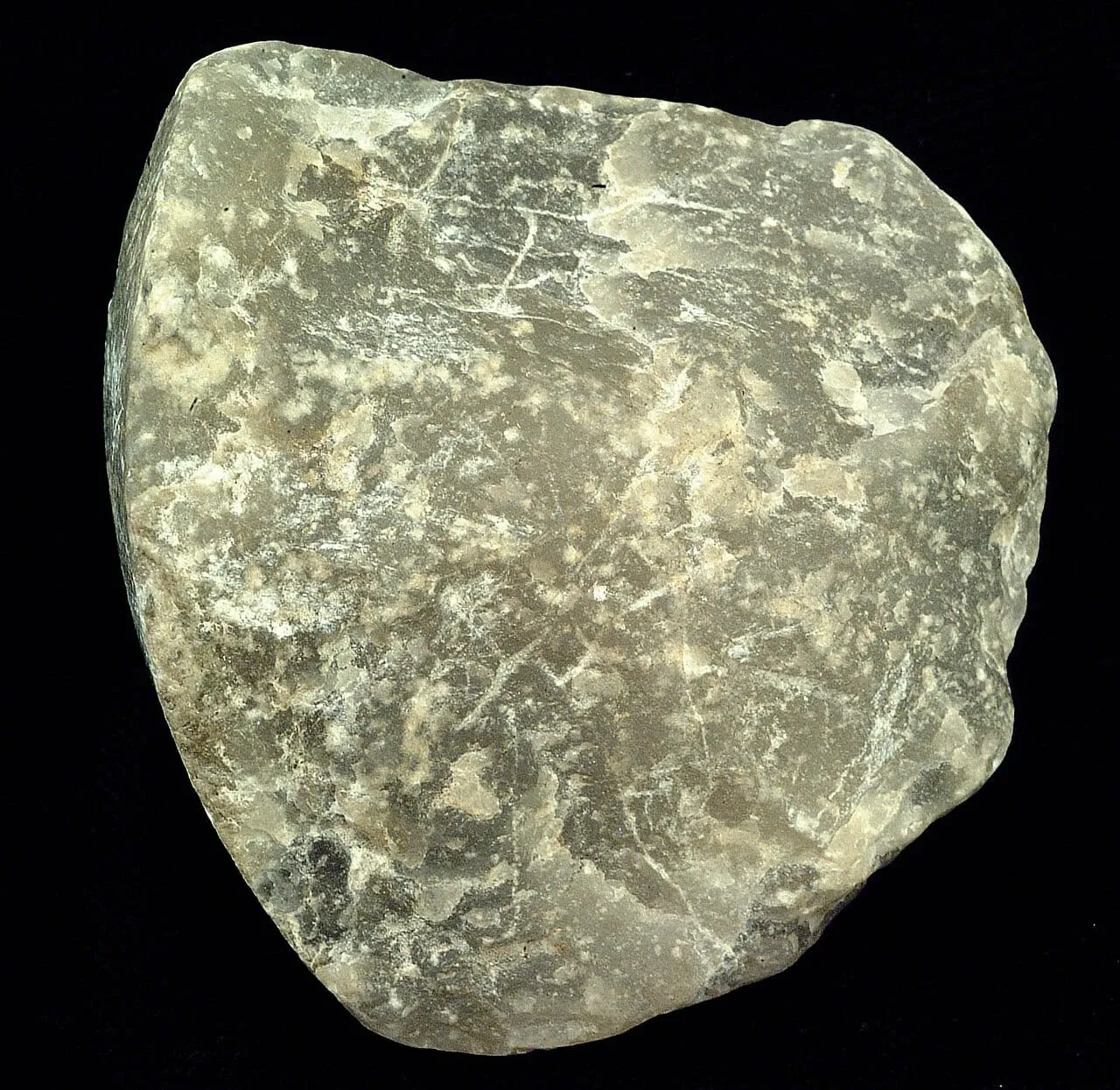
It is a light grey, cream or pinkish, fine-grained rock; in the groundmass you can sometimes see large, shiny sanidine (feldspar) crystals up to 5 cm long.
- 2
Its broken surface is rough, slightly sandpapery, which is where the name comes from. Some samples have small holes left by gas bubbles in the lava.
- 3
It is much paler than basalt; it resembles andesite and rhyolite, but quartz grains are absent or very few.
- 4
Without chemical analysis it is hard to tell trachyte for certain from trachyandesite and andesite.
Fakes and imitations
What shops usually don’t tell you:
- The boundaries between trachyte, andesite and rhyolite are drawn by chemical composition (silica and alkali contents), so names given in the field or in the trade are often wrong. Trachyte is usually sold as “andesite” or simply as “volcanic stone”.
Myths and misconceptions
MythVolcanic rocks are dark; there can be no pale volcanic stone.
FactLavas rich in alkalis and silica, such as trachyte, make pale grey, cream or pinkish rocks. The rock of Afyonkarahisar Castle is a pale volcanic stone of this kind.
MythAll the grey volcanic stones used for paving and cladding are andesite or basalt.
FactThe volcanic rocks around Afyon include trachyte, trachyandesite, andesite and basalt together, and the Elvanpaşa quarry produces trachyandesite. The names under which stone is sold may not give its scientific name.
Did you know?
The Puy de Dôme in France is a trachyte lava dome. In 1648 Florin Périer, at Blaise Pascal's request, carried a barometer up its slope and showed that air pressure falls as height increases.
Trachyte quarried at the Drachenfels in Germany was used to build Cologne Cathedral; the quarry has been worked since Roman times.
Afyonkarahisar Castle stands on a 226-metre volcanic plug of trachyte; the Hittite king Mursili II is known to have fortified it about 1350 BC.
Where is it found?
Loading map…
- Drachenfels, Siebengebirge, Germany · Historic sourceA hill quarried for trachyte since Roman times; it is a source of the stone used to build Cologne Cathedral. The Prussian government bought the quarry in 1836, ending commercial working.
- Euganean Hills, Veneto, Italy · Historic sourceVolcanic hills south of Padua formed in two phases, about 43 and 35 million years ago; trachyte formed in the later one. Trachyte was widely used as dimension stone in the Roman Empire and the Republic of Venice.
- Puy de Dôme, Chaîne des Puys, France · Known localityA trachyte lava dome 1,465 metres high that formed about 10,700 years ago; the Chaîne des Puys was inscribed on the UNESCO World Heritage List in 2018. In 1648 an air-pressure experiment was carried out here at Blaise Pascal's request.
- Campi Flegrei (Phlegraean Fields), Naples, Italy · Known localityA caldera about 10-12 km across where trachyte is the most common eruptive product. The Campanian Ignimbrite eruption about 39,000 years ago ejected about 200 km³ of magma.
- Lake Magadi area, Kenya Rift Valley, Kenya · Known localityIn the Kenyan section of the East African Rift Valley, flood lavas of “Magadi trachyte” spread 700,000 to 1.4 million years ago (Pleistocene).
- Afyonkarahisar Castle, Afyonkarahisar, Türkiye · Historic sourceThe 226-metre castle rock in the middle of the city is a volcanic plug of trachyte (a trachytic neck). Its first fortification is credited to the Hittite king Mursili II (about 1350 BC).
Locations are approximate to protect sites. Red dots mark places in Türkiye. Open in the big map →
Frequently asked questions
What is trachyte?
Trachyte is a light grey or cream, fine-grained rock formed when lava of intermediate silica content, rich in sodium and potassium, cools quickly at the surface. Its slowly cooled equivalent from depth is syenite. Its broken surface is rough, which is why it is named after the Greek trachys, “rough”. It has been used as building stone since Roman times; in Türkiye it covers wide areas around Afyon, and the rock of Afyonkarahisar Castle is trachyte.
What is trachyte used for?
Building stone: It was widely used as dimension stone in the Roman Empire and the Republic of Venice. Cologne Cathedral was built with trachyte from the Drachenfels in Germany. Cladding and paving stone: Today it is used as slabs, kerbs and paving. Crushed stone: Crushed, it is used as road and construction aggregate. Science: Trachyte is studied to understand how volcanoes evolve and how alkaline magmas form; trachyte has also been found in Gale crater on Mars.
How hard is trachyte?
It has a hardness of 5.5–6.5 on the Mohs scale. It can scratch glass; a steel knife scratches it only with difficulty. Its specific gravity is 2.4–2.7 g/cm³.
Where is trachyte found?
Its best-known localities: Drachenfels, Siebengebirge, Germany; Euganean Hills, Veneto, Italy; Afyonkarahisar Castle, Afyonkarahisar, Türkiye; Puy de Dôme, Chaîne des Puys, France; Campi Flegrei (Phlegraean Fields), Naples, Italy.
Where is trachyte found in Türkiye?
Known localities in Türkiye: Afyonkarahisar Castle, Afyonkarahisar, Türkiye.
How can you tell if trachyte is real?
It is a light grey, cream or pinkish, fine-grained rock; in the groundmass you can sometimes see large, shiny sanidine (feldspar) crystals up to 5 cm long. Its broken surface is rough, slightly sandpapery, which is where the name comes from. Some samples have small holes left by gas bubbles in the lava. It is much paler than basalt; it resembles andesite and rhyolite, but quartz grains are absent or very few. The boundaries between trachyte, andesite and rhyolite are drawn by chemical composition (silica and alkali contents), so names given in the field or in the trade are often wrong. Trachyte is usually sold as “andesite” or simply as “volcanic stone”.
Is trachyte valuable?
On the “street to diamond” value ladder it sits on step 3 of nine: Building and industrial stone. Trachyte is not very plentiful but is a cheap building stone; sold by the tonne as crushed stone it is worth little. As block and cladding stone, its value depends on whether large, crack-free blocks can be quarried, on an even colour and pattern (for example the distribution of large sanidine crystals), on porosity and degree of weathering, on resistance to frost and wear, and on the distance of the quarry. Weathered, porous trachyte is weak, while unweathered trachyte is durable.
Sources
- Trachyte · Wikipedia
- Trakit · Vikipedi
- Drachenfels (Siebengebirge) · Wikipedia
- Euganean Hills · Wikipedia
- Petrophysical and mechanical properties of Euganean trachyte and implications for dimension stone decay and durability performance · Environmental Earth Sciences, 2017
- Puy de Dôme · Wikipedia
- Campi Flegrei · Wikipedia
- Lake Magadi · Wikipedia
- Vesicular porphyritic trachyte (Magadi Trachyte, Pleistocene, 700 ka to 1.4 Ma; Lake Magadi, Kenya), file description by James St. John · Wikimedia Commons
- Afyonkarahisar Castle · Wikipedia
- Afyonkarahisar yöresi volkanik kayaçlarının mineralojik ve petrografik özellikleri (Kibici, Dinç & Uçar), Dumlupınar Üniversitesi Fen Bilimleri Enstitüsü Dergisi 29 · Dumlupınar Üniversitesi, 2012
- Elvanpaşa (Afyon) trakiandezitlerinin jeolojisi ve yapı taşı olarak kullanılabilirliğinin araştırılması (Çelik & Kavas), Osmangazi Üniversitesi Mühendislik Mimarlık Fakültesi Dergisi 14(2) · Osmangazi Üniversitesi, 2001
- Gölcük volkanik alanının jeomorfolojisi, Isparta - Türkiye (Canpolat), İstanbul Üniversitesi Edebiyat Fakültesi Coğrafya Dergisi 31 · İstanbul Üniversitesi, 2015
,_Pleistocene,_700_ka_to_1.4_Ma;_northern_end_of_Lake_Magadi,_Kenya_Rift_segment_of_the_East_African_Rift_Valley).jpg)
External links
Draft: awaiting expert reviewReport an error ↗
On the same step
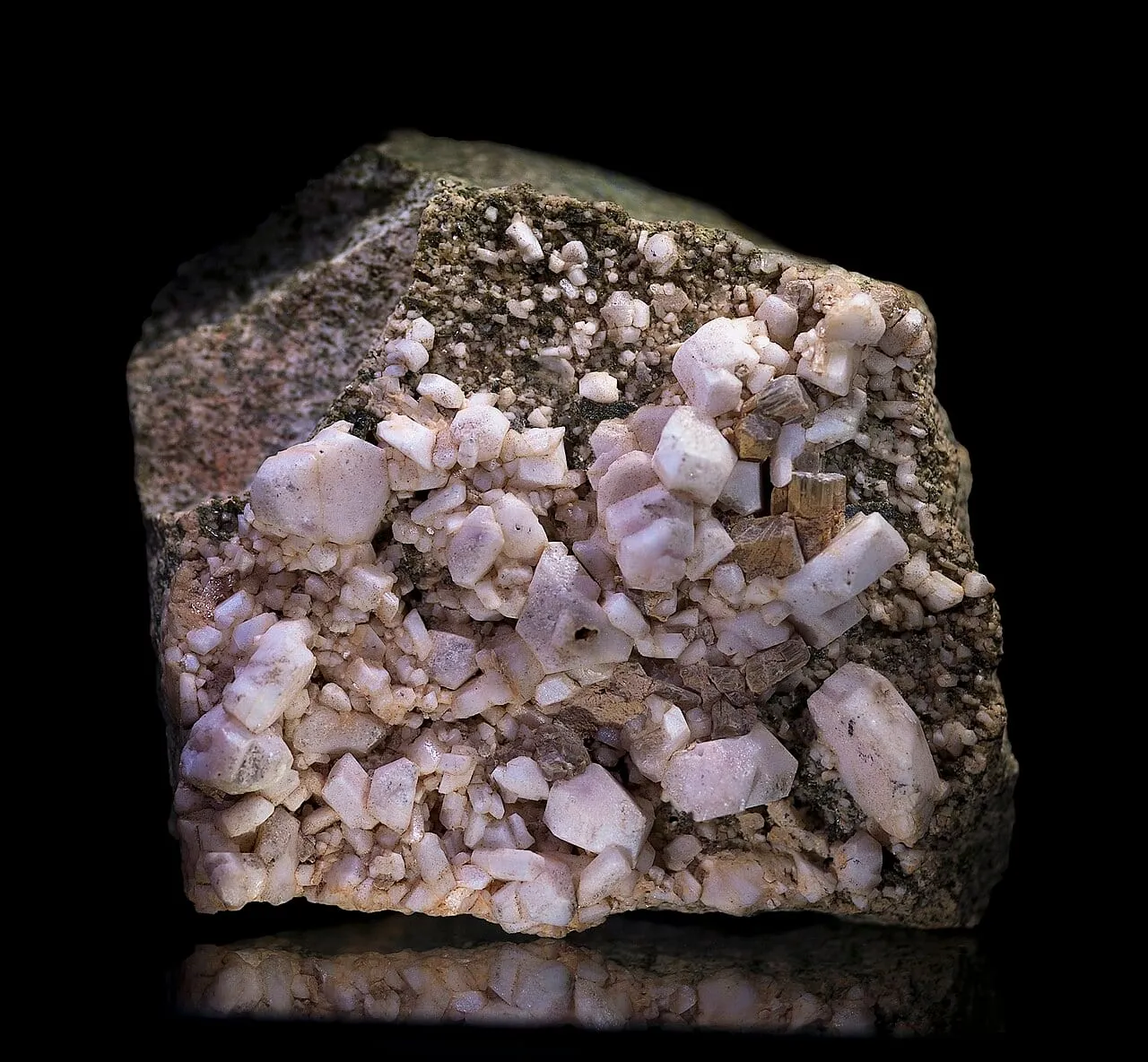
Albite
The white, sodium end of the feldspars: with its deposits at Çine–Milas, a glass and ceramics raw material that makes Türkiye one of the world’s main feldspar producers.
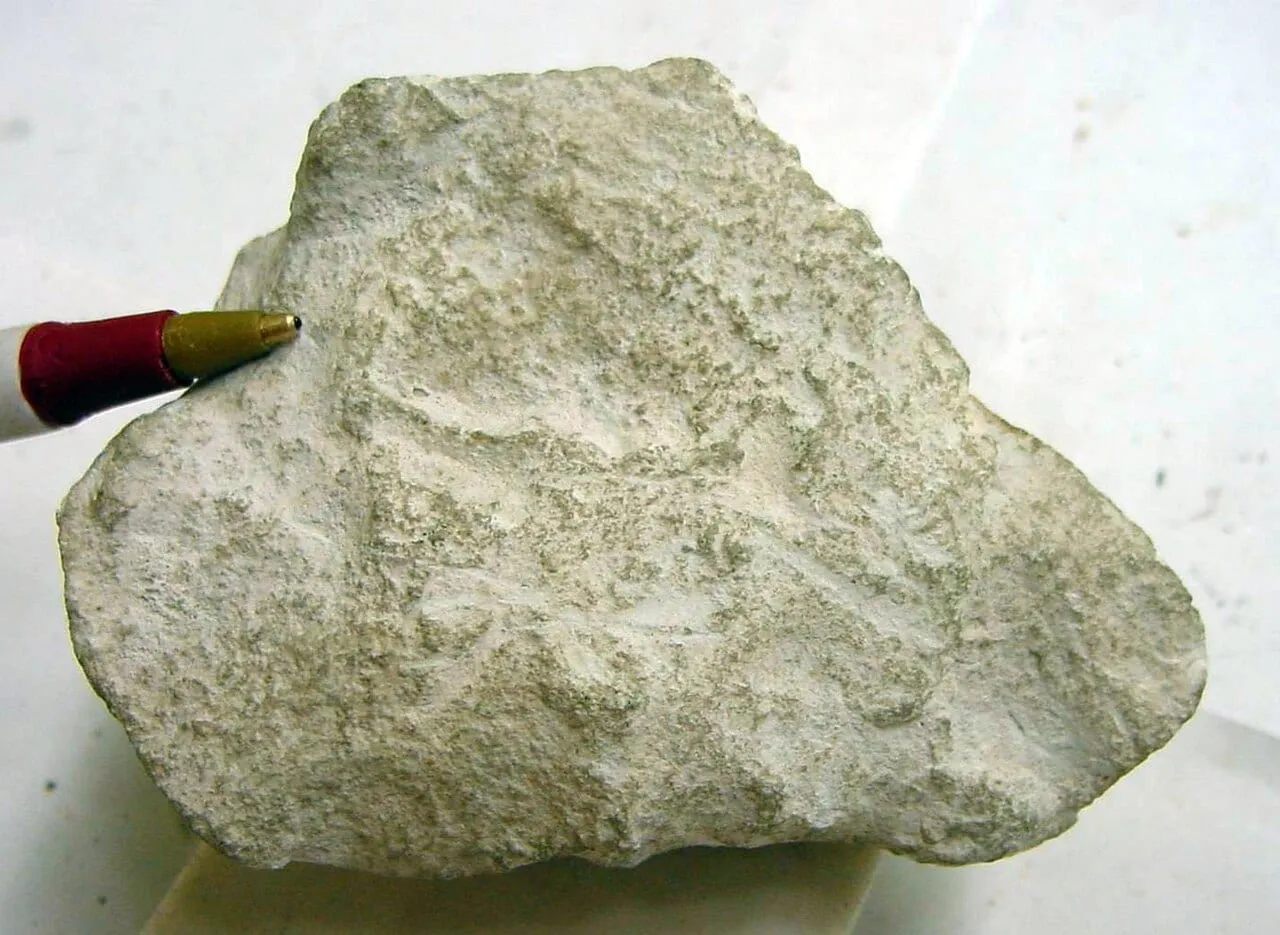
Alunite
The “alum stone” from which alum was made for centuries. Foça, Şaphane in Kütahya and Şebinkarahisar are Türkiye's old alum homelands.
Anhydrite
Gypsum without its water: a calcium sulfate mineral, whose blue-grey Peruvian form is sold as “angelite”.