Rock
Proconnesian marble
Prokonnesos mermeri
The stone that named the Sea of Marmara: a white and grey-banded marble quarried on Marmara Island for over 2,000 years, from Hagia Sophia to the Pergamon Altar.
Also known as: Marmara marble · Marmor Proconnesium
- Popularly: Natural stone (building and decor)

In short
Proconnesian marble, or Marmara marble, is a high-quality marble quarried for more than 2,000 years on today's Marmara Island, known in antiquity as Prokonnesos. Its plain snow-white to light grey kind is used mostly for statues, and its grey-banded kind for architecture and decoration. It met a large share of the Roman Empire's demand for marble and was used in Istanbul's Hagia Sophia, Blue Mosque and Süleymaniye Mosque and in the Pergamon Altar now in Berlin.
Photos

How does it form?
Proconnesian marble formed when old limestones fully recrystallised under heat and pressure. The deposit is dated to between the Late Paleozoic and the Triassic (about 251 million years ago). Because metamorphism was complete, no fossils remain that could date it more precisely.
The marble deposit lies in the northern half of the island. A belt of granodiorite running east–west cuts through it, and metamorphic rocks such as micaceous gneisses occur in the contact zones. Near the shore the beds dip at 30–35 degrees, steepening to as much as 50 degrees towards the granodiorite. Lens-shaped bodies of dolomite also occur within it.
What is it used for?
- Antiquity: According to the Roman writer Vitruvius, it was used in the 4th century BC for the palace of Mausolus at Halicarnassus. At Pergamon the Temple of Demeter (281–263 BC) and the Pergamon Altar (about 170 BC) were built with it.
- Roman Empire: It was sent across the empire as architectural parts, statues, fountain basins, capitals, columns, sarcophagi and wall reliefs. Semi-finished and finished pieces were shipped from the harbour of Saraylar.
- Byzantine and Ottoman times: It was used in Hagia Sophia, the Blue Mosque, the Süleymaniye Mosque and Topkapı Palace. In Ottoman mosques, columns, capitals, minbars and mihrabs were made of it.
- Today: From the late 19th century it was used for gravestones, bathrooms and flooring; today it is exported worldwide and is the island’s main export.
In Türkiye
Proconnesian marble is quarried only on Marmara Island in Balıkesir Province. The quarries lie mostly around the village of Saraylar in the north and across the northern half of the island; the marbles of the southern half are not worked. A small open-air museum in Saraylar shows unfinished Roman and Byzantine architectural pieces, some still bearing masons’ marks. The stone has been used without a break through Greek, Roman, Byzantine, Ottoman and Republican times; few natural stones in the Mediterranean have such a long history.
What determines its value?
Its value depends on whiteness, regular and attractive grey banding, the large sound blocks the deposit yields, and its resistance to weathering. The unbanded white-grey kind is most sought for sculpture. Today it is exported worldwide under the trade name “Marmara”, sorted into white, light grey and banded grades.
This information is educational, not buying, selling or investment advice. Value varies enormously with quality and treatment.
How to recognise it
- 1
Its most familiar look is parallel grey or bluish-grey bands on a white ground.
- 2
Medium-grained and crystalline; it takes a good polish.
- 3
Being calcite, it is scratched by a steel knife and fizzes in dilute acid.
Myths and misconceptions
MythMarmara Island is named after the Sea of Marmara.
FactIt is the other way round: the island was named “Marmara” after its marble, from the Greek word for “shining stone”. In the Middle Ages the surrounding sea came to be called the Sea of Marmara after the island.
Did you know?
The island's modern name, “Marmara”, comes from the Greek mármaros, “shining stone”. First the island and then the surrounding sea took this name.
Ancient column pieces that broke while being worked, or were never shipped, still lie on the island. A survey of them showed that column shafts were usually made 40–90 cm across.
During Diocletian's persecution, high-status Manichaeans were sent to work in the quarries of Prokonnesos as punishment.
Where is it found?
Loading map…
- Saraylar quarries, Marmara Island, Balıkesir · Type localityThe quarries lie mostly around Saraylar, a harbour village in the north of the island, and cover about 40 square kilometres. The marble body is 2.5–3.5 km wide and about 300 m thick. An open-air museum in the village displays unfinished Roman and Byzantine architectural pieces.
Locations are approximate to protect sites. Red dots mark places in Türkiye. Open in the big map →
Frequently asked questions
What is proconnesian marble?
Proconnesian marble, or Marmara marble, is a high-quality marble quarried for more than 2,000 years on today's Marmara Island, known in antiquity as Prokonnesos. Its plain snow-white to light grey kind is used mostly for statues, and its grey-banded kind for architecture and decoration. It met a large share of the Roman Empire's demand for marble and was used in Istanbul's Hagia Sophia, Blue Mosque and Süleymaniye Mosque and in the Pergamon Altar now in Berlin.
Which buildings used Proconnesian marble?
In Istanbul it was used in many architectural parts and Byzantine capitals of Hagia Sophia, in the Blue Mosque and Süleymaniye Mosque, Topkapı Palace and the Forum of Theodosius. At Pergamon, the frieze of the Temple of Demeter and the great frieze of the Pergamon Altar are of this marble. In Rome it went into the Basilica of Maxentius and the Arch of Septimius Severus.
What is proconnesian marble used for?
Antiquity: According to the Roman writer Vitruvius, it was used in the 4th century BC for the palace of Mausolus at Halicarnassus. At Pergamon the Temple of Demeter (281–263 BC) and the Pergamon Altar (about 170 BC) were built with it. Roman Empire: It was sent across the empire as architectural parts, statues, fountain basins, capitals, columns, sarcophagi and wall reliefs. Semi-finished and finished pieces were shipped from the harbour of Saraylar. Byzantine and Ottoman times: It was used in Hagia Sophia, the Blue Mosque, the Süleymaniye Mosque and Topkapı Palace.
How hard is proconnesian marble?
It has a hardness of 3 on the Mohs scale. A fingernail cannot scratch it, but a steel knife can. Its specific gravity is 2.7 g/cm³.
Where is proconnesian marble found?
Its best-known localities: Saraylar quarries, Marmara Island, Balıkesir.
Where is proconnesian marble found in Türkiye?
Known localities in Türkiye: Saraylar quarries, Marmara Island, Balıkesir.
How can you tell if proconnesian marble is real?
Its most familiar look is parallel grey or bluish-grey bands on a white ground. Medium-grained and crystalline; it takes a good polish. Being calcite, it is scratched by a steel knife and fizzes in dilute acid.
Is proconnesian marble valuable?
On the “street to diamond” value ladder it sits on step 4 of nine: Fine dimension stone and ore. Its value depends on whiteness, regular and attractive grey banding, the large sound blocks the deposit yields, and its resistance to weathering. The unbanded white-grey kind is most sought for sculpture. Today it is exported worldwide under the trade name “Marmara”, sorted into white, light grey and banded grades.
Sources
- Prokonnesos mermeri · Vikipedi
- Prokonnesischer Marmor · Wikipedia (de)
- Marmara Island · Wikipedia
- Calcite · Wikipedia
External links
Draft: awaiting expert reviewReport an error
On the same step
Alabaster
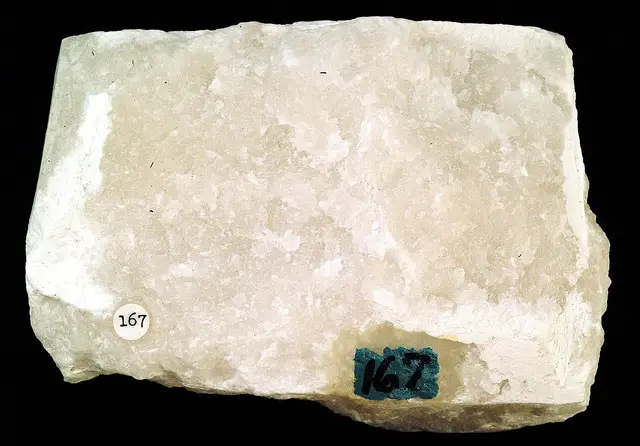
The fine-grained, translucent form of gypsum: a white stone soft enough to scratch with a fingernail, carved into statues, vessels and lamps for thousands of years.
Anglesite
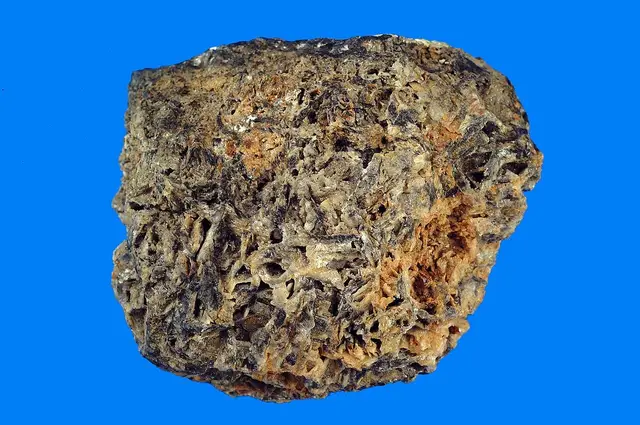
A heavy lead sulfate mineral with a diamond-like shine that grows as a crust around galena; it is named after the island of Anglesey in Wales.
Arsenopyrite
A widespread silvery-grey sulfide containing arsenic: it smells of garlic when struck and is poisonous.