Mineral
Enstatite
Mg₂Si₂O₆Enstatit
The common mineral of Earth's mantle, of meteorites and of dust around distant stars: a magnesium pyroxene.
Also known as: Bronzite (brownish kind) · Chrome enstatite (emerald-green gem kind)
- Popularly: Semi-precious stone

In short
Enstatite is a pyroxene mineral made of magnesium, silicon and oxygen (MgSiO₃). It forms a continuous series with its iron counterpart, ferrosilite, and is the magnesium end of that series. It is one of the essential minerals of rocks such as peridotite and pyroxenite that make up Earth's mantle, and it is abundant in many meteorites. Its colour ranges from white to olive green and brown. Its name comes from the Greek for “opponent”, because it resists melting under the blowpipe.
Photos
.jpg)
How does it form?
Enstatite is one of the essential minerals of the peridotites, pyroxenites and dunites that make up Earth’s mantle; mantle enstatite is about 90% magnesium and 10% iron in composition. It also occurs in mantle fragments carried up by basalts and kimberlites, in some volcanic rocks, and in rocks metamorphosed at high temperature such as granulites and charnockites. It is common in chondrite, achondrite and stony-iron meteorites.
What is it used for?
- Understanding Earth’s interior: As an essential mineral of mantle rocks, it helps scientists study the temperature and pressure conditions of the mantle.
- Meteorite science: It is important for classifying meteorites and understanding the early Solar System.
- Gemstone: Chrome enstatite, bronzite and chatoyant black kinds are cut as gemstones.
What determines its value?
Enstatite's value is mostly scientific: it helps us understand mantle rocks and meteorites. As a gemstone, emerald-green chrome enstatite is cut; lustrous brownish bronzite and chatoyant black kinds are also used as semi-precious stones. In these stones, colour, transparency and quality of cut set the value.
This information is educational, not buying, selling or investment advice. Value varies enormously with quality and treatment.
How to recognise it
- 1
White, greyish, yellowish, greenish, olive green or brown; forms prismatic crystals or lamellar and fibrous masses.
- 2
Vitreous lustre; it can look pearly on cleavage surfaces.
- 3
Hardness 5–6; a steel knife scratches it only with difficulty, if at all.
- 4
Its two cleavage directions meet at nearly right angles (about 88°), typical of pyroxenes.
- 5
Usually found with olivine, diopside, spinel, pyrope and phlogopite.
Fakes and imitations
What shops usually don’t tell you:
- Diopside and other pyroxenes look very similar to enstatite; telling them apart takes optical or chemical study.
- Emerald-green chrome enstatite can be mistaken for other green gemstones when cut; a certain identification takes gemmological testing.
Myths and misconceptions
MythBronzite and hypersthene are mineral species separate from enstatite.
FactBronzite and hypersthene are old names for certain compositions in the enstatite–ferrosilite series. The name hypersthene has been formally abandoned; today such specimens are called enstatite or ferrosilite according to their composition.
Did you know?
Enstatite is one of the few silicate minerals observed in crystalline form outside the Solar System; it has been detected around evolved stars and planetary nebulae.
The names bronzite and hypersthene were known long before enstatite, which was first described in 1855 by G. A. Kenngott. The name hypersthene is no longer used officially.
Its crystals can grow up to 40 cm.
Where is it found?
Loading map…
- Mbeya, Tanzania · Known localityYields fine crystals, according to the Handbook of Mineralogy
- Lizard Peninsula, Cornwall, United Kingdom · Known localityWell-studied enstatite from the Lizard, where mantle rock is exposed
- Bamble, Telemark, Norway · Known localityØdegården and Kjørrestad; cited by the Handbook of Mineralogy for well-studied material
Locations are approximate to protect sites. Red dots mark places in Türkiye. Open in the big map →
Frequently asked questions
What is enstatite?
Enstatite is a pyroxene mineral made of magnesium, silicon and oxygen (MgSiO₃). It forms a continuous series with its iron counterpart, ferrosilite, and is the magnesium end of that series. It is one of the essential minerals of rocks such as peridotite and pyroxenite that make up Earth's mantle, and it is abundant in many meteorites. Its colour ranges from white to olive green and brown. Its name comes from the Greek for “opponent”, because it resists melting under the blowpipe.
Is there enstatite in space?
Yes. Enstatite is abundant in many meteorites and is the main mineral of the meteorites called “enstatite chondrites”. It has also been observed in crystalline form outside the Solar System, in the dust around evolved stars and planetary nebulae.
What is enstatite used for?
Understanding Earth's interior: As an essential mineral of mantle rocks, it helps scientists study the temperature and pressure conditions of the mantle. Meteorite science: It is important for classifying meteorites and understanding the early Solar System. Gemstone: Chrome enstatite, bronzite and chatoyant black kinds are cut as gemstones.
How hard is enstatite?
It has a hardness of 5–6 on the Mohs scale. It can scratch glass; a steel knife scratches it only with difficulty. Its specific gravity is 3.2–3.9 g/cm³.
Where is enstatite found?
Its best-known localities: Mbeya, Tanzania; Lizard Peninsula, Cornwall, United Kingdom; Bamble, Telemark, Norway.
How can you tell if enstatite is real?
White, greyish, yellowish, greenish, olive green or brown; forms prismatic crystals or lamellar and fibrous masses. Vitreous lustre; it can look pearly on cleavage surfaces. Hardness 5–6; a steel knife scratches it only with difficulty, if at all. Diopside and other pyroxenes look very similar to enstatite; telling them apart takes optical or chemical study.
Is enstatite valuable?
On the “street to diamond” value ladder it sits on step 2 of nine: Raw material by the tonne. Enstatite's value is mostly scientific: it helps us understand mantle rocks and meteorites. As a gemstone, emerald-green chrome enstatite is cut; lustrous brownish bronzite and chatoyant black kinds are also used as semi-precious stones. In these stones, colour, transparency and quality of cut set the value.
Sources
- Enstatite · Wikipedia
- Handbook of Mineralogy: Enstatite · Mineralogical Society of America
External links
ReviewedLast checked: 4 October 2026
On the same step
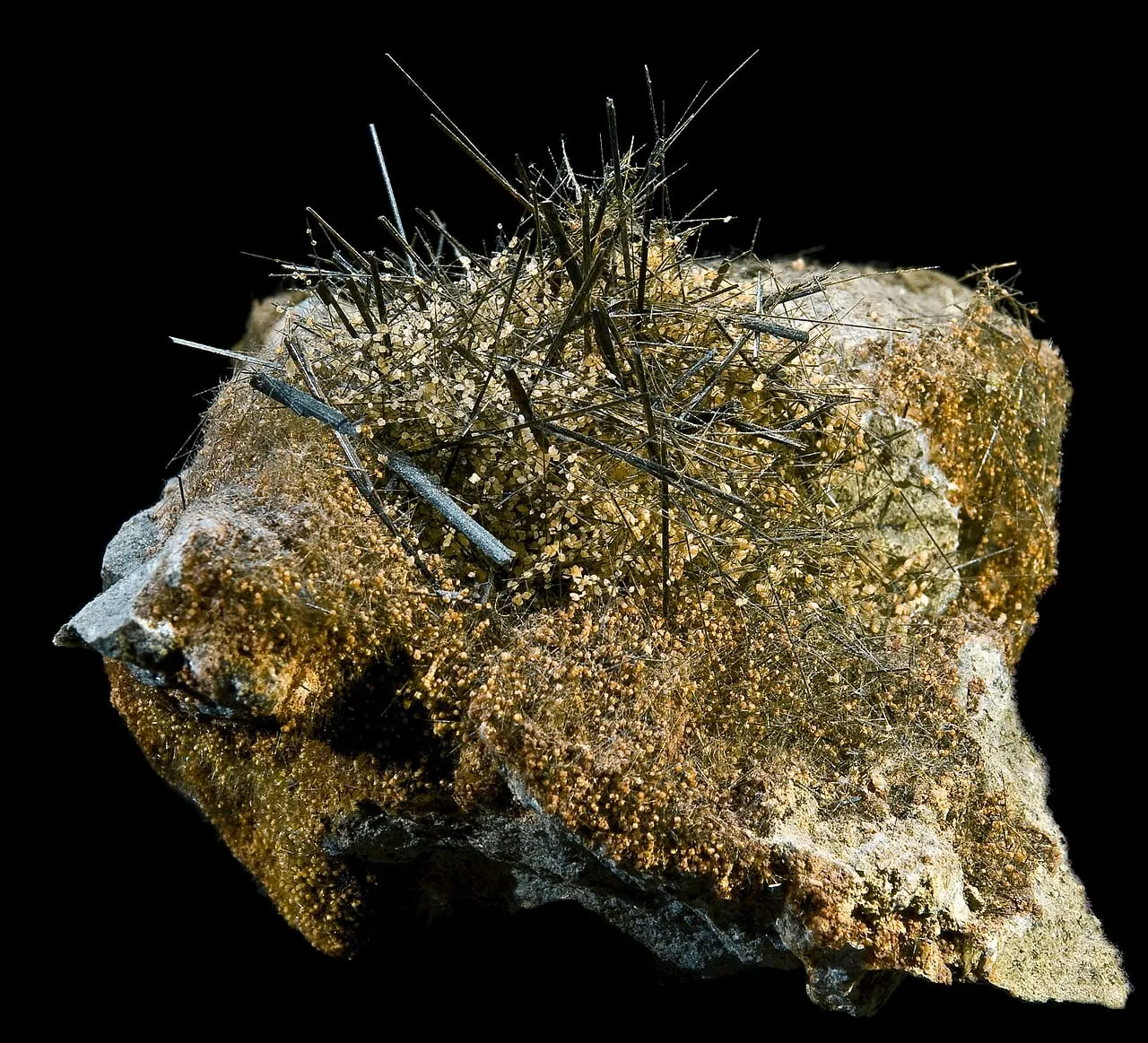
Actinolite
A green amphibole that grows like rays: a raw material of nephrite jade and cat's-eye stones; its fibrous form is asbestos.
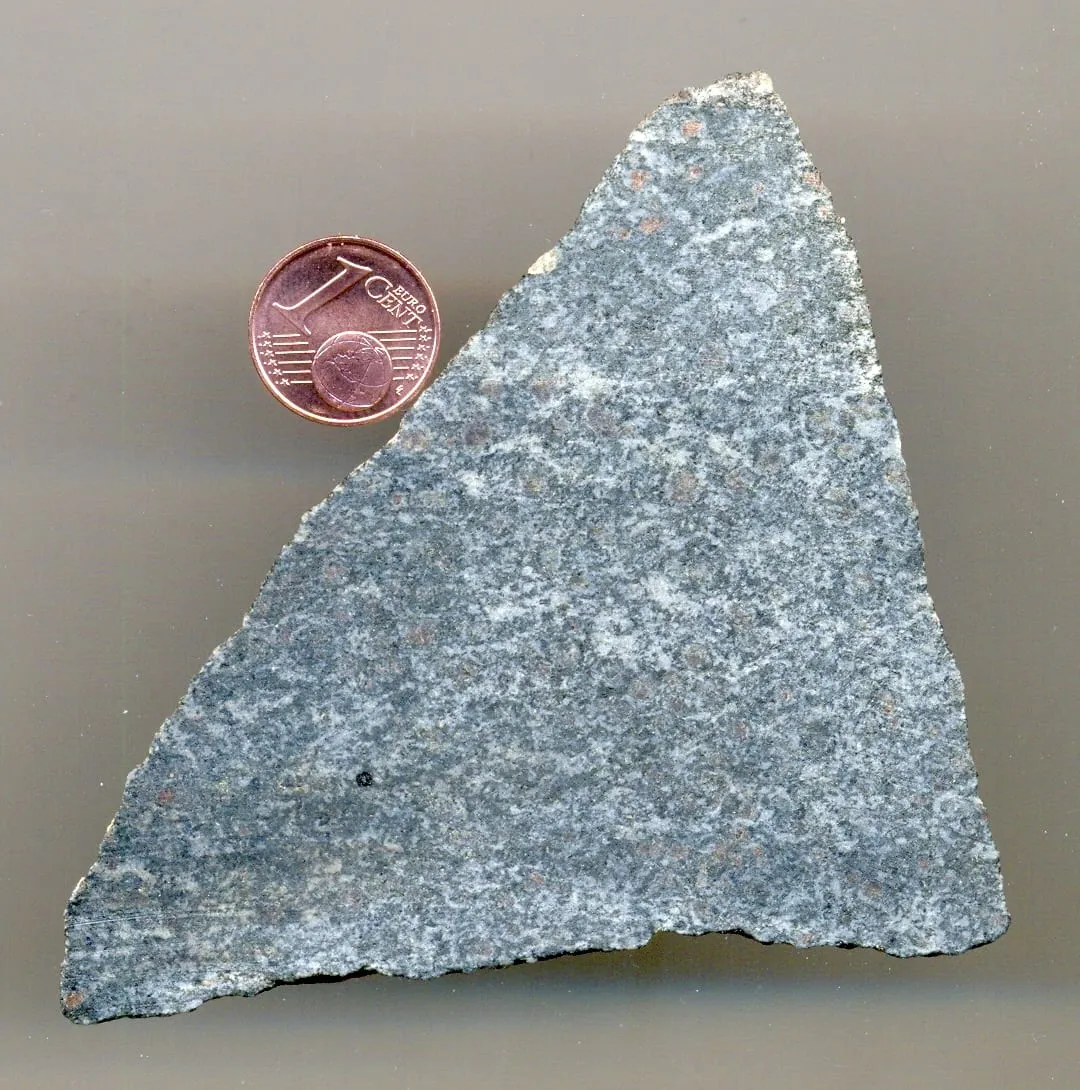
Amphibolite
A dark, heavy, salt-and-pepper metamorphic rock: basalt or gabbro transformed at depth; the stone of Neolithic axes.
Anatase
Rutile's sibling in titanium dioxide: its sharp, stretched double pyramids turn into rutile when heated.