Mineral
Brochantite
Cu₄(SO₄)(OH)₆Brokantit
An emerald-green copper sulfate: it forms in copper deposits of dry regions and in the green crust of outdoor bronze statues.
- Popularly: Ore and raw material

In short
Brochantite is an emerald-green mineral made of copper, sulfate, oxygen and hydrogen (Cu₄(SO₄)(OH)₆). It is common in the parts of copper deposits exposed to air and forms mostly in arid regions or in rapidly oxidising copper sulfide deposits. It also forms in the green crust on bronze statues standing outdoors in cities. It was described in 1824 and named after the French geologist Brochant de Villiers.
Photos
.jpg)
How does it form?
Brochantite is common in the oxidised zone of copper deposits, the part near the surface exposed to air and water. It forms at low acidity, mainly in arid regions or where copper sulfide deposits oxidise rapidly. It occurs with malachite, azurite, tenorite, cuprite, linarite, atacamite and chrysocolla. Its crystals can reach 5 cm and are often twinned.
The same process works on bronze objects outdoors. On city bronze statues, brochantite forms on exposed surfaces where rain stops copper ions from building up, while antlerite forms in sheltered parts.
What is it used for?
- Copper ore: It is rarely an ore; at Chuquicamata in Chile it was mined for copper from 1879 to 1912.
- Bronze statues: It is one of the common components of the green crust on city bronze statues.
- Collecting: Its emerald-green crystals are sought by collectors.
What determines its value?
Brochantite is common in copper deposits but rarely mined as an ore; Chuquicamata is a historic example. Collectors look for emerald-green, lustrous, needle-like sprays of crystals or druses.
This information is educational, not buying, selling or investment advice. Value varies enormously with quality and treatment.
How to recognise it
- 1
Emerald green, blackish green or pale green; its streak is pale green.
- 2
Its crystals are thick prisms or needles; it usually forms crusts, druses or clusters.
- 3
Vitreous lustre; it can look slightly pearly on cleavage surfaces.
- 4
Hardness 3.5–4; a knife scratches it.
- 5
Found with malachite, azurite, cuprite, atacamite and chrysocolla.
Fakes and imitations
What shops usually don’t tell you:
- Malachite is also a green copper mineral that occurs with brochantite; malachite, however, is a carbonate and fizzes in dilute acid, while brochantite does not.
- Atacamite is also an emerald-green copper mineral; telling them apart takes laboratory study.
Myths and misconceptions
MythThe green crust on bronze statues is mould or moss.
FactThis green crust is not alive but mineral: it is made of green copper minerals such as brochantite and antlerite, formed by the reaction of copper with the air.
Did you know?
On city bronze statues, brochantite forms mainly on surfaces exposed to rain and wind; in sheltered parts another copper sulfate, antlerite, forms instead.
At Chuquicamata in Chile, brochantite veins were mined for copper from 1879 to 1912.
It can replace malachite, azurite and chrysocolla while keeping their shape, forming pseudomorphs.
Where is it found?
Loading map…
- Chuquicamata, Antofagasta, Chile · Historic sourceBrochantite veins were mined for copper here from 1879 to 1912
- Nizhny Tagil, Ural Mountains, Russia · Known localityThe nearby Mednorudyanskoye copper deposit, cited by the Handbook of Mineralogy for brochantite
- Tsumeb, Oshikoto, Namibia · Known localityA mine famous for many copper minerals; brochantite occurs here
- Broken Hill, New South Wales, Australia · Known localityOne of the world's great lead–zinc–silver deposits
Locations are approximate to protect sites. Red dots mark places in Türkiye. Open in the big map →
Frequently asked questions
What is brochantite?
Brochantite is an emerald-green mineral made of copper, sulfate, oxygen and hydrogen (Cu₄(SO₄)(OH)₆). It is common in the parts of copper deposits exposed to air and forms mostly in arid regions or in rapidly oxidising copper sulfide deposits. It also forms in the green crust on bronze statues standing outdoors in cities. It was described in 1824 and named after the French geologist Brochant de Villiers.
Why do bronze statues turn green over time?
The copper in bronze reacts with moisture, oxygen and sulfur compounds in the air, forming green copper minerals on the surface. On city bronze statues, brochantite is one of the common components of this green crust; antlerite forms in sheltered corners.
What is brochantite used for?
Copper ore: It is rarely an ore; at Chuquicamata in Chile it was mined for copper from 1879 to 1912. Bronze statues: It is one of the common components of the green crust on city bronze statues. Collecting: Its emerald-green crystals are sought by collectors.
How hard is brochantite?
It has a hardness of 3.5–4 on the Mohs scale. A fingernail cannot scratch it, but a steel knife can. Its specific gravity is 3.97–4.09 g/cm³.
Where is brochantite found?
Its best-known localities: Chuquicamata, Antofagasta, Chile; Nizhny Tagil, Ural Mountains, Russia; Tsumeb, Oshikoto, Namibia; Broken Hill, New South Wales, Australia.
How can you tell if brochantite is real?
Emerald green, blackish green or pale green; its streak is pale green. Its crystals are thick prisms or needles; it usually forms crusts, druses or clusters. Vitreous lustre; it can look slightly pearly on cleavage surfaces. Malachite is also a green copper mineral that occurs with brochantite; malachite, however, is a carbonate and fizzes in dilute acid, while brochantite does not.
Is brochantite valuable?
On the “street to diamond” value ladder it sits on step 2 of nine: Raw material by the tonne. Brochantite is common in copper deposits but rarely mined as an ore; Chuquicamata is a historic example. Collectors look for emerald-green, lustrous, needle-like sprays of crystals or druses.
Sources
- Brochantite · Wikipedia
- Handbook of Mineralogy: Brochantite · Mineralogical Society of America
External links
ReviewedLast checked: 4 October 2026
On the same step
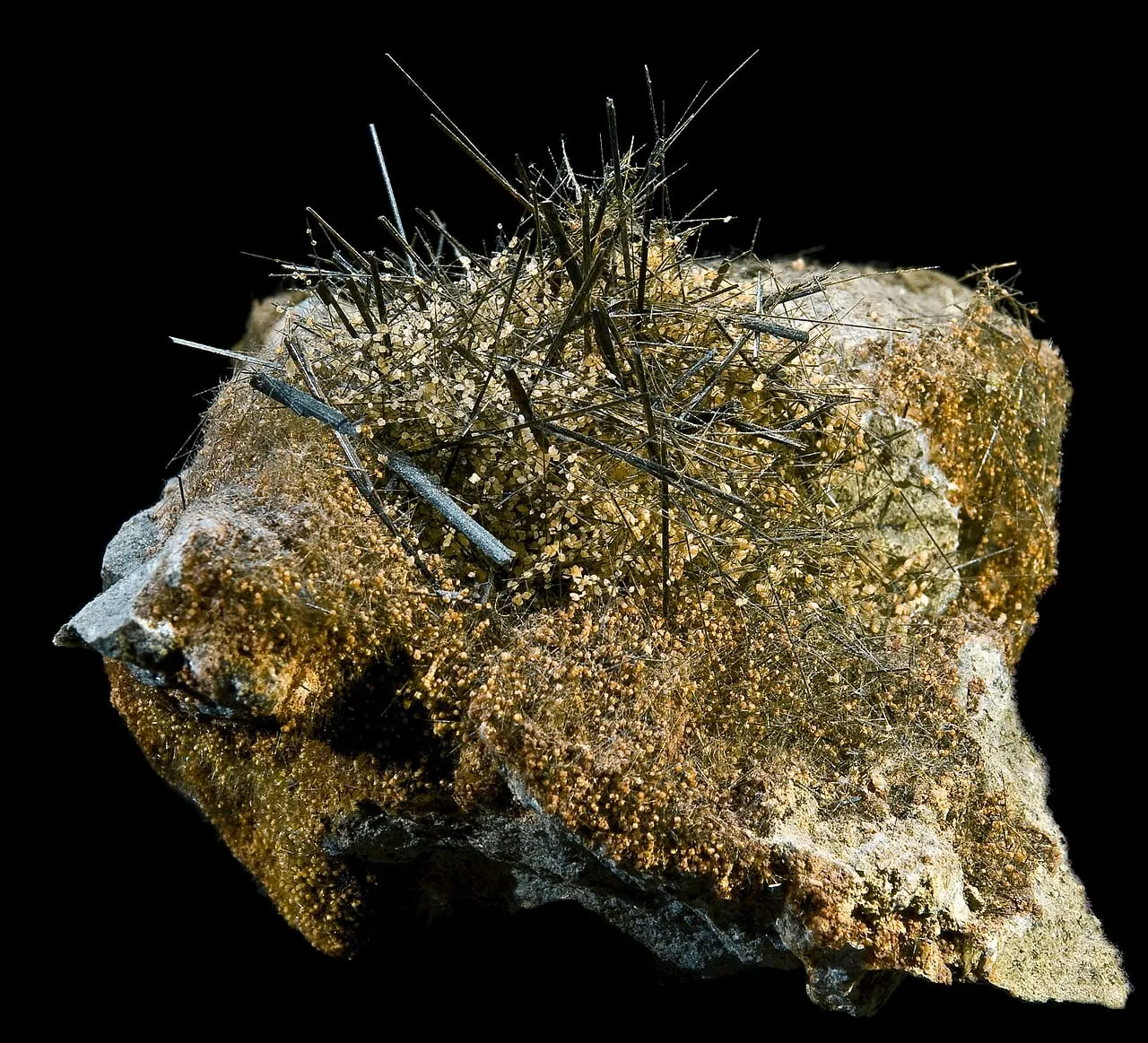
Actinolite
A green amphibole that grows like rays: a raw material of nephrite jade and cat's-eye stones; its fibrous form is asbestos.
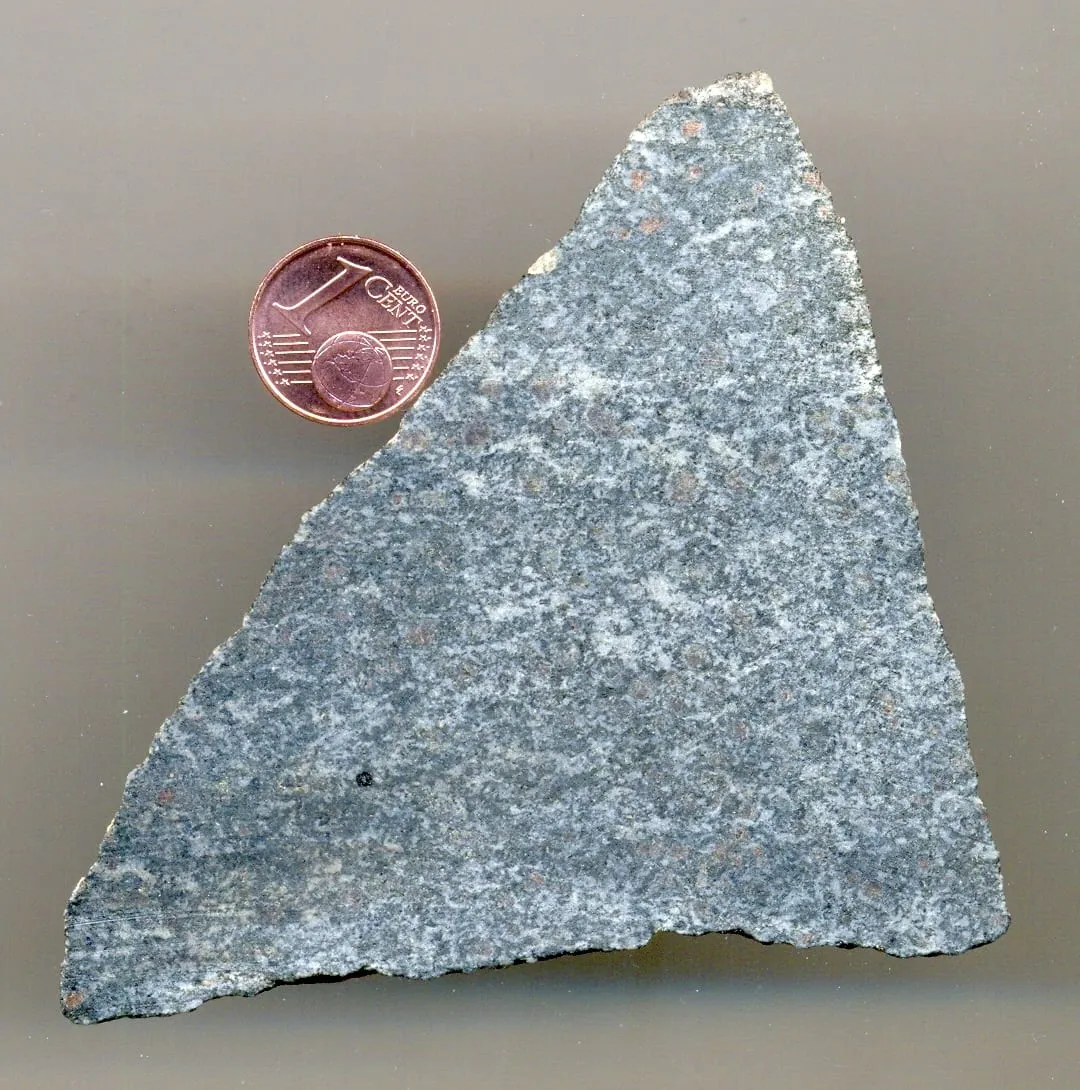
Amphibolite
A dark, heavy, salt-and-pepper metamorphic rock: basalt or gabbro transformed at depth; the stone of Neolithic axes.
Anatase
Rutile's sibling in titanium dioxide: its sharp, stretched double pyramids turn into rutile when heated.