Rock
Banded iron formation
Bantlı demir formasyonu
An ancient rock of alternating iron-oxide and chert bands: the record of oxygen beginning to build up on Earth, and the main source of iron ore.
Also known as: BIF
- Popularly: Ore and raw material
- Ore

In short
A banded iron formation (BIF) is a sedimentary rock built of iron-oxide and chert (silica) bands, each a few millimetres to centimetres thick. Most formed around 2.5 billion years ago, when the oceans were rich in dissolved iron and the air held no free oxygen. The bands are read as a record of iron in the sea combining with oxygen and settling to the bottom, the rusting of the planet turned to stone. More than 60% of the world's iron reserves lie in these rocks.
Photos

How does it form?
Banded iron formations formed in the oceans of Earth’s early history. Deep sea water then held no oxygen and carried dissolved iron (Fe²⁺). On the most widely held view, when this iron-rich water welled up near the surface it was oxidised in the upper layer where oxygen-producing cyanobacteria lived and sank as rust particles, while the alternating chert bands formed by the settling of silica. Other ways of oxidising the iron, such as iron-oxidising bacteria or direct sunlight, are also debated.
Banded iron formations were laid down mostly in the Late Archean (2.8–2.5 billion years ago) and again around 1.85 billion years ago, and almost stopped after 1.8 billion years ago. The main phase of deposition overlaps with the Great Oxidation Event (about 2.4 billion years ago), when permanent oxygen appeared in the atmosphere. By one view, once the deep ocean was oxygenated too, iron could no longer stay dissolved and deposition ceased. About 750 million years ago, linked to the “Snowball Earth” ice age, small hematite-rich banded iron formations formed once more.
What is it used for?
- Iron and steel: Most of the world’s iron ore is mined from banded iron formations; the main producers are Australia, Brazil, Canada, India, Russia, South Africa, Ukraine and the USA. Magnetite-rich types are crushed, separated with magnets and pelletised.
- Scientific record: It is one of the most important archives of how the ancient oceans and atmosphere changed.
What determines its value?
What matters first for a banded iron formation is its iron grade; most hold about 30% iron by mass, so the rock has to be crushed, separated with magnets and pelletised. Whether the iron is in magnetite or hematite, how few harmful impurities such as phosphorus and sulfur it has, the size of the deposit and the distance from mine to railway and port also shape the cost. Its market value follows the demand for steel.
This information is educational, not buying, selling or investment advice. Value varies enormously with quality and treatment.
How to recognise it
- 1
It shows regular stripes of metallic grey, black or red iron bands alternating with pale grey, red or yellowish chert bands.
- 2
It is very hard and heavy; the chert bands cannot be scratched with a steel knife.
- 3
Specimens rich in magnetite bands attract a magnet.
- 4
The bands are millimetres to centimetres thick and often keep the same pattern over great distances along the outcrop; they may be bent or folded.
Fakes and imitations
What shops usually don’t tell you:
- A banded iron formation with red jasper bands is also called jaspilite. The jasper is only the chert part of the bands here; the rock is not the same thing as jasper, the ornamental stone.
- Taconite and itabirite are not separate rocks but regional names for banded iron formation: taconite is the lean, hard type mined around Lake Superior, while itabirite is the name for the metamorphosed type in Brazil.
Safety
The rock is harmless in a solid piece, but breaking and crushing it releases breathable chert (silica) dust, and asbestos can occur near some deposits. Mining of blue asbestos (crocidolite) at Wittenoom in Australia's Hamersley region left the largest contaminated site in the southern hemisphere. Asbestos fibres cause serious lung disease if inhaled, so in such areas warnings should be obeyed and rocks should not be broken.
Myths and misconceptions
MythTrees and forests created the oxygen in the air.
FactThe banded iron record shows that oxygen began to accumulate in the atmosphere around 2.4 billion years ago, long before land plants, most probably through photosynthesis by microscopic cyanobacteria. Exactly how the bands formed is still debated.
MythBanded iron stone is pure iron.
FactBanded iron formations mostly contain about 30% iron, and most of the rest is silica (chert). To be used as ore, the rock has to be crushed and enriched.
Did you know?
The roughly 3.8-billion-year-old iron formation of the Isua belt in Greenland is probably the oldest known banded iron formation in the world.
More than 100 million tonnes of iron ore are removed from Western Australia's Hamersley Range every year; the banded iron formations there are the thickest and most extensive in the world.
By a widely held view, once oxygen built up and destroyed methane, a powerful greenhouse gas, Earth fell into an ice age; the evidence for this Huronian glaciation is glacial deposits about 2.3 billion years old in Canada.
Where is it found?
Loading map…
- Hamersley Range and Karijini National Park, Pilbara, Western Australia · Major depositBanded iron formations about 2.5 billion years old, the thickest and most extensive in the world, over 900 m thick. Rio Tinto mines such as Mount Tom Price remove more than 100 million tonnes of iron ore a year.
- Mesabi Range, Minnesota, USA · Major depositIron ore in the Biwabik Iron Formation was found by the Merritt brothers in 1890. Today the only product is taconite pellets, made from the harder, leaner (30–35% iron) banded iron stone. The Hull–Rust–Mahoning pit at Hibbing is the world's largest open-pit iron mine.
- Isua Greenstone Belt, south-west Greenland · Known localityAbout 150 km north-east of Nuuk; at about 3.8 billion years old it is probably the oldest banded iron formation in the world. Found by a Danish company in 1962, with a resource of about 2 billion tonnes of ore (averaging 32.9% iron) estimated.
- Quadrilátero Ferrífero (Iron Quadrangle), Minas Gerais, Brazil · Major depositAn area of about 7,000 km² with itabirite, a metamorphosed banded iron formation. The region's Paleoproterozoic banded iron formations were named an IUGS Geological Heritage Site in 2022.
- Kryvyi Rih, Ukraine · Known localityThe Kryvbas iron ore basin; mining began in the 1880s with open pits, and with the first underground mine in 1886. By the end of the Soviet era it produced 42% of the USSR's iron ore.
- Kuruman, Northern Cape, South Africa · Known localityThe Kuruman Iron Formation is one of the main banded iron formations of South Africa's Transvaal Basin.
- Anshan, Liaoning, China · Known localityOne of China's major banded iron formation deposits; mining began in 1918.
- Temagami, Ontario, Canada · Known localityThe iron formation in the Temagami Greenstone Belt is 2.74–2.69 billion years old and about 60 m thick.
Locations are approximate to protect sites. Red dots mark places in Türkiye. Open in the big map →
Frequently asked questions
What is banded iron formation?
A banded iron formation (BIF) is a sedimentary rock built of iron-oxide and chert (silica) bands, each a few millimetres to centimetres thick. Most formed around 2.5 billion years ago, when the oceans were rich in dissolved iron and the air held no free oxygen. The bands are read as a record of iron in the sea combining with oxygen and settling to the bottom, the rusting of the planet turned to stone. More than 60% of the world's iron reserves lie in these rocks.
What is banded iron formation used for?
Iron and steel: Most of the world's iron ore is mined from banded iron formations; the main producers are Australia, Brazil, Canada, India, Russia, South Africa, Ukraine and the USA. Magnetite-rich types are crushed, separated with magnets and pelletised. Scientific record: It is one of the most important archives of how the ancient oceans and atmosphere changed.
How hard is banded iron formation?
It has a hardness of 5.5–7 on the Mohs scale. It can scratch glass; a steel knife scratches it only with difficulty. Its specific gravity is 3–3.7 g/cm³.
Where is banded iron formation found?
Its best-known localities: Hamersley Range and Karijini National Park, Pilbara, Western Australia; Mesabi Range, Minnesota, USA; Quadrilátero Ferrífero (Iron Quadrangle), Minas Gerais, Brazil; Isua Greenstone Belt, south-west Greenland; Kryvyi Rih, Ukraine.
How can you tell if banded iron formation is real?
It shows regular stripes of metallic grey, black or red iron bands alternating with pale grey, red or yellowish chert bands. It is very hard and heavy; the chert bands cannot be scratched with a steel knife. Specimens rich in magnetite bands attract a magnet. A banded iron formation with red jasper bands is also called jaspilite. The jasper is only the chert part of the bands here; the rock is not the same thing as jasper, the ornamental stone.
Is banded iron formation valuable?
On the “street to diamond” value ladder it sits on step 4 of nine: Fine dimension stone and ore. What matters first for a banded iron formation is its iron grade; most hold about 30% iron by mass, so the rock has to be crushed, separated with magnets and pelletised. Whether the iron is in magnetite or hematite, how few harmful impurities such as phosphorus and sulfur it has, the size of the deposit and the distance from mine to railway and port also shape the cost. Its market value follows the demand for steel.
Is banded iron formation dangerous?
The rock is harmless in a solid piece, but breaking and crushing it releases breathable chert (silica) dust, and asbestos can occur near some deposits. Mining of blue asbestos (crocidolite) at Wittenoom in Australia's Hamersley region left the largest contaminated site in the southern hemisphere. Asbestos fibres cause serious lung disease if inhaled, so in such areas warnings should be obeyed and rocks should not be broken.
Sources
- Banded iron formation · Wikipedia
- Bantlı demir formasyonu · Vikipedi
- Banded iron formation (BIF) deposits, GO factsheet 16 · Geological Survey of Denmark and Greenland (GEUS), 2008
- Hamersley Range · Wikipedia
- Karijini National Park · Wikipedia
- Mesabi Range · Wikipedia
- Isua Greenstone Belt · Wikipedia
- Iron Quadrangle · Wikipedia
- Kryvyi Rih · Wikipedia
- Kuruman, Northern Cape · Wikipedia
- Anshan · Wikipedia
- Temagami · Wikipedia
- Huronian glaciation · Wikipedia
External links
Draft: awaiting expert reviewReport an error ↗
On the same step
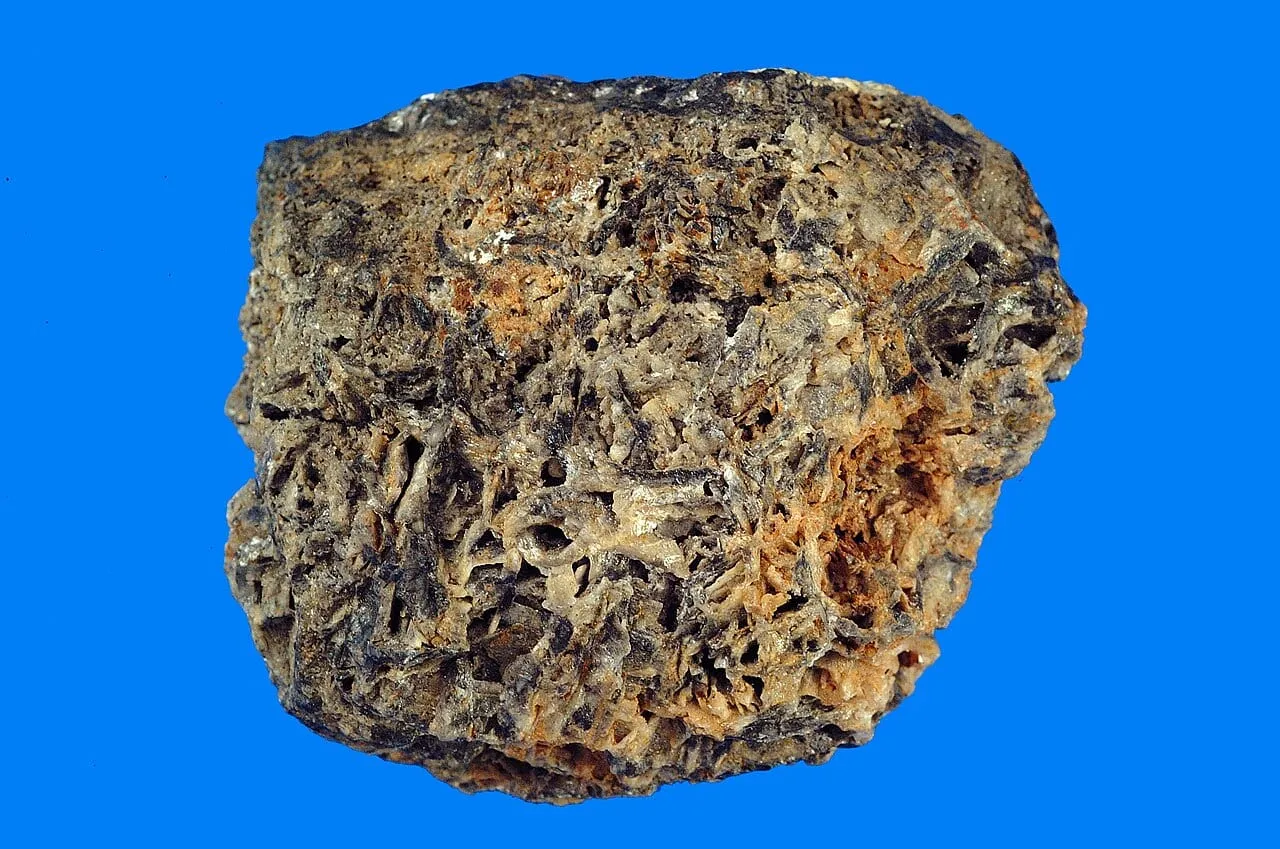
Anglesite
A heavy lead sulfate mineral with a diamond-like shine that grows as a crust around galena; it is named after the island of Anglesey in Wales.
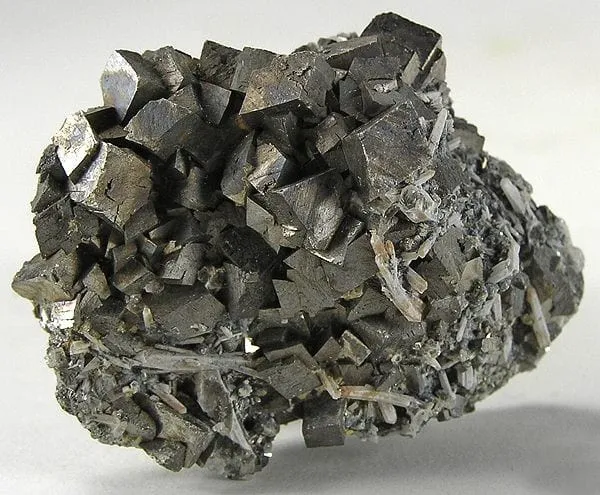
Arsenopyrite
A widespread silvery-grey sulfide containing arsenic: it smells of garlic when struck and is poisonous.
Bastnäsite
One of the main ore minerals of the “rare earth” elements such as cerium, lanthanum and neodymium; a raw material for magnets and electronics.