Mineral
Tetrahedrite
(Cu,Fe,Ag,Zn)₁₂Sb₄S₁₃Tetraedrit
The grey copper ore that grows as four-faced pyramids: it carries copper, antimony and often silver.
Also known as: Fahlore · Grey copper ore
- Popularly: Ore and raw material

In short
Tetrahedrite is a sulfosalt mineral made of copper, antimony and sulfur, which can also contain iron, zinc and silver. It is grey to iron black with a metallic lustre. It is named after the tetrahedron, the crystal shape with four triangular faces. It is one of the most common sulfosalt minerals. Historically it was an important copper ore, and it was also worked as a silver ore. It forms a continuous series in composition with its arsenic counterpart, tennantite.
Photos
.jpg)
How does it form?
Tetrahedrite forms at low to medium temperatures in ore veins left by hot water solutions (hydrothermal fluids) moving through cracks, and in contact metamorphic deposits where magma heats the surrounding rock. That is why it occurs with sulfides such as chalcopyrite, galena, sphalerite, pyrite, bornite and acanthite, and with calcite, dolomite, siderite, baryte, fluorite and quartz. It is one of the most common sulfosalt minerals, but few places have produced good crystals.
Tetrahedrite forms a continuous series with its arsenic counterpart, tennantite: arsenic gradually takes the place of antimony, and mixtures in any proportion between the two end members can occur. Part of the copper can be replaced by iron, zinc, mercury, cadmium, nickel or manganese; the International Mineralogical Association now recognises seven separate tetrahedrite species based on these differences.
What is it used for?
- Copper and silver ore: Historically it was an important copper ore; silver-bearing kinds were worked as silver ores.
- Research: It has been studied as a thermoelectric material that turns heat into electricity.
- Collecting: Its sharp tetrahedral crystals are sought by collectors.
What determines its value?
As an ore, tetrahedrite's value depends on its copper and especially its silver content; silver-rich kinds were worked as silver ores throughout history. Collectors look for sharp, lustrous, large tetrahedral crystals and attractive groups with chalcopyrite or quartz.
This information is educational, not buying, selling or investment advice. Value varies enormously with quality and treatment.
How to recognise it
- 1
Its crystals are usually tetrahedra, pyramids with four triangular faces; they often form parallel groups or twins.
- 2
Flint grey to iron black, metallic and often brilliantly lustrous; completely opaque.
- 3
Its streak is black to brown.
- 4
It has no cleavage; it breaks with subconchoidal (shell-like) surfaces.
- 5
Usually found with chalcopyrite, galena, sphalerite, pyrite, quartz and calcite.
Fakes and imitations
What shops usually don’t tell you:
- Chalcopyrite is also a copper ore and often occurs in the same veins; chalcopyrite, however, is brass yellow, while tetrahedrite is grey or black.
- Tennantite has the same structure as tetrahedrite but contains arsenic instead of antimony; the two cannot be told apart by eye, and a certain distinction takes chemical analysis.
Myths and misconceptions
MythTetrahedrite is the name of a single mineral.
FactOn the International Mineralogical Association's current list, tetrahedrite is a group: seven separate species are recognised according to the second metal in their composition, such as tetrahedrite-(Fe), tetrahedrite-(Zn) and tetrahedrite-(Hg). In everyday use and older sources they are all simply called tetrahedrite.
Did you know?
On the International Mineralogical Association's list, “tetrahedrite” is now a group rather than a single mineral: there are seven separate species named for the iron, zinc, mercury, cadmium, nickel, manganese or copper in them, such as tetrahedrite-(Fe) and tetrahedrite-(Zn).
Its crystals can grow up to 15 cm.
Tetrahedrite has been studied for use in devices that turn heat into electricity (thermoelectrics); Alphabet Energy, the company behind the effort, is now defunct.
Where is it found?
Loading map…
- Freiberg, Saxony, Germany · Historic sourceOld silver mines cited by the Handbook of Mineralogy for well-crystallised tetrahedrite
- Clausthal, Harz Mountains, Germany · Historic sourceAn old Harz mining district that has yielded good crystals
- Brixlegg, Tyrol, Austria · Known localityAmong the places the Handbook of Mineralogy cites for good crystals
- Cavnic, Maramureș, Romania · Known localityThe famous Kapnikbánya mines; yields good tetrahedrite crystals
Locations are approximate to protect sites. Red dots mark places in Türkiye. Open in the big map →
Frequently asked questions
What is tetrahedrite?
Tetrahedrite is a sulfosalt mineral made of copper, antimony and sulfur, which can also contain iron, zinc and silver. It is grey to iron black with a metallic lustre. It is named after the tetrahedron, the crystal shape with four triangular faces. It is one of the most common sulfosalt minerals. Historically it was an important copper ore, and it was also worked as a silver ore. It forms a continuous series in composition with its arsenic counterpart, tennantite.
Which metals come from tetrahedrite?
Tetrahedrite contains mainly copper and antimony; iron, zinc and sometimes significant amounts of silver can also be present. Historically it was an important copper ore, and its silver-rich kinds were worked as silver ores.
What is tetrahedrite used for?
Copper and silver ore: Historically it was an important copper ore; silver-bearing kinds were worked as silver ores. Research: It has been studied as a thermoelectric material that turns heat into electricity. Collecting: Its sharp tetrahedral crystals are sought by collectors.
How hard is tetrahedrite?
It has a hardness of 3–4.5 on the Mohs scale. A fingernail cannot scratch it, but a steel knife can. Its specific gravity is 4.97–4.99 g/cm³.
Where is tetrahedrite found?
Its best-known localities: Freiberg, Saxony, Germany; Clausthal, Harz Mountains, Germany; Brixlegg, Tyrol, Austria; Cavnic, Maramureș, Romania.
How can you tell if tetrahedrite is real?
Its crystals are usually tetrahedra, pyramids with four triangular faces; they often form parallel groups or twins. Flint grey to iron black, metallic and often brilliantly lustrous; completely opaque. Its streak is black to brown. Chalcopyrite is also a copper ore and often occurs in the same veins; chalcopyrite, however, is brass yellow, while tetrahedrite is grey or black.
Is tetrahedrite valuable?
On the “street to diamond” value ladder it sits on step 3 of nine: Building and industrial stone. As an ore, tetrahedrite's value depends on its copper and especially its silver content; silver-rich kinds were worked as silver ores throughout history. Collectors look for sharp, lustrous, large tetrahedral crystals and attractive groups with chalcopyrite or quartz.
Sources
- Tetrahedrite · Wikipedia
- Handbook of Mineralogy: Tetrahedrite · Mineralogical Society of America
- The New IMA List of Minerals – Updated: September 2026 · International Mineralogical Association, CNMNC, 2026
External links
ReviewedLast checked: 4 October 2026
On the same step
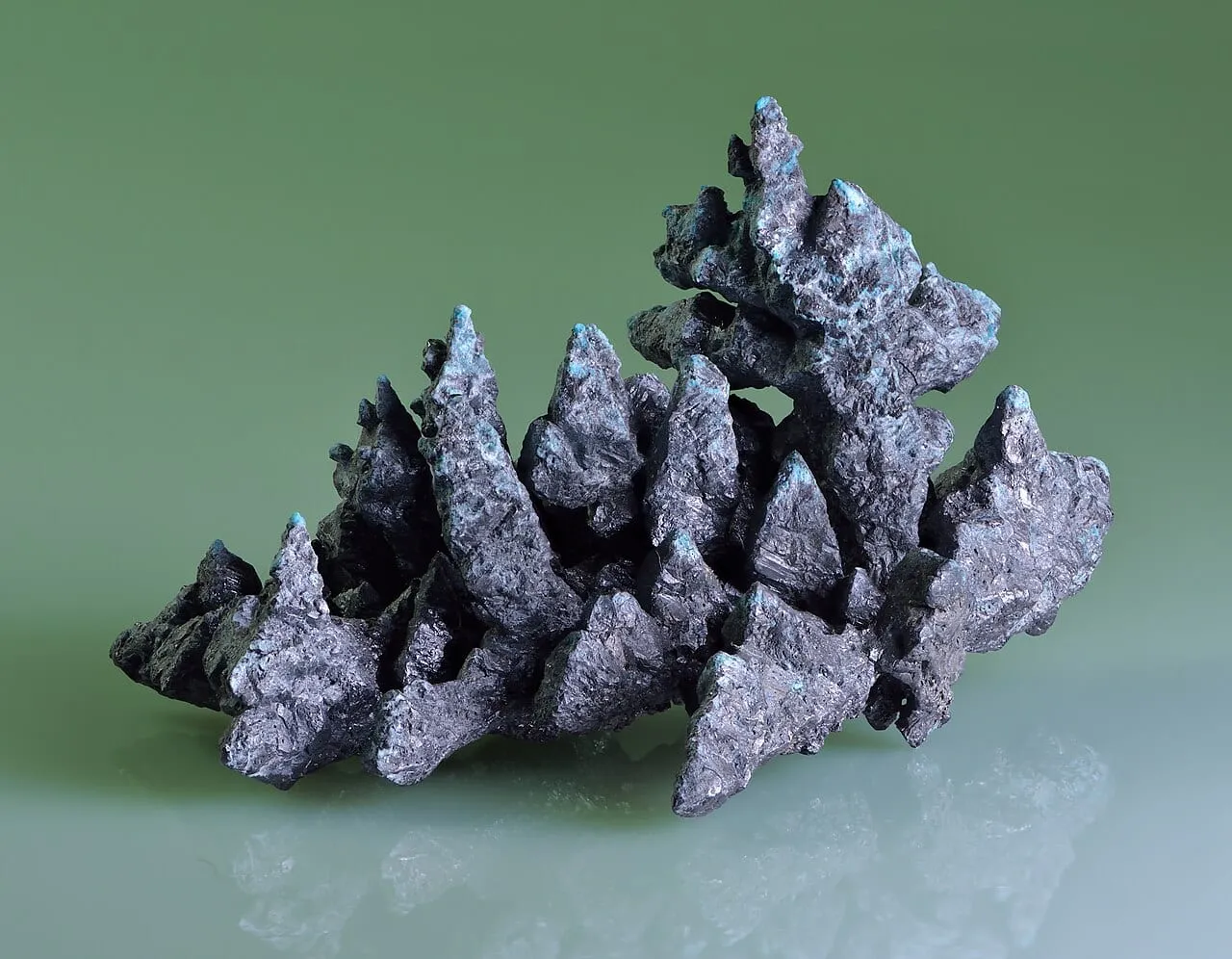
Acanthite
Silver's black sulfide: one of the world's main silver ores and the mineral that coats tarnished native silver.
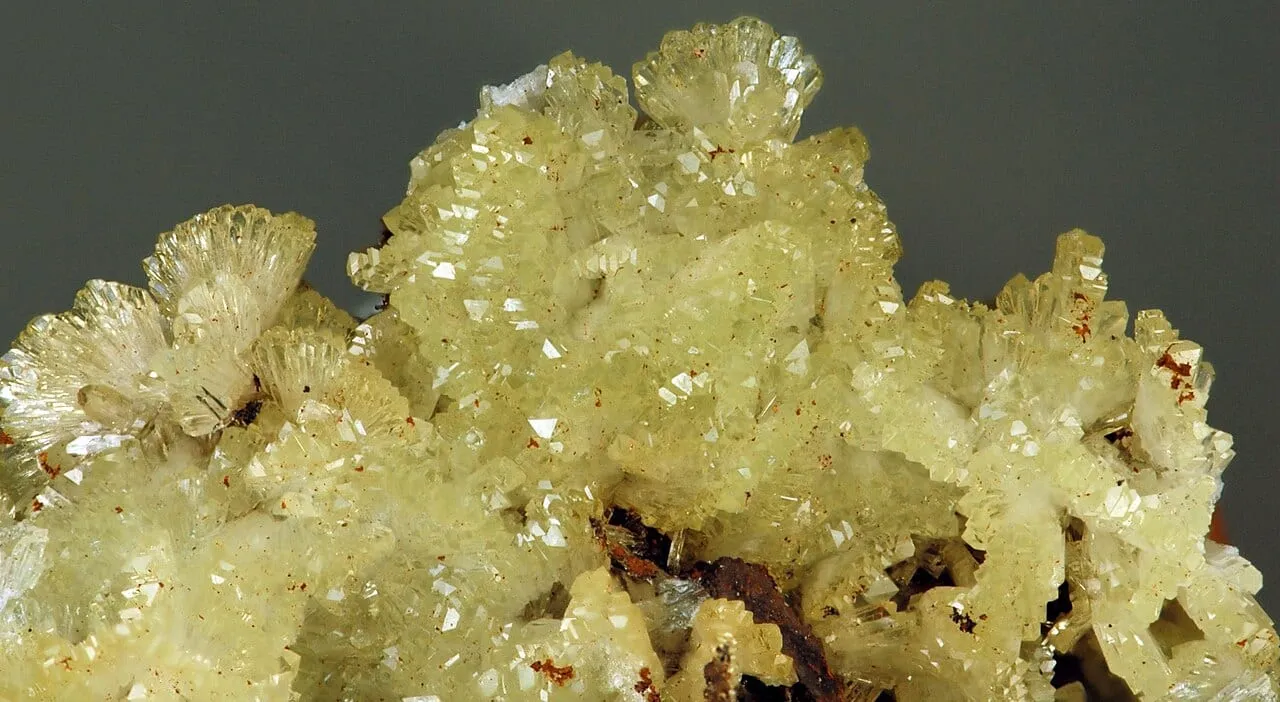
Adamite
Zinc arsenate in fan-shaped crystals from honey yellow to green: some specimens glow under ultraviolet light.
Albite
The white, sodium end of the feldspars: with its deposits at Çine–Milas, a glass and ceramics raw material that makes Türkiye one of the world’s main feldspar producers.