Mineral
Ilmenite
FeTiO₃İlmenit
The main ore of titanium: a black, weakly magnetic iron-titanium mineral from which the white titanium dioxide in paint is made.
Also known as: Manaccanite (old name, from Manaccan in Cornwall)
- Popularly: Ore and raw material
- Ore
- Industrial
- Important in Türkiye

In short
Ilmenite is a black mineral with a metallic or submetallic lustre, made of iron, titanium and oxygen (FeTiO₃). It is a common accessory mineral in rocks, and because it is heavy and durable it collects in beach and river sands as “black sand”. According to the USGS, about 90% of the titanium minerals used in the world are ilmenite.
Photos

How does it form?
Ilmenite is a common accessory mineral in igneous rocks such as granite, gabbro and kimberlite, in granite pegmatites, in carbonatites and in high-grade metamorphic rocks. In layered mafic intrusions and anorthosite bodies (Tellnes and Lac Tio in MTA’s table) it can concentrate into workable deposits.
When the host rock wears away, heavy and durable ilmenite collects in river and beach sands. According to MTA, the economic titanium deposits worked today are mostly these marine and continental placer (sand) deposits.
What is it used for?
- White pigment: Ilmenite is the main source of the white titanium dioxide (TiO₂) pigment used in paint, printing ink, plastic, paper, sunscreen, food and cosmetics. According to the USGS, more than 95% of titanium mineral concentrates in the United States are consumed in pigment production.
- Titanium metal: A light metal, as strong as steel and resistant to corrosion. According to MTA, about 80% of titanium metal produced in the United States in 2018 was used in aerospace; it is also found in seawater desalination plants, surgical implants and sports equipment.
- Other uses: The small remainder goes into welding-rod coatings, carbides and chemicals.
- Collecting: Well-formed crystals attract collectors.
In Türkiye
Ilmenite is not mined in Türkiye, but titanium exploration has identified important sites. In the “Titanium Exploration Project” started by MTA in 1996, the gabbros and meta-gabbros of the Menderes Massif, the Kaz Mountains and the Kütahya-Tavşanlı region were investigated, along with coastal sands in the deltas of the Sakarya, Yeşilırmak, Kızılırmak, Seyhan and Ceyhan rivers.
One of the hard-rock sites MTA presents is the Azıtepe gabbro body in Alaşehir district, Manisa: it is described as a primary deposit averaging 6% TiO₂, and in 2012 data its apparent reserve is given as about 5.1 million tonnes (4.95% TiO₂). The Azıtepe meta-gabbros of the Menderes Massif host Fe-Ti-(V) oxide mineralisation; a 2025 study lists Ti-magnetite, magnetite, ilmenite, rutile, hematite and goethite as ore minerals. The Sakarya-Karasu and Samsun-Çarşamba beach placers, on the other hand, show potential as secondary deposits at an average of about 1% TiO₂ (at Karasu the apparent reserve is given as about 161 million tonnes at 0.87–0.98% TiO₂). Later MTA studies state that the Karasu and Çarşamba placers are not economic under present conditions in terms of grade, reserve and yield. For rutile, see the rutile page.
What determines its value?
Ilmenite is an ore, and its value depends on the proportion of titanium dioxide (TiO₂) in the ore, the size and type of the deposit (beach sand or hard-rock), the cost of separating impurities such as iron, and demand from the pigment and titanium-metal industries. In beach-sand deposits ilmenite is often mined together with rutile and zircon, and earnings depend on these by-products too. Supply is concentrated in a few countries: according to the USGS, of about 9.4 million tonnes (TiO₂ content) of world ilmenite output in 2025, 3.2 million came from China, 1.9 million from Mozambique and 1.3 million from South Africa. For collectors, large, lustrous, well-formed crystals and classic localities such as Miass (Ilmen Mountains) count.
This information is educational, not buying, selling or investment advice. Value varies enormously with quality and treatment.
How to recognise it
- 1
It is iron-black with a metallic or submetallic lustre. The streak (powder colour) is black, brownish black or reddish brown.
- 2
Its hardness is 5–6 and its specific gravity about 4.7–4.8: clearly heavier than a piece of quartz of the same size. It breaks with a shell-like (conchoidal) surface.
- 3
It is only weakly magnetic; magnetite, by contrast, sticks to a magnet at once.
- 4
It occurs as thick tabular crystals or scattered grains; on beaches it forms bands of black sand together with heavy minerals such as magnetite, zircon and rutile.
Fakes and imitations
What shops usually don’t tell you:
- Ilmenite has no widely known imitation; the confusion is with other black, heavy minerals. Magnetite is strongly magnetic and hematite usually gives a redder streak; because streak colours overlap, a sure identification often needs analysis.
Safety
Ilmenite is harmless to handle. However, the black heavy-mineral sands on beaches may also contain minerals that can be radioactive, such as monazite, as well as zircon (the USGS lists monazite and zircon among the by-products of titanium mineral mining). Do not collect these sands by the sackful or store them at home, and do not breathe the dust.
Myths and misconceptions
MythThe white titanium dioxide in paint, plastic, sunscreen and cosmetics is taken from a white rock.
FactThe main source of this white pigment is the black ore ilmenite: according to the USGS, more than 95% of titanium mineral concentrates consumed in the United States go to titanium dioxide pigment producers. The black ore is turned into a white powder by chemical processing.
MythTitanium is a rare metal.
FactAccording to MTA, titanium is the ninth most abundant element in the Earth’s crust. It is a hard metal to produce not because it is scarce but because it is difficult to separate from its ore; commercial production was not possible until the Kroll process was developed in 1938.
Did you know?
The element titanium was found in 1791 by the Englishman William Gregor in black sand from Cornwall, which he named “manaccanite”. In Germany, Martin Heinrich Klaproth discovered the element independently in 1795 and named it after the Titans of Greek mythology.
Ilmenite occurs in the high-titanium mare basalts of the Moon; according to Wikipedia, on average up to 5% of lunar meteorites is ilmenite, and extracting oxygen from it has been proposed for Moon missions.
Titanium metal is as strong as steel but, according to MTA, 45% lighter.
Where is it found?
Loading map…
- Ilmen Mountains (Miass), Chelyabinsk, Russia · Type localityThe mineral is named after these mountains and was first found here; the area is the type locality of 17 minerals
- Tellnes mine, Sokndal, Norway · Major depositOne of the largest titanium mines in Europe; the ore of the open pit, opened in 1960, is ilmenite
- Lac Tio, Havre-Saint-Pierre, Quebec, Canada · Major depositAn ilmenite deposit worked since 1948, about 40 km north of Havre-Saint-Pierre
- Richards Bay, KwaZulu-Natal, South Africa · Major depositIlmenite, rutile and zircon are dredged from the coastal dunes; mining began in 1976
- Panzhihua, Sichuan, China · Major depositVanadium-bearing titanomagnetite deposits; according to Wikipedia, 93% of China's titanium reserves lie here. According to the USGS, China is the world's largest ilmenite producer
- Chavara, Kerala, India · Known localityA Kerala coast whose beach sands hold mainly titanium minerals; Indian Rare Earths and Kerala Minerals and Metals operate here. India appears in the USGS ilmenite table
- Eneabba, Western Australia · Known localityZircon and titanium dioxide minerals are produced from mineral sands; monazite and xenotime are by-products
- Azıtepe, Alaşehir, Manisa, Türkiye · Known localityFe-Ti-(V) oxide mineralisation in meta-gabbro of the Menderes Massif; ilmenite and rutile are listed among the ore minerals, and according to MTA it is a primary deposit averaging 6% TiO₂ (location given as Alaşehir town)
Locations are approximate to protect sites. Red dots mark places in Türkiye. Open in the big map →
Frequently asked questions
What is ilmenite?
Ilmenite is a black mineral with a metallic or submetallic lustre, made of iron, titanium and oxygen (FeTiO₃). It is a common accessory mineral in rocks, and because it is heavy and durable it collects in beach and river sands as “black sand”. According to the USGS, about 90% of the titanium minerals used in the world are ilmenite.
What is ilmenite used for?
White pigment: Ilmenite is the main source of the white titanium dioxide (TiO₂) pigment used in paint, printing ink, plastic, paper, sunscreen, food and cosmetics. According to the USGS, more than 95% of titanium mineral concentrates in the United States are consumed in pigment production. Titanium metal: A light metal, as strong as steel and resistant to corrosion. According to MTA, about 80% of titanium metal produced in the United States in 2018 was used in aerospace; it is also found in seawater desalination plants, surgical implants and sports equipment.
How hard is ilmenite?
It has a hardness of 5–6 on the Mohs scale. It can scratch glass; a steel knife scratches it only with difficulty. Its specific gravity is 4.72–4.79 g/cm³.
Where is ilmenite found?
Its best-known localities: Ilmen Mountains (Miass), Chelyabinsk, Russia; Tellnes mine, Sokndal, Norway; Lac Tio, Havre-Saint-Pierre, Quebec, Canada; Richards Bay, KwaZulu-Natal, South Africa; Panzhihua, Sichuan, China.
Where is ilmenite found in Türkiye?
Known localities in Türkiye: Azıtepe, Alaşehir, Manisa, Türkiye.
How can you tell if ilmenite is real?
It is iron-black with a metallic or submetallic lustre. The streak (powder colour) is black, brownish black or reddish brown. Its hardness is 5–6 and its specific gravity about 4.7–4.8: clearly heavier than a piece of quartz of the same size. It breaks with a shell-like (conchoidal) surface. It is only weakly magnetic; magnetite, by contrast, sticks to a magnet at once. Ilmenite has no widely known imitation; the confusion is with other black, heavy minerals. Magnetite is strongly magnetic and hematite usually gives a redder streak; because streak colours overlap, a sure identification often needs analysis.
Is ilmenite valuable?
On the “street to diamond” value ladder it sits on step 4 of nine: Fine dimension stone and ore. Ilmenite is an ore, and its value depends on the proportion of titanium dioxide (TiO₂) in the ore, the size and type of the deposit (beach sand or hard-rock), the cost of separating impurities such as iron, and demand from the pigment and titanium-metal industries. In beach-sand deposits ilmenite is often mined together with rutile and zircon, and earnings depend on these by-products too. Supply is concentrated in a few countries: according to the USGS, of about 9.4 million tonnes (TiO₂ content) of world ilmenite output in 2025, 3.2 million came from China, 1.9 million from Mozambique and 1.3 million from South Africa. For collectors, large, lustrous, well-formed crystals and classic localities such as Miass (Ilmen Mountains) count.
Is ilmenite dangerous?
Ilmenite is harmless to handle. However, the black heavy-mineral sands on beaches may also contain minerals that can be radioactive, such as monazite, as well as zircon (the USGS lists monazite and zircon among the by-products of titanium mineral mining). Do not collect these sands by the sackful or store them at home, and do not breathe the dust.
Sources
- Handbook of Mineralogy: Ilmenite · Mineralogical Society of America
- Ilmenite · Wikipedia
- Ilmenite (Webmineral) · Webmineral
- Mineral Commodity Summaries 2026: Titanium Mineral Concentrates · U.S. Geological Survey, 2026
- Üretiminden ticari kullanımına titanyum (Yücel, MTA Doğal Kaynaklar ve Ekonomi Bülteni 26: 63–76) · MTA Genel Müdürlüğü, 2018
- Origin and evolution of vanadium (V) enrichment in Azıtepe (Alaşehir-Manisa) meta-gabbroic rocks in Menderes massif (Western Turkiye) (Sutcu et al.), Geochemistry · Elsevier, 2025
- Ilmensky Nature Reserve · Wikipedia
- Tellnes mine · Wikipedia
- Havre-Saint-Pierre, Quebec · Wikipedia
- Richards Bay Minerals · Wikipedia
- Panzhihua · Wikipedia
- Chavara · Wikipedia
- Eneabba · Wikipedia
- Alaşehir · Wikipedia
External links
Draft: awaiting expert reviewReport an error ↗
On the same step
Anglesite
A heavy lead sulfate mineral with a diamond-like shine that grows as a crust around galena; it is named after the island of Anglesey in Wales.
Arsenopyrite
A widespread silvery-grey sulfide containing arsenic: it smells of garlic when struck and is poisonous.
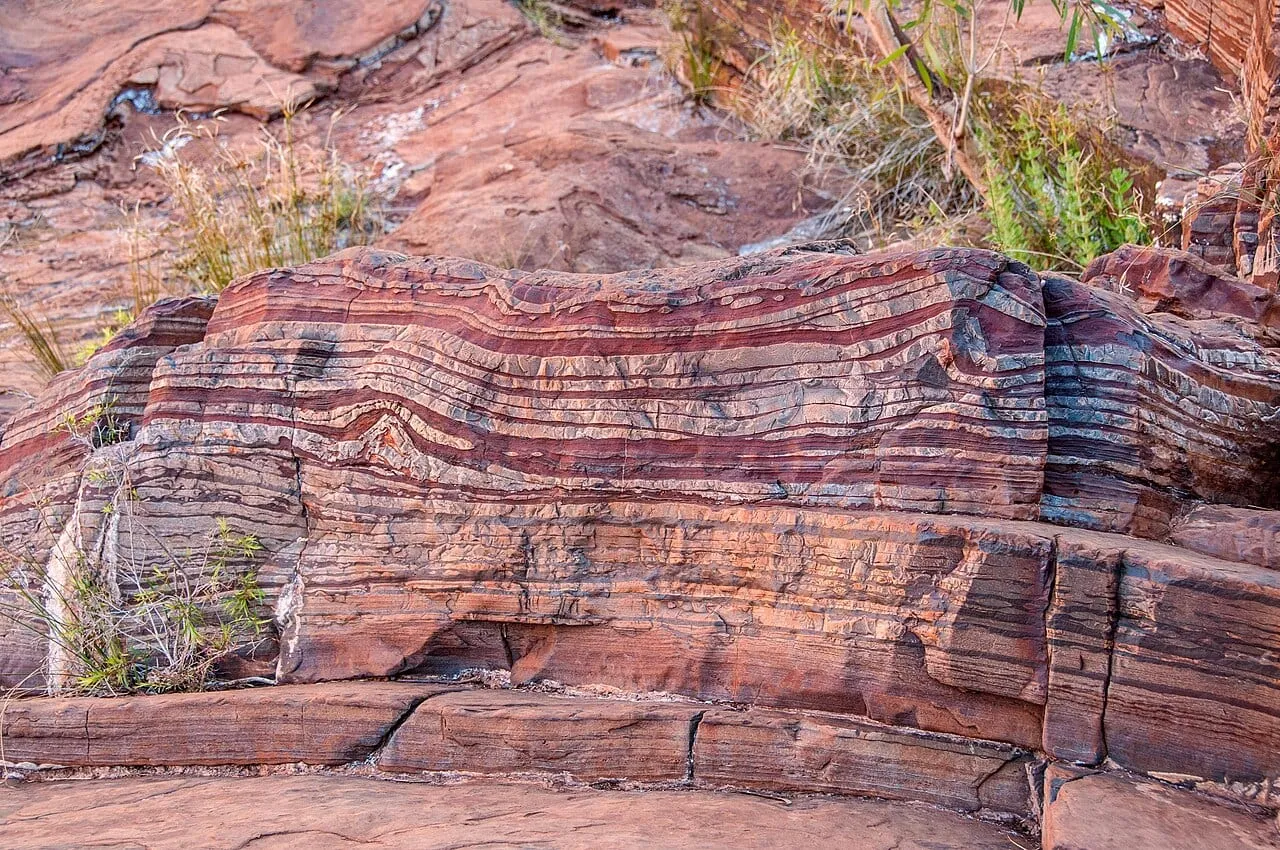
Banded iron formation
An ancient rock of alternating iron-oxide and chert bands: the record of oxygen beginning to build up on Earth, and the main source of iron ore.